

I hadn’t studied before. I was also pleased to be asked to join a joint Franco-German
effort to share scientific and technical means. The VIP Program (VIP = Volcanisme
Intra-Plaque = Intraplate Volcanism) was a welcome addition to the scientific
projects that were currently happening in France. The funding agencies for the VIP
Project included IFREMER (Institut Français pour l’Exploitation des Oceans),
Centre National de Recherche Scientifique (CNRS), Deutshe Forschungsgemeinschaft (DFG), and Bundesministerium für Forschung and Technologie (BMFT).
Several German institutions were involved in the program, such as the University of
Bremen, Kiel, Hamburg and Regensburg.
However, at the time, this project was not a priority in the marine geosciences
department of IFREMER, so it was difficult for me to mobilize my colleagues
around such an endeavor. In order to have funding and ship time at sea, it was
important that my institution accept the program on intraplate volcanism. Since I
couldn’t seem to raise much enthusiasm from the direction of IFREMER, I had to
rely on other French institutions in order to be able to get this project launched.
Indeed, the person responsible for the scientific programs at IFREMER was quite
reluctant to approve the project. As has been true in many other cases, when a lack
of interest in ocean exploration infected some people who had responsibilities in
Paris and/or in my department, it was hard for me to pass my message. Therefore,
because I had a lot of difficulty in promoting the project within my department, the
only way for me to get involved in VIP was by means of help from outside
institutions such the CNRS (IPG in Paris) and from some French universities.
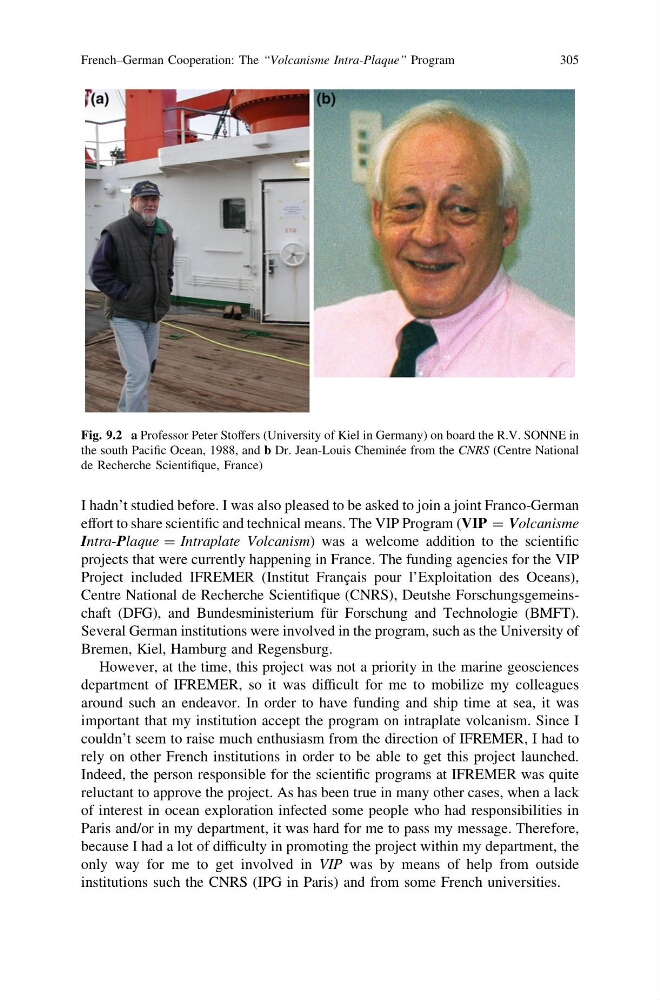
Fig. 9.2 a Professor Peter Stoffers (University of Kiel in Germany) on board the R.V. SONNE in
the south Pacific Ocean, 1988, and b Dr. Jean-Louis Cheminée from the CNRS (Centre National
de Recherche Scientifique, France)
French–German Cooperation: The ‘‘Volcanisme Intra-Plaque’’ Program
305
effort to share scientific and technical means. The VIP Program (VIP = Volcanisme
Intra-Plaque = Intraplate Volcanism) was a welcome addition to the scientific
projects that were currently happening in France. The funding agencies for the VIP
Project included IFREMER (Institut Français pour l’Exploitation des Oceans),
Centre National de Recherche Scientifique (CNRS), Deutshe Forschungsgemeinschaft (DFG), and Bundesministerium für Forschung and Technologie (BMFT).
Several German institutions were involved in the program, such as the University of
Bremen, Kiel, Hamburg and Regensburg.
However, at the time, this project was not a priority in the marine geosciences
department of IFREMER, so it was difficult for me to mobilize my colleagues
around such an endeavor. In order to have funding and ship time at sea, it was
important that my institution accept the program on intraplate volcanism. Since I
couldn’t seem to raise much enthusiasm from the direction of IFREMER, I had to
rely on other French institutions in order to be able to get this project launched.
Indeed, the person responsible for the scientific programs at IFREMER was quite
reluctant to approve the project. As has been true in many other cases, when a lack
of interest in ocean exploration infected some people who had responsibilities in
Paris and/or in my department, it was hard for me to pass my message. Therefore,
because I had a lot of difficulty in promoting the project within my department, the
only way for me to get involved in VIP was by means of help from outside
institutions such the CNRS (IPG in Paris) and from some French universities.
Fig. 9.2 a Professor Peter Stoffers (University of Kiel in Germany) on board the R.V. SONNE in
the south Pacific Ocean, 1988, and b Dr. Jean-Louis Cheminée from the CNRS (Centre National
de Recherche Scientifique, France)
French–German Cooperation: The ‘‘Volcanisme Intra-Plaque’’ Program
305