

(1) The gabbroic rocks consisting of olivine gabbro, normal gabbro, gabbronorite,
and ilmenite-bearing gabbro. Metasomatic reactions taking place between the
intrusive and the host peridotite will give rise to the transformation of the
pyroxene into actinolite, probably at temperatures higher than 500 °C.
(2) The deformed and tectonized gabbroic rocks consist essentially of amphibolatized gabbros. Evidence of tectonic activity was observed on a microscopic scale. Lenses of amphibolatized and bent clinopyroxene relics, and
albitized broken plagioclase set in a granulated matrix were observed in amphibolatized gabbros collected from the northern flank of the Median Ridge.
It was found that the minimum temperature of equilibrium for the Garrett FZ
ultramafic–gabbro association was less than 1000 °C (Hébert et al. 1983). Such a
temperature occurs in lower crust/mantle conditions, which are in agreement with
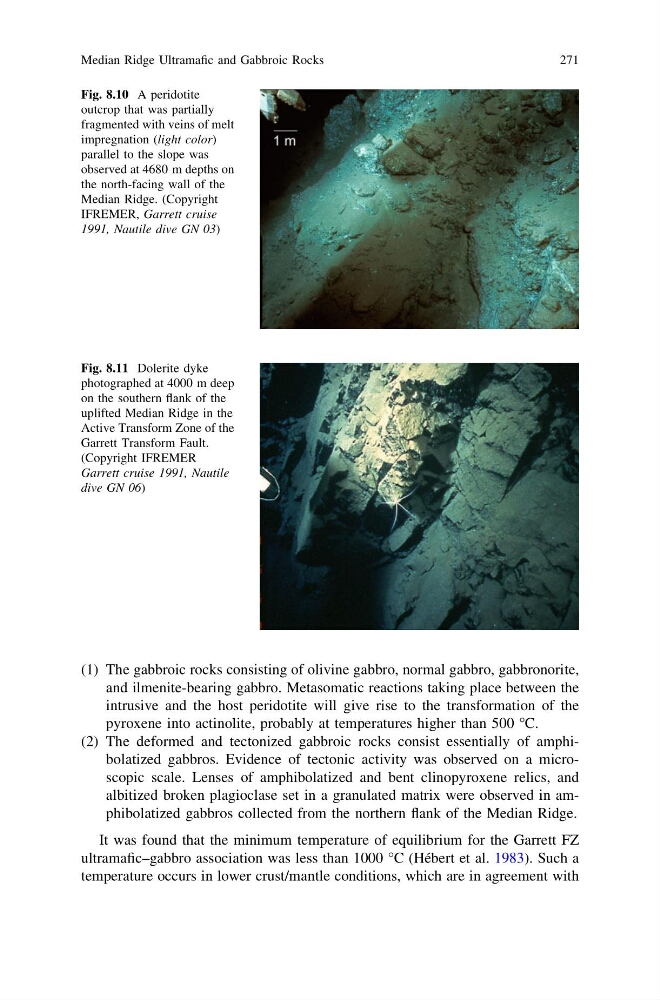
Fig. 8.10 A peridotite
outcrop that was partially
fragmented with veins of melt
impregnation (light color)
parallel to the slope was
observed at 4680 m depths on
the north-facing wall of the
Median Ridge. (Copyright
IFREMER, Garrett cruise
1991, Nautile dive GN 03)
Fig. 8.11 Dolerite dyke
photographed at 4000 m deep
on the southern flank of the
uplifted Median Ridge in the
Active Transform Zone of the
Garrett Transform Fault.
(Copyright IFREMER
Garrett cruise 1991, Nautile
dive GN 06)
Median Ridge Ultramafic and Gabbroic Rocks
271
and ilmenite-bearing gabbro. Metasomatic reactions taking place between the
intrusive and the host peridotite will give rise to the transformation of the
pyroxene into actinolite, probably at temperatures higher than 500 °C.
(2) The deformed and tectonized gabbroic rocks consist essentially of amphibolatized gabbros. Evidence of tectonic activity was observed on a microscopic scale. Lenses of amphibolatized and bent clinopyroxene relics, and
albitized broken plagioclase set in a granulated matrix were observed in amphibolatized gabbros collected from the northern flank of the Median Ridge.
It was found that the minimum temperature of equilibrium for the Garrett FZ
ultramafic–gabbro association was less than 1000 °C (Hébert et al. 1983). Such a
temperature occurs in lower crust/mantle conditions, which are in agreement with
Fig. 8.10 A peridotite
outcrop that was partially
fragmented with veins of melt
impregnation (light color)
parallel to the slope was
observed at 4680 m depths on
the north-facing wall of the
Median Ridge. (Copyright
IFREMER, Garrett cruise
1991, Nautile dive GN 03)
Fig. 8.11 Dolerite dyke
photographed at 4000 m deep
on the southern flank of the
uplifted Median Ridge in the
Active Transform Zone of the
Garrett Transform Fault.
(Copyright IFREMER
Garrett cruise 1991, Nautile
dive GN 06)
Median Ridge Ultramafic and Gabbroic Rocks
271