

seen with abundant interstitial pelagic sediment. At 12h54 at 3543 m, we arrived
on the summit of the ridge and encountered a fissure that was 3 m wide, oriented in
the N 040° direction, which was also the general direction of the ridge axis. Then,
we immediately changed our course and followed the shallowest depths. We
crossed several faults and fissures during our exploration. At 3515 m, we descend
into a fissure, which was 25 m deep, located between two vertical walls; at the
fissure’s bottom, we observed lava flows. Coming back to the top of this fissure,
we continued our course to the southwest, and crossed several volcanic hills,
which were gashed by fissures and faults with a relief of 2–5 m between 3496 and
3499 m depth. This area revealed large talus piles at the foot of the scarps. At
15h27 at 3440 m, while still on the summit of the ridge, we received the order to
come up. Our dive time was already over.
Thus, the Alfa and Beta ridges showed numerous fissures less than 5 m in width
cutting across the pillows and lobated flows. In addition, fault scarps with low
relief (\2 m) were observed. This suggests that these ridges were in an intermediate stage of volcanism where fracturing and fissuring had replaced volcanism.
Indeed, cyclic volcanic activity interrupted by the tectonic events of fissuring and
faulting is a common phenomenon during magma upwelling processes.
The new discovery concerning volcanic activity in the Garrett Transform was
the presence of small, deep-seated circular volcanic mounds that had been emplaced in the eastern Central Trough within the transform valley floor in the ATZ
(Active Transform Zone), at the intersection of the Median Ridge’s northern flank
and in the deepest part of the Central Trough (4910 m). These are the sites where
freshly erupted pillow lava flows (Figs. 8.1 and 8.9) were observed during several
dives (GN01, -09, -13 and -15). This type of volcanism is related to the motion of
the tectonic plates.
The origin of the volcanic rocks on the Garrett’s transform ridges is due to the
melting of a source enriched in Large Ion Lithophile Element (LILE), probably
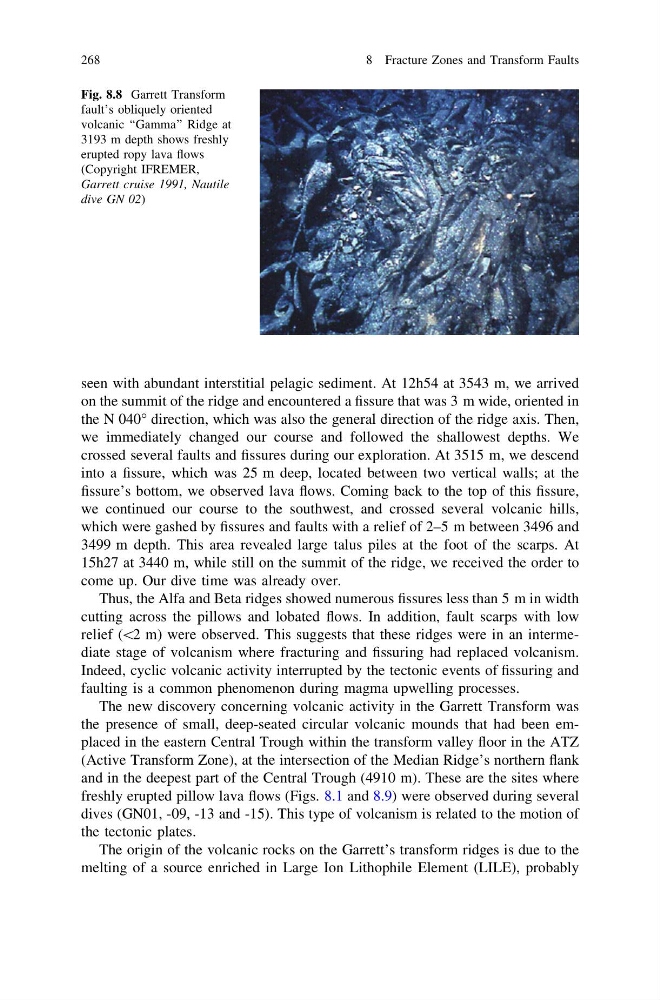
Fig. 8.8 Garrett Transform
fault’s obliquely oriented
volcanic ‘‘Gamma’’ Ridge at
3193 m depth shows freshly
erupted ropy lava flows
(Copyright IFREMER,
Garrett cruise 1991, Nautile
dive GN 02)
268
8 Fracture Zones and Transform Faults
on the summit of the ridge and encountered a fissure that was 3 m wide, oriented in
the N 040° direction, which was also the general direction of the ridge axis. Then,
we immediately changed our course and followed the shallowest depths. We
crossed several faults and fissures during our exploration. At 3515 m, we descend
into a fissure, which was 25 m deep, located between two vertical walls; at the
fissure’s bottom, we observed lava flows. Coming back to the top of this fissure,
we continued our course to the southwest, and crossed several volcanic hills,
which were gashed by fissures and faults with a relief of 2–5 m between 3496 and
3499 m depth. This area revealed large talus piles at the foot of the scarps. At
15h27 at 3440 m, while still on the summit of the ridge, we received the order to
come up. Our dive time was already over.
Thus, the Alfa and Beta ridges showed numerous fissures less than 5 m in width
cutting across the pillows and lobated flows. In addition, fault scarps with low
relief (\2 m) were observed. This suggests that these ridges were in an intermediate stage of volcanism where fracturing and fissuring had replaced volcanism.
Indeed, cyclic volcanic activity interrupted by the tectonic events of fissuring and
faulting is a common phenomenon during magma upwelling processes.
The new discovery concerning volcanic activity in the Garrett Transform was
the presence of small, deep-seated circular volcanic mounds that had been emplaced in the eastern Central Trough within the transform valley floor in the ATZ
(Active Transform Zone), at the intersection of the Median Ridge’s northern flank
and in the deepest part of the Central Trough (4910 m). These are the sites where
freshly erupted pillow lava flows (Figs. 8.1 and 8.9) were observed during several
dives (GN01, -09, -13 and -15). This type of volcanism is related to the motion of
the tectonic plates.
The origin of the volcanic rocks on the Garrett’s transform ridges is due to the
melting of a source enriched in Large Ion Lithophile Element (LILE), probably
Fig. 8.8 Garrett Transform
fault’s obliquely oriented
volcanic ‘‘Gamma’’ Ridge at
3193 m depth shows freshly
erupted ropy lava flows
(Copyright IFREMER,
Garrett cruise 1991, Nautile
dive GN 02)
268
8 Fracture Zones and Transform Faults