

in a magma reservoir. Also, the tectonics of spreading might control magmatic and
hydrothermal activities at the ridge axis.
The evolution of spreading ridge axial volcanism at a fast spreading center in
the South Pacific indicates that hydrothermalism is intimately related to the tectonic and magmatic processes.
A generalized overview of crustal extrusion and the temporal evolution of a
ridge segment (over a few tens of thousand years) reconstructed from sea floor
topography, lava morphology and the extent of hydrothermal activities was
obtained from submersible observations on three ridge segments, which were at
different stages of formation, and which are reported below (Fig. 7.31).
(1) Magmatic stage is marked by voluminous eruptions of mafic lava, forming
narrow shallow-depth grabens with domed shape structures, and large magma
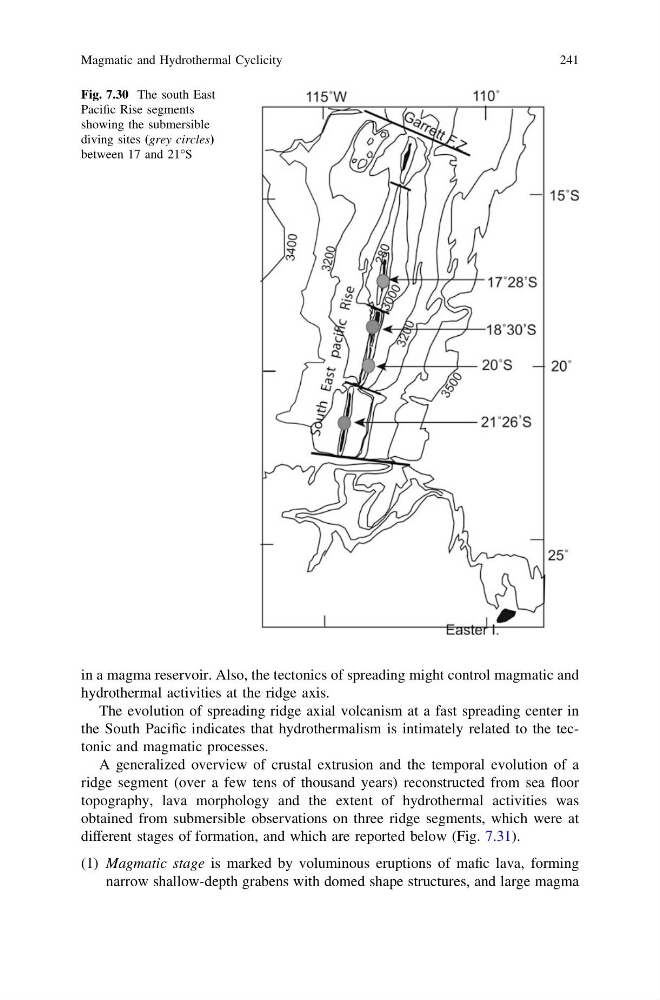
Fig. 7.30 The south East
Pacific Rise segments
showing the submersible
diving sites (grey circles)
between 17 and 21°S
Magmatic and Hydrothermal Cyclicity
241
hydrothermal activities at the ridge axis.
The evolution of spreading ridge axial volcanism at a fast spreading center in
the South Pacific indicates that hydrothermalism is intimately related to the tectonic and magmatic processes.
A generalized overview of crustal extrusion and the temporal evolution of a
ridge segment (over a few tens of thousand years) reconstructed from sea floor
topography, lava morphology and the extent of hydrothermal activities was
obtained from submersible observations on three ridge segments, which were at
different stages of formation, and which are reported below (Fig. 7.31).
(1) Magmatic stage is marked by voluminous eruptions of mafic lava, forming
narrow shallow-depth grabens with domed shape structures, and large magma
Fig. 7.30 The south East
Pacific Rise segments
showing the submersible
diving sites (grey circles)
between 17 and 21°S
Magmatic and Hydrothermal Cyclicity
241