

axis is dominated by the upwelling of a large amount of magmatic input by dyke
and sill injection. These loci of magmatic upwelling could flow along the ridge
strike or retract down into the lithosphere during the periods when there was a lack
of magmatic upwelling. White et al. (2000) reported domed structures during the
Sojourn cruise, of the R.V. MELVILLE in1996. On the larger domes of 2–3 km
wide and up to 6 km long, lava lakes and sheet lava were observed at 17°52.5
0 -
17°53.3
0 S on the south EPR. These lava domes are associated with third order
short segments averaging about 10 km in length on ultra fast spreading ridges (full
rate [140 km/million years) (White et al. 2000). Also in the Mantle Electromagnetic and Tomography (MELT) experiment area of the South East Pacific Rise
(SEPR) near 17°26
0 S, the thickness of the crust is about 7 km at mid-segment and
decreases to 5 km at the segment-ends (White et al. 2000).
The presence of ‘‘rift zones’’ and the distribution of small volcanic cones
indicate that there is sub-crustal magma circulation along the spreading ridge axis.
A diving program in the south Pacific Ocean was initiated and conducted by
scientists from the Geosciences department of IFREMER in collaboration with
other French, German and US Institutions to explore, for the first time by submersible, the ultra-fast spreading ridge segments between 17°S and 21°S in January
1984 during the GEOCYARISE cruise Leg 1. This initiative of diving in the South
Pacific Ocean opened the way for other surface ship and submersible expeditions
carried out by international Institutions in Japan and the USA between 1993 and
2004. The Germans (Bäker et al. 1985), Americans (Scheider et al. 1993), French
(Renard et al.1985; Hekinian et al. 1995; Auzende et al. 1994; Jollivet et al. 2004)
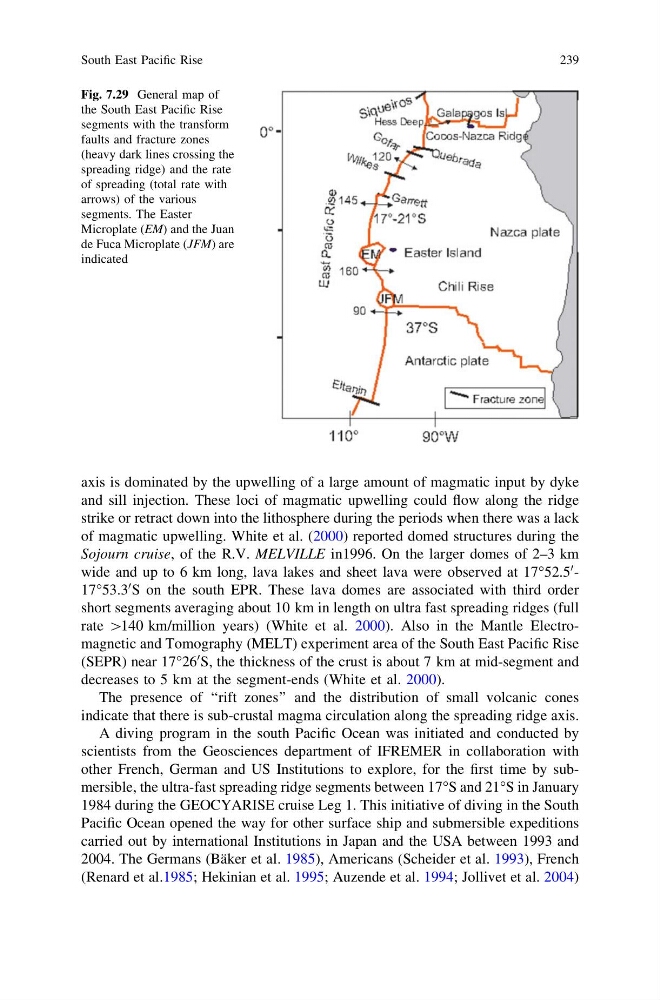
Fig. 7.29 General map of
the South East Pacific Rise
segments with the transform
faults and fracture zones
(heavy dark lines crossing the
spreading ridge) and the rate
of spreading (total rate with
arrows) of the various
segments. The Easter
Microplate (EM) and the Juan
de Fuca Microplate (JFM) are
indicated
South East Pacific Rise
239
and sill injection. These loci of magmatic upwelling could flow along the ridge
strike or retract down into the lithosphere during the periods when there was a lack
of magmatic upwelling. White et al. (2000) reported domed structures during the
Sojourn cruise, of the R.V. MELVILLE in1996. On the larger domes of 2–3 km
wide and up to 6 km long, lava lakes and sheet lava were observed at 17°52.5
0 -
17°53.3
0 S on the south EPR. These lava domes are associated with third order
short segments averaging about 10 km in length on ultra fast spreading ridges (full
rate [140 km/million years) (White et al. 2000). Also in the Mantle Electromagnetic and Tomography (MELT) experiment area of the South East Pacific Rise
(SEPR) near 17°26
0 S, the thickness of the crust is about 7 km at mid-segment and
decreases to 5 km at the segment-ends (White et al. 2000).
The presence of ‘‘rift zones’’ and the distribution of small volcanic cones
indicate that there is sub-crustal magma circulation along the spreading ridge axis.
A diving program in the south Pacific Ocean was initiated and conducted by
scientists from the Geosciences department of IFREMER in collaboration with
other French, German and US Institutions to explore, for the first time by submersible, the ultra-fast spreading ridge segments between 17°S and 21°S in January
1984 during the GEOCYARISE cruise Leg 1. This initiative of diving in the South
Pacific Ocean opened the way for other surface ship and submersible expeditions
carried out by international Institutions in Japan and the USA between 1993 and
2004. The Germans (Bäker et al. 1985), Americans (Scheider et al. 1993), French
(Renard et al.1985; Hekinian et al. 1995; Auzende et al. 1994; Jollivet et al. 2004)
Fig. 7.29 General map of
the South East Pacific Rise
segments with the transform
faults and fracture zones
(heavy dark lines crossing the
spreading ridge) and the rate
of spreading (total rate with
arrows) of the various
segments. The Easter
Microplate (EM) and the Juan
de Fuca Microplate (JFM) are
indicated
South East Pacific Rise
239