

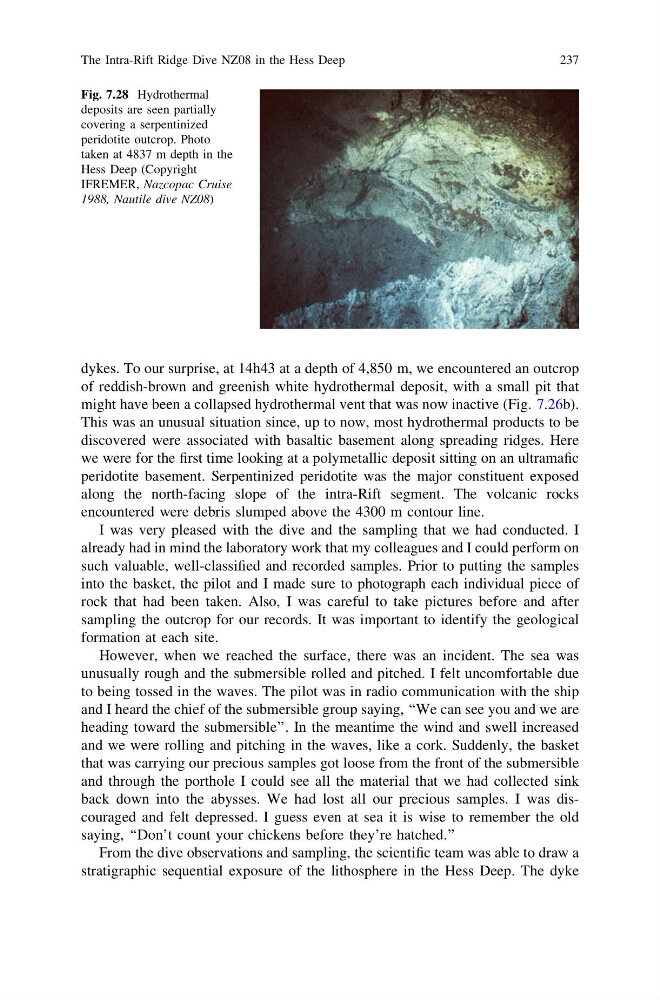
dykes. To our surprise, at 14h43 at a depth of 4,850 m, we encountered an outcrop
of reddish-brown and greenish white hydrothermal deposit, with a small pit that
might have been a collapsed hydrothermal vent that was now inactive (Fig. 7.26b).
This was an unusual situation since, up to now, most hydrothermal products to be
discovered were associated with basaltic basement along spreading ridges. Here
we were for the first time looking at a polymetallic deposit sitting on an ultramafic
peridotite basement. Serpentinized peridotite was the major constituent exposed
along the north-facing slope of the intra-Rift segment. The volcanic rocks
encountered were debris slumped above the 4300 m contour line.
I was very pleased with the dive and the sampling that we had conducted. I
already had in mind the laboratory work that my colleagues and I could perform on
such valuable, well-classified and recorded samples. Prior to putting the samples
into the basket, the pilot and I made sure to photograph each individual piece of
rock that had been taken. Also, I was careful to take pictures before and after
sampling the outcrop for our records. It was important to identify the geological
formation at each site.
However, when we reached the surface, there was an incident. The sea was
unusually rough and the submersible rolled and pitched. I felt uncomfortable due
to being tossed in the waves. The pilot was in radio communication with the ship
and I heard the chief of the submersible group saying, ‘‘We can see you and we are
heading toward the submersible’’. In the meantime the wind and swell increased
and we were rolling and pitching in the waves, like a cork. Suddenly, the basket
that was carrying our precious samples got loose from the front of the submersible
and through the porthole I could see all the material that we had collected sink
back down into the abysses. We had lost all our precious samples. I was discouraged and felt depressed. I guess even at sea it is wise to remember the old
saying, ‘‘Don’t count your chickens before they’re hatched.’’
From the dive observations and sampling, the scientific team was able to draw a
stratigraphic sequential exposure of the lithosphere in the Hess Deep. The dyke
Fig. 7.28 Hydrothermal
deposits are seen partially
covering a serpentinized
peridotite outcrop. Photo
taken at 4837 m depth in the
Hess Deep (Copyright
IFREMER, Nazcopac Cruise
1988, Nautile dive NZ08)
The Intra-Rift Ridge Dive NZ08 in the Hess Deep
237
of reddish-brown and greenish white hydrothermal deposit, with a small pit that
might have been a collapsed hydrothermal vent that was now inactive (Fig. 7.26b).
This was an unusual situation since, up to now, most hydrothermal products to be
discovered were associated with basaltic basement along spreading ridges. Here
we were for the first time looking at a polymetallic deposit sitting on an ultramafic
peridotite basement. Serpentinized peridotite was the major constituent exposed
along the north-facing slope of the intra-Rift segment. The volcanic rocks
encountered were debris slumped above the 4300 m contour line.
I was very pleased with the dive and the sampling that we had conducted. I
already had in mind the laboratory work that my colleagues and I could perform on
such valuable, well-classified and recorded samples. Prior to putting the samples
into the basket, the pilot and I made sure to photograph each individual piece of
rock that had been taken. Also, I was careful to take pictures before and after
sampling the outcrop for our records. It was important to identify the geological
formation at each site.
However, when we reached the surface, there was an incident. The sea was
unusually rough and the submersible rolled and pitched. I felt uncomfortable due
to being tossed in the waves. The pilot was in radio communication with the ship
and I heard the chief of the submersible group saying, ‘‘We can see you and we are
heading toward the submersible’’. In the meantime the wind and swell increased
and we were rolling and pitching in the waves, like a cork. Suddenly, the basket
that was carrying our precious samples got loose from the front of the submersible
and through the porthole I could see all the material that we had collected sink
back down into the abysses. We had lost all our precious samples. I was discouraged and felt depressed. I guess even at sea it is wise to remember the old
saying, ‘‘Don’t count your chickens before they’re hatched.’’
From the dive observations and sampling, the scientific team was able to draw a
stratigraphic sequential exposure of the lithosphere in the Hess Deep. The dyke
Fig. 7.28 Hydrothermal
deposits are seen partially
covering a serpentinized
peridotite outcrop. Photo
taken at 4837 m depth in the
Hess Deep (Copyright
IFREMER, Nazcopac Cruise
1988, Nautile dive NZ08)
The Intra-Rift Ridge Dive NZ08 in the Hess Deep
237