

limited on board. Indeed, the number of cabins for the scientific party did not
exceed three and accommodated a total of eight scientists in each room. The
engineers and technicians of the submersible, and the navigation team, occupied
the rest of the cabin space. Later on, they increased the ship’s capacity by adding
two cabins, and they managed to stack five persons in each one. The scientific
team on board was always the least favored for accommodations, but we scientists
tolerated this since we are volunteers and usually spend less time at sea than the
crew and technicians. When the ship was full, it was very uncomfortable to live on
board the Nadir. I always marveled since this type of scientific vessel was in total
contrast to the highly sophisticated submersible that it carried.
The Nazcopac cruise was proposed and conducted by Jean Francheteau. At this
period Jean was still at IFREMER before moving to Paris to work at the Institute
Fig. 7.26 General location map (a), and a Block 3D diagram (b) of the Hess Deep in the
Equatorial Pacific shows the Cocos-Nazca spreading center separating the ancient, 1 million year
old East Pacific Rise lithosphere-crust. The submersible dive tracks are indicated with the
corresponding dive numbers 1–21. A drilling site 895 is shown
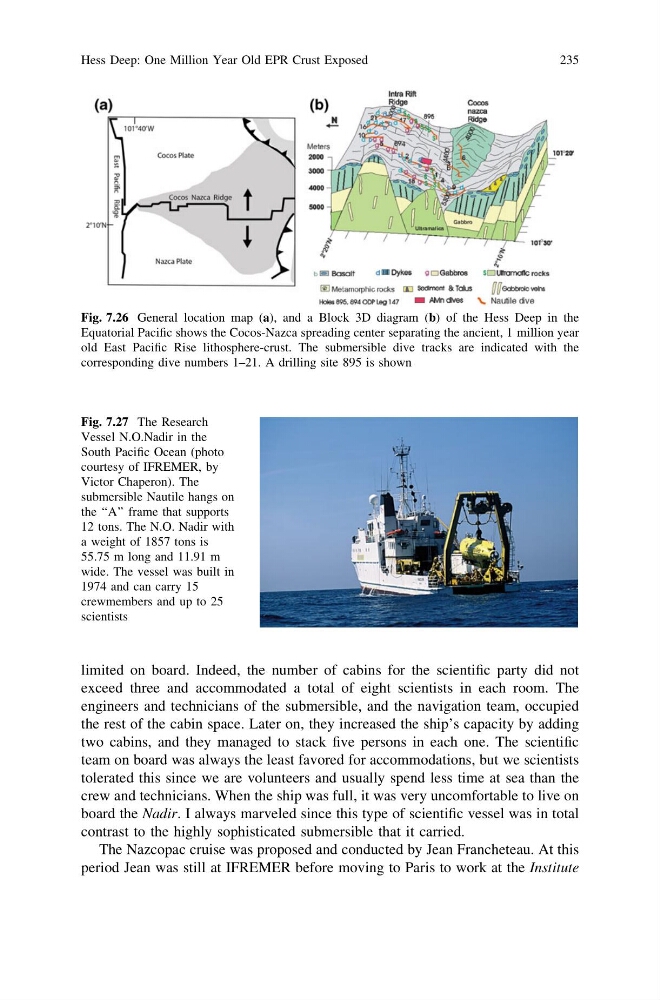
Fig. 7.27 The Research
Vessel N.O.Nadir in the
South Pacific Ocean (photo
courtesy of IFREMER, by
Victor Chaperon). The
submersible Nautile hangs on
the ‘‘A’’ frame that supports
12 tons. The N.O. Nadir with
a weight of 1857 tons is
55.75 m long and 11.91 m
wide. The vessel was built in
1974 and can carry 15
crewmembers and up to 25
scientists
Hess Deep: One Million Year Old EPR Crust Exposed
235
exceed three and accommodated a total of eight scientists in each room. The
engineers and technicians of the submersible, and the navigation team, occupied
the rest of the cabin space. Later on, they increased the ship’s capacity by adding
two cabins, and they managed to stack five persons in each one. The scientific
team on board was always the least favored for accommodations, but we scientists
tolerated this since we are volunteers and usually spend less time at sea than the
crew and technicians. When the ship was full, it was very uncomfortable to live on
board the Nadir. I always marveled since this type of scientific vessel was in total
contrast to the highly sophisticated submersible that it carried.
The Nazcopac cruise was proposed and conducted by Jean Francheteau. At this
period Jean was still at IFREMER before moving to Paris to work at the Institute
Fig. 7.26 General location map (a), and a Block 3D diagram (b) of the Hess Deep in the
Equatorial Pacific shows the Cocos-Nazca spreading center separating the ancient, 1 million year
old East Pacific Rise lithosphere-crust. The submersible dive tracks are indicated with the
corresponding dive numbers 1–21. A drilling site 895 is shown
Fig. 7.27 The Research
Vessel N.O.Nadir in the
South Pacific Ocean (photo
courtesy of IFREMER, by
Victor Chaperon). The
submersible Nautile hangs on
the ‘‘A’’ frame that supports
12 tons. The N.O. Nadir with
a weight of 1857 tons is
55.75 m long and 11.91 m
wide. The vessel was built in
1974 and can carry 15
crewmembers and up to 25
scientists
Hess Deep: One Million Year Old EPR Crust Exposed
235