

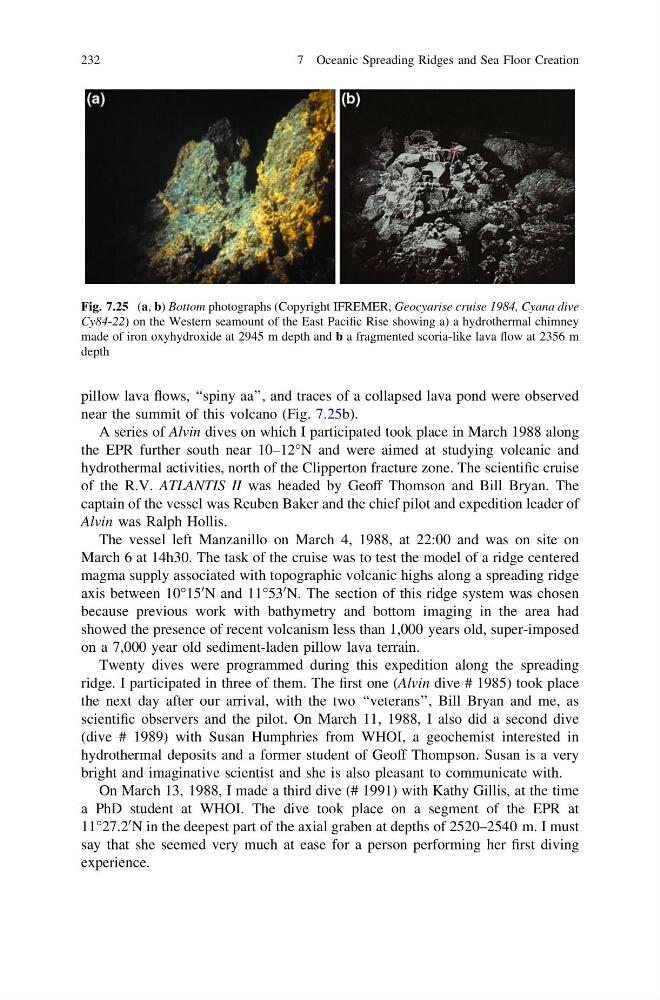
pillow lava flows, ‘‘spiny aa’’, and traces of a collapsed lava pond were observed
near the summit of this volcano (Fig. 7.25b).
A series of Alvin dives on which I participated took place in March 1988 along
the EPR further south near 10–12°N and were aimed at studying volcanic and
hydrothermal activities, north of the Clipperton fracture zone. The scientific cruise
of the R.V. ATLANTIS II was headed by Geoff Thomson and Bill Bryan. The
captain of the vessel was Reuben Baker and the chief pilot and expedition leader of
Alvin was Ralph Hollis.
The vessel left Manzanillo on March 4, 1988, at 22:00 and was on site on
March 6 at 14h30. The task of the cruise was to test the model of a ridge centered
magma supply associated with topographic volcanic highs along a spreading ridge
axis between 10°15
0 N and 11°53
0 N. The section of this ridge system was chosen
because previous work with bathymetry and bottom imaging in the area had
showed the presence of recent volcanism less than 1,000 years old, super-imposed
on a 7,000 year old sediment-laden pillow lava terrain.
Twenty dives were programmed during this expedition along the spreading
ridge. I participated in three of them. The first one (Alvin dive # 1985) took place
the next day after our arrival, with the two ‘‘veterans’’, Bill Bryan and me, as
scientific observers and the pilot. On March 11, 1988, I also did a second dive
(dive # 1989) with Susan Humphries from WHOI, a geochemist interested in
hydrothermal deposits and a former student of Geoff Thompson. Susan is a very
bright and imaginative scientist and she is also pleasant to communicate with.
On March 13, 1988, I made a third dive (# 1991) with Kathy Gillis, at the time
a PhD student at WHOI. The dive took place on a segment of the EPR at
11°27.2
0 N in the deepest part of the axial graben at depths of 2520–2540 m. I must
say that she seemed very much at ease for a person performing her first diving
experience.
Fig. 7.25 (a, b) Bottom photographs (Copyright IFREMER, Geocyarise cruise 1984, Cyana dive
Cy84-22) on the Western seamount of the East Pacific Rise showing a) a hydrothermal chimney
made of iron oxyhydroxide at 2945 m depth and b a fragmented scoria-like lava flow at 2356 m
depth
232
7 Oceanic Spreading Ridges and Sea Floor Creation
near the summit of this volcano (Fig. 7.25b).
A series of Alvin dives on which I participated took place in March 1988 along
the EPR further south near 10–12°N and were aimed at studying volcanic and
hydrothermal activities, north of the Clipperton fracture zone. The scientific cruise
of the R.V. ATLANTIS II was headed by Geoff Thomson and Bill Bryan. The
captain of the vessel was Reuben Baker and the chief pilot and expedition leader of
Alvin was Ralph Hollis.
The vessel left Manzanillo on March 4, 1988, at 22:00 and was on site on
March 6 at 14h30. The task of the cruise was to test the model of a ridge centered
magma supply associated with topographic volcanic highs along a spreading ridge
axis between 10°15
0 N and 11°53
0 N. The section of this ridge system was chosen
because previous work with bathymetry and bottom imaging in the area had
showed the presence of recent volcanism less than 1,000 years old, super-imposed
on a 7,000 year old sediment-laden pillow lava terrain.
Twenty dives were programmed during this expedition along the spreading
ridge. I participated in three of them. The first one (Alvin dive # 1985) took place
the next day after our arrival, with the two ‘‘veterans’’, Bill Bryan and me, as
scientific observers and the pilot. On March 11, 1988, I also did a second dive
(dive # 1989) with Susan Humphries from WHOI, a geochemist interested in
hydrothermal deposits and a former student of Geoff Thompson. Susan is a very
bright and imaginative scientist and she is also pleasant to communicate with.
On March 13, 1988, I made a third dive (# 1991) with Kathy Gillis, at the time
a PhD student at WHOI. The dive took place on a segment of the EPR at
11°27.2
0 N in the deepest part of the axial graben at depths of 2520–2540 m. I must
say that she seemed very much at ease for a person performing her first diving
experience.
Fig. 7.25 (a, b) Bottom photographs (Copyright IFREMER, Geocyarise cruise 1984, Cyana dive
Cy84-22) on the Western seamount of the East Pacific Rise showing a) a hydrothermal chimney
made of iron oxyhydroxide at 2945 m depth and b a fragmented scoria-like lava flow at 2356 m
depth
232
7 Oceanic Spreading Ridges and Sea Floor Creation