

we continued our work as planned. After our second sampling station, we progressed in the same direction to NNE (course 347°) towards our target, which was
on the second volcanic cone located on the northeast corner of the seamount. We
went down slope from the first cone and reached a flattish sedimented bottom. At
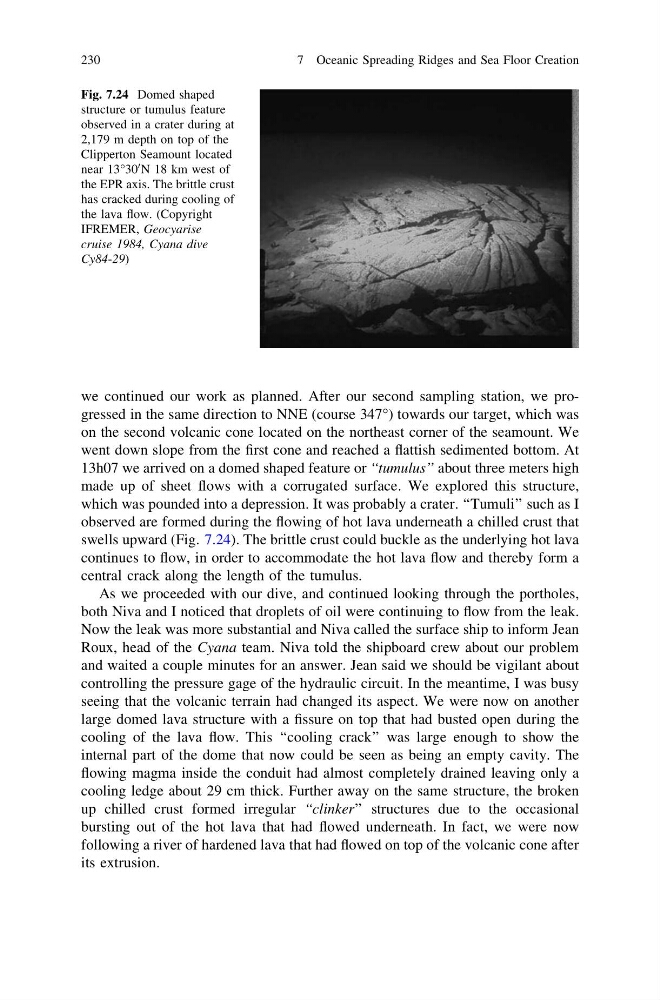
13h07 we arrived on a domed shaped feature or ‘‘tumulus’’ about three meters high
made up of sheet flows with a corrugated surface. We explored this structure,
which was pounded into a depression. It was probably a crater. ‘‘Tumuli’’ such as I
observed are formed during the flowing of hot lava underneath a chilled crust that
swells upward (Fig. 7.24). The brittle crust could buckle as the underlying hot lava
continues to flow, in order to accommodate the hot lava flow and thereby form a
central crack along the length of the tumulus.
As we proceeded with our dive, and continued looking through the portholes,
both Niva and I noticed that droplets of oil were continuing to flow from the leak.
Now the leak was more substantial and Niva called the surface ship to inform Jean
Roux, head of the Cyana team. Niva told the shipboard crew about our problem
and waited a couple minutes for an answer. Jean said we should be vigilant about
controlling the pressure gage of the hydraulic circuit. In the meantime, I was busy
seeing that the volcanic terrain had changed its aspect. We were now on another
large domed lava structure with a fissure on top that had busted open during the
cooling of the lava flow. This ‘‘cooling crack’’ was large enough to show the
internal part of the dome that now could be seen as being an empty cavity. The
flowing magma inside the conduit had almost completely drained leaving only a
cooling ledge about 29 cm thick. Further away on the same structure, the broken
up chilled crust formed irregular ‘‘clinker’’ structures due to the occasional
bursting out of the hot lava that had flowed underneath. In fact, we were now
following a river of hardened lava that had flowed on top of the volcanic cone after
its extrusion.
Fig. 7.24 Domed shaped
structure or tumulus feature
observed in a crater during at
2,179 m depth on top of the
Clipperton Seamount located
near 13°30
0 N 18 km west of
the EPR axis. The brittle crust
has cracked during cooling of
the lava flow. (Copyright
IFREMER, Geocyarise
cruise 1984, Cyana dive
Cy84-29)
230
7 Oceanic Spreading Ridges and Sea Floor Creation
on the second volcanic cone located on the northeast corner of the seamount. We
went down slope from the first cone and reached a flattish sedimented bottom. At
13h07 we arrived on a domed shaped feature or ‘‘tumulus’’ about three meters high
made up of sheet flows with a corrugated surface. We explored this structure,
which was pounded into a depression. It was probably a crater. ‘‘Tumuli’’ such as I
observed are formed during the flowing of hot lava underneath a chilled crust that
swells upward (Fig. 7.24). The brittle crust could buckle as the underlying hot lava
continues to flow, in order to accommodate the hot lava flow and thereby form a
central crack along the length of the tumulus.
As we proceeded with our dive, and continued looking through the portholes,
both Niva and I noticed that droplets of oil were continuing to flow from the leak.
Now the leak was more substantial and Niva called the surface ship to inform Jean
Roux, head of the Cyana team. Niva told the shipboard crew about our problem
and waited a couple minutes for an answer. Jean said we should be vigilant about
controlling the pressure gage of the hydraulic circuit. In the meantime, I was busy
seeing that the volcanic terrain had changed its aspect. We were now on another
large domed lava structure with a fissure on top that had busted open during the
cooling of the lava flow. This ‘‘cooling crack’’ was large enough to show the
internal part of the dome that now could be seen as being an empty cavity. The
flowing magma inside the conduit had almost completely drained leaving only a
cooling ledge about 29 cm thick. Further away on the same structure, the broken
up chilled crust formed irregular ‘‘clinker’’ structures due to the occasional
bursting out of the hot lava that had flowed underneath. In fact, we were now
following a river of hardened lava that had flowed on top of the volcanic cone after
its extrusion.
Fig. 7.24 Domed shaped
structure or tumulus feature
observed in a crater during at
2,179 m depth on top of the
Clipperton Seamount located
near 13°30
0 N 18 km west of
the EPR axis. The brittle crust
has cracked during cooling of
the lava flow. (Copyright
IFREMER, Geocyarise
cruise 1984, Cyana dive
Cy84-29)
230
7 Oceanic Spreading Ridges and Sea Floor Creation