

within a field of bottom transponders. This was the method we used to navigate
Alvin on the sea floor, which meant that during our stations to gather samples or
take photos, we had to take our bearings by measuring our distance from Lulu and
then ask Lulu to give us her position via radio.
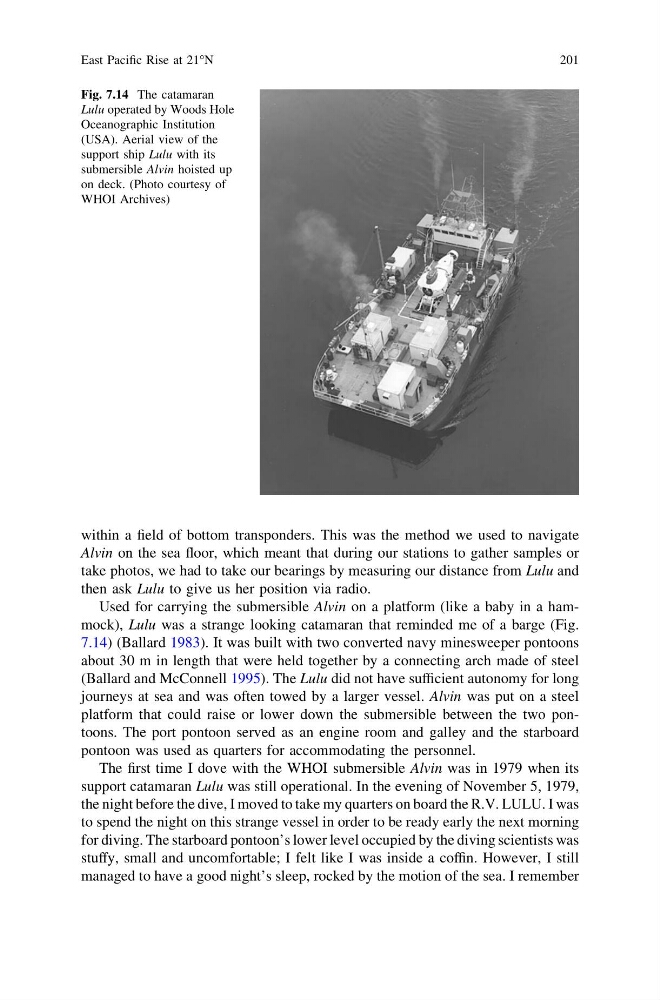
Used for carrying the submersible Alvin on a platform (like a baby in a hammock), Lulu was a strange looking catamaran that reminded me of a barge (Fig.
7.14) (Ballard 1983). It was built with two converted navy minesweeper pontoons
about 30 m in length that were held together by a connecting arch made of steel
(Ballard and McConnell 1995). The Lulu did not have sufficient autonomy for long
journeys at sea and was often towed by a larger vessel. Alvin was put on a steel
platform that could raise or lower down the submersible between the two pontoons. The port pontoon served as an engine room and galley and the starboard
pontoon was used as quarters for accommodating the personnel.
The first time I dove with the WHOI submersible Alvin was in 1979 when its
support catamaran Lulu was still operational. In the evening of November 5, 1979,
the night before the dive, I moved to take my quarters on board the R.V. LULU. I was
to spend the night on this strange vessel in order to be ready early the next morning
for diving. The starboard pontoon’s lower level occupied by the diving scientists was
stuffy, small and uncomfortable; I felt like I was inside a coffin. However, I still
managed to have a good night’s sleep, rocked by the motion of the sea. I remember
Fig. 7.14 The catamaran
Lulu operated by Woods Hole
Oceanographic Institution
(USA). Aerial view of the
support ship Lulu with its
submersible Alvin hoisted up
on deck. (Photo courtesy of
WHOI Archives)
East Pacific Rise at 21°N
201
Alvin on the sea floor, which meant that during our stations to gather samples or
take photos, we had to take our bearings by measuring our distance from Lulu and
then ask Lulu to give us her position via radio.
Used for carrying the submersible Alvin on a platform (like a baby in a hammock), Lulu was a strange looking catamaran that reminded me of a barge (Fig.
7.14) (Ballard 1983). It was built with two converted navy minesweeper pontoons
about 30 m in length that were held together by a connecting arch made of steel
(Ballard and McConnell 1995). The Lulu did not have sufficient autonomy for long
journeys at sea and was often towed by a larger vessel. Alvin was put on a steel
platform that could raise or lower down the submersible between the two pontoons. The port pontoon served as an engine room and galley and the starboard
pontoon was used as quarters for accommodating the personnel.
The first time I dove with the WHOI submersible Alvin was in 1979 when its
support catamaran Lulu was still operational. In the evening of November 5, 1979,
the night before the dive, I moved to take my quarters on board the R.V. LULU. I was
to spend the night on this strange vessel in order to be ready early the next morning
for diving. The starboard pontoon’s lower level occupied by the diving scientists was
stuffy, small and uncomfortable; I felt like I was inside a coffin. However, I still
managed to have a good night’s sleep, rocked by the motion of the sea. I remember
Fig. 7.14 The catamaran
Lulu operated by Woods Hole
Oceanographic Institution
(USA). Aerial view of the
support ship Lulu with its
submersible Alvin hoisted up
on deck. (Photo courtesy of
WHOI Archives)
East Pacific Rise at 21°N
201