

ends. The most recent lava flows occupy a narrow (less than 1 km wide), flat and
slightly depressed (a few meters) area in the axial rift valley.
The dives took place in the middle of the ridge segment at 34°50
0 N–36°30
0 W.
During dives OT01 and OT02, we were able to recognize the differences between
fresh lava flow with its glowing, shiny surface as seen in the submersible’s projector lights from some older flow, which appears to be duller looking, with some
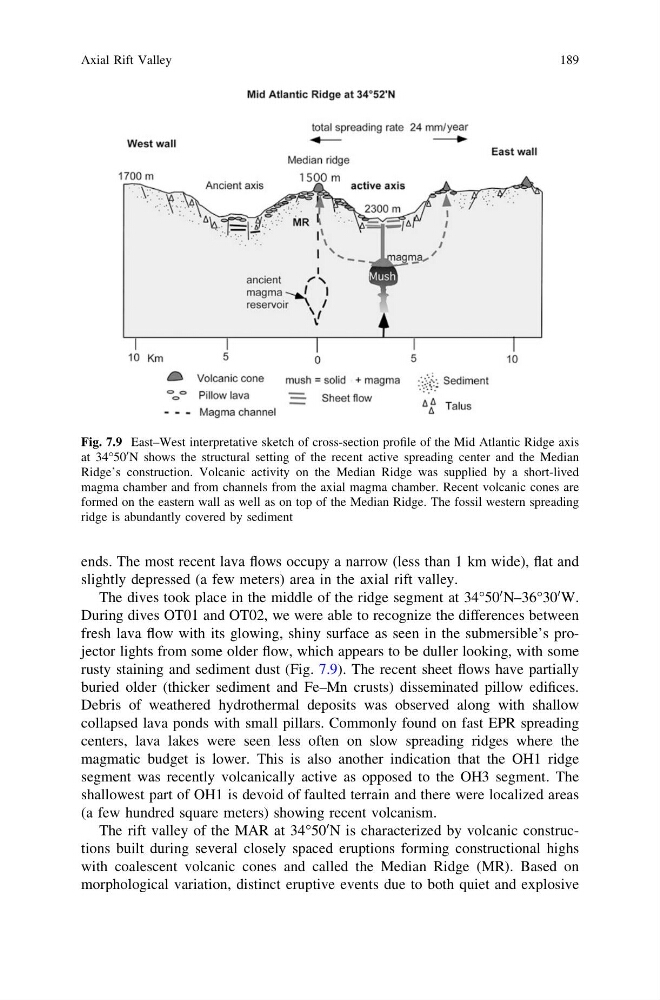
rusty staining and sediment dust (Fig. 7.9). The recent sheet flows have partially
buried older (thicker sediment and Fe–Mn crusts) disseminated pillow edifices.
Debris of weathered hydrothermal deposits was observed along with shallow
collapsed lava ponds with small pillars. Commonly found on fast EPR spreading
centers, lava lakes were seen less often on slow spreading ridges where the
magmatic budget is lower. This is also another indication that the OH1 ridge
segment was recently volcanically active as opposed to the OH3 segment. The
shallowest part of OH1 is devoid of faulted terrain and there were localized areas
(a few hundred square meters) showing recent volcanism.
The rift valley of the MAR at 34°50
0 N is characterized by volcanic constructions built during several closely spaced eruptions forming constructional highs
with coalescent volcanic cones and called the Median Ridge (MR). Based on
morphological variation, distinct eruptive events due to both quiet and explosive
Fig. 7.9 East–West interpretative sketch of cross-section profile of the Mid Atlantic Ridge axis
at 34°50
0 N shows the structural setting of the recent active spreading center and the Median
Ridge’s construction. Volcanic activity on the Median Ridge was supplied by a short-lived
magma chamber and from channels from the axial magma chamber. Recent volcanic cones are
formed on the eastern wall as well as on top of the Median Ridge. The fossil western spreading
ridge is abundantly covered by sediment
Axial Rift Valley
189
slightly depressed (a few meters) area in the axial rift valley.
The dives took place in the middle of the ridge segment at 34°50
0 N–36°30
0 W.
During dives OT01 and OT02, we were able to recognize the differences between
fresh lava flow with its glowing, shiny surface as seen in the submersible’s projector lights from some older flow, which appears to be duller looking, with some
rusty staining and sediment dust (Fig. 7.9). The recent sheet flows have partially
buried older (thicker sediment and Fe–Mn crusts) disseminated pillow edifices.
Debris of weathered hydrothermal deposits was observed along with shallow
collapsed lava ponds with small pillars. Commonly found on fast EPR spreading
centers, lava lakes were seen less often on slow spreading ridges where the
magmatic budget is lower. This is also another indication that the OH1 ridge
segment was recently volcanically active as opposed to the OH3 segment. The
shallowest part of OH1 is devoid of faulted terrain and there were localized areas
(a few hundred square meters) showing recent volcanism.
The rift valley of the MAR at 34°50
0 N is characterized by volcanic constructions built during several closely spaced eruptions forming constructional highs
with coalescent volcanic cones and called the Median Ridge (MR). Based on
morphological variation, distinct eruptive events due to both quiet and explosive
Fig. 7.9 East–West interpretative sketch of cross-section profile of the Mid Atlantic Ridge axis
at 34°50
0 N shows the structural setting of the recent active spreading center and the Median
Ridge’s construction. Volcanic activity on the Median Ridge was supplied by a short-lived
magma chamber and from channels from the axial magma chamber. Recent volcanic cones are
formed on the eastern wall as well as on top of the Median Ridge. The fossil western spreading
ridge is abundantly covered by sediment
Axial Rift Valley
189