

transform faults. These 1st order segments range between more than 20 km up to
more than several hundred km in length. This type of segmentation has the longest
temporal stability (10
7 years) before any tectonic disruption, and the largest depth
difference (up to 500 m) at the ridge-transform intersections (RTI). The 1st order
discontinuities have offset the ridge axis along distances of about 200 and 800 km.
Superimposed on the first-order segments are smaller discontinuities (which are
2nd, 3rd and 4th orders). These segments divide the ridge into smaller and shorterlived offsets. The 1st and 2nd order discontinuities are seismically marked by long
wavelengths. There are long-lived magma injections along these inflated, volcanically active segments, which have large and steady state magma reservoirs with
replenishing and mixing.
The 2nd order discontinuities have a segment length of 30 to 300 km. They
have a well-developed Overlapping Spreading Center (OSC) along the ridge axis
where their two ends curve toward each other and distances of 1–20 km separate
them from each other. These segments have an average relief of about 100 m at
their segment ends and a stability of about 10
5 yr.
The 3rd order segmentation is represented by 10–30 km long discontinuities
and shows a ridge topography that pinches in at the segment ends due to the
decrease in magmatism. 3rd order segmentation is characterized by a vertical relief
of less than 50 m in height at the segment ends and has a stability of less than
10
4 yr.
These 2nd and 3rd intermediate types of discontinuities (about 10–50 km in
length, 1–10 km in width) have offset the strike of the EPR ridge axis by more than
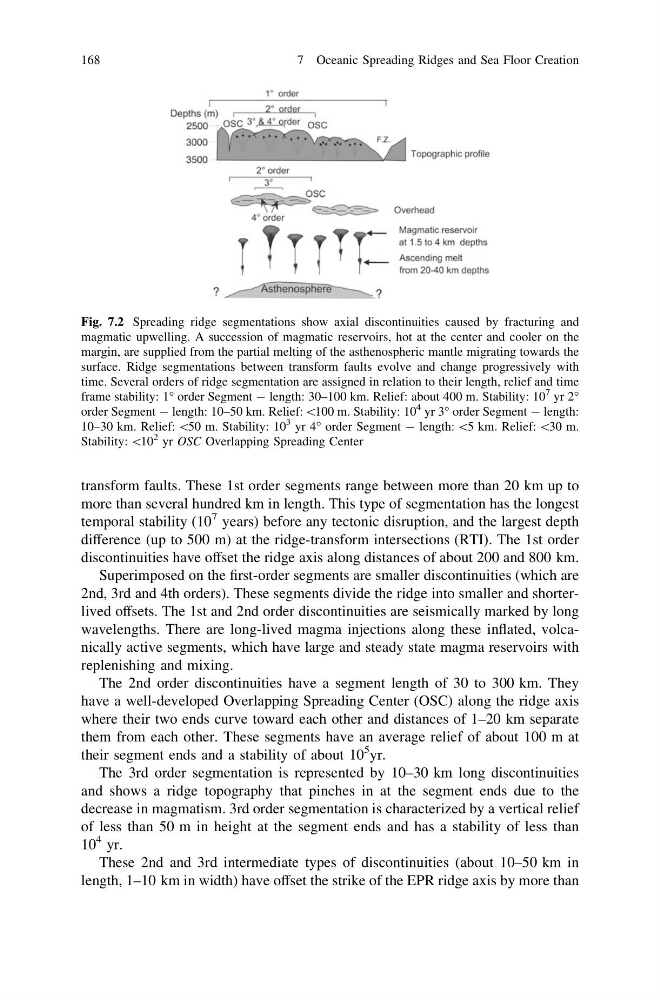
Fig. 7.2 Spreading ridge segmentations show axial discontinuities caused by fracturing and
magmatic upwelling. A succession of magmatic reservoirs, hot at the center and cooler on the
margin, are supplied from the partial melting of the asthenospheric mantle migrating towards the
surface. Ridge segmentations between transform faults evolve and change progressively with
time. Several orders of ridge segmentation are assigned in relation to their length, relief and time
frame stability: 1° order Segment - length: 30–100 km. Relief: about 400 m. Stability: 10
7 yr 2°
order Segment - length: 10–50 km. Relief:\100 m. Stability: 10
4 yr 3° order Segment - length:
10–30 km. Relief: \50 m. Stability: 10
3 yr 4° order Segment - length: \5 km. Relief: \30 m.
Stability: \10
2 yr OSC Overlapping Spreading Center
168
7 Oceanic Spreading Ridges and Sea Floor Creation
more than several hundred km in length. This type of segmentation has the longest
temporal stability (10
7 years) before any tectonic disruption, and the largest depth
difference (up to 500 m) at the ridge-transform intersections (RTI). The 1st order
discontinuities have offset the ridge axis along distances of about 200 and 800 km.
Superimposed on the first-order segments are smaller discontinuities (which are
2nd, 3rd and 4th orders). These segments divide the ridge into smaller and shorterlived offsets. The 1st and 2nd order discontinuities are seismically marked by long
wavelengths. There are long-lived magma injections along these inflated, volcanically active segments, which have large and steady state magma reservoirs with
replenishing and mixing.
The 2nd order discontinuities have a segment length of 30 to 300 km. They
have a well-developed Overlapping Spreading Center (OSC) along the ridge axis
where their two ends curve toward each other and distances of 1–20 km separate
them from each other. These segments have an average relief of about 100 m at
their segment ends and a stability of about 10
5 yr.
The 3rd order segmentation is represented by 10–30 km long discontinuities
and shows a ridge topography that pinches in at the segment ends due to the
decrease in magmatism. 3rd order segmentation is characterized by a vertical relief
of less than 50 m in height at the segment ends and has a stability of less than
10
4 yr.
These 2nd and 3rd intermediate types of discontinuities (about 10–50 km in
length, 1–10 km in width) have offset the strike of the EPR ridge axis by more than
Fig. 7.2 Spreading ridge segmentations show axial discontinuities caused by fracturing and
magmatic upwelling. A succession of magmatic reservoirs, hot at the center and cooler on the
margin, are supplied from the partial melting of the asthenospheric mantle migrating towards the
surface. Ridge segmentations between transform faults evolve and change progressively with
time. Several orders of ridge segmentation are assigned in relation to their length, relief and time
frame stability: 1° order Segment - length: 30–100 km. Relief: about 400 m. Stability: 10
7 yr 2°
order Segment - length: 10–50 km. Relief:\100 m. Stability: 10
4 yr 3° order Segment - length:
10–30 km. Relief: \50 m. Stability: 10
3 yr 4° order Segment - length: \5 km. Relief: \30 m.
Stability: \10
2 yr OSC Overlapping Spreading Center
168
7 Oceanic Spreading Ridges and Sea Floor Creation