

Hydrothermal Breccia
Hydrothermal breccia are caused by the debris formed when hydrothermal edifices
become old so they crumble into a pile of fragments. However, hydrothermal
breccia could also be formed during the percolation of fluid charged with metalliferous matter through talus piles in the active tectonic zone associated with
spreading ridges or normal faulted terrains which are areas of recent volcanic and
tectonic activity.
An example of hydrothermal breccia was discovered in the south-east Pacific
Ridge segment near 18°30
0 S at the foot of a vertical wall forming the axial graben
where sand, gravel, and boulder sized (0.1–20 cm in diameter) altered rock fragments were cemented by sulfides and Fe-oxyhydroxide precipitates. In addition,
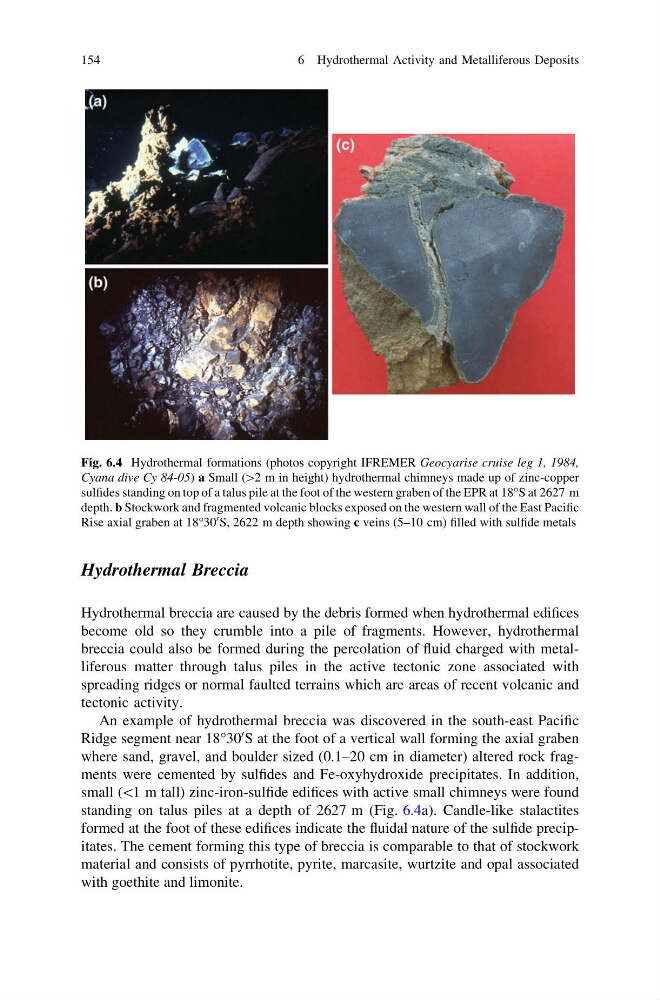
small (\1 m tall) zinc-iron-sulfide edifices with active small chimneys were found
standing on talus piles at a depth of 2627 m (Fig. 6.4a). Candle-like stalactites
formed at the foot of these edifices indicate the fluidal nature of the sulfide precipitates. The cement forming this type of breccia is comparable to that of stockwork
material and consists of pyrrhotite, pyrite, marcasite, wurtzite and opal associated
with goethite and limonite.
Fig. 6.4 Hydrothermal formations (photos copyright IFREMER Geocyarise cruise leg 1, 1984,
Cyana dive Cy 84-05) a Small ([2 m in height) hydrothermal chimneys made up of zinc-copper
sulfides standing on top of a talus pile at the foot of the western graben of the EPR at 18°S at 2627 m
depth. b Stockwork and fragmented volcanic blocks exposed on the western wall of the East Pacific
Rise axial graben at 18°30
0 S, 2622 m depth showing c veins (5–10 cm) filled with sulfide metals
154
6 Hydrothermal Activity and Metalliferous Deposits
Hydrothermal breccia are caused by the debris formed when hydrothermal edifices
become old so they crumble into a pile of fragments. However, hydrothermal
breccia could also be formed during the percolation of fluid charged with metalliferous matter through talus piles in the active tectonic zone associated with
spreading ridges or normal faulted terrains which are areas of recent volcanic and
tectonic activity.
An example of hydrothermal breccia was discovered in the south-east Pacific
Ridge segment near 18°30
0 S at the foot of a vertical wall forming the axial graben
where sand, gravel, and boulder sized (0.1–20 cm in diameter) altered rock fragments were cemented by sulfides and Fe-oxyhydroxide precipitates. In addition,
small (\1 m tall) zinc-iron-sulfide edifices with active small chimneys were found
standing on talus piles at a depth of 2627 m (Fig. 6.4a). Candle-like stalactites
formed at the foot of these edifices indicate the fluidal nature of the sulfide precipitates. The cement forming this type of breccia is comparable to that of stockwork
material and consists of pyrrhotite, pyrite, marcasite, wurtzite and opal associated
with goethite and limonite.
Fig. 6.4 Hydrothermal formations (photos copyright IFREMER Geocyarise cruise leg 1, 1984,
Cyana dive Cy 84-05) a Small ([2 m in height) hydrothermal chimneys made up of zinc-copper
sulfides standing on top of a talus pile at the foot of the western graben of the EPR at 18°S at 2627 m
depth. b Stockwork and fragmented volcanic blocks exposed on the western wall of the East Pacific
Rise axial graben at 18°30
0 S, 2622 m depth showing c veins (5–10 cm) filled with sulfide metals
154
6 Hydrothermal Activity and Metalliferous Deposits