

In 1977, in parallel with these discoveries, Peter Lonsdale (University of
California at Scripps Institute of Oceanography in San Diego) found evidence of
active hydrothermal springs in the area of high heat flow in the Guaymas basin in
the Gulf of California (see News and Views 289, 9, 1981). This portion of the
spreading ridge axis is buried under several hundred meters of sediment carried off
the continent by the Colorado River. Subsequent drilling operations and Alvin
dives and drilling operations later confirmed the presence of hydrothermal activity
in this area.
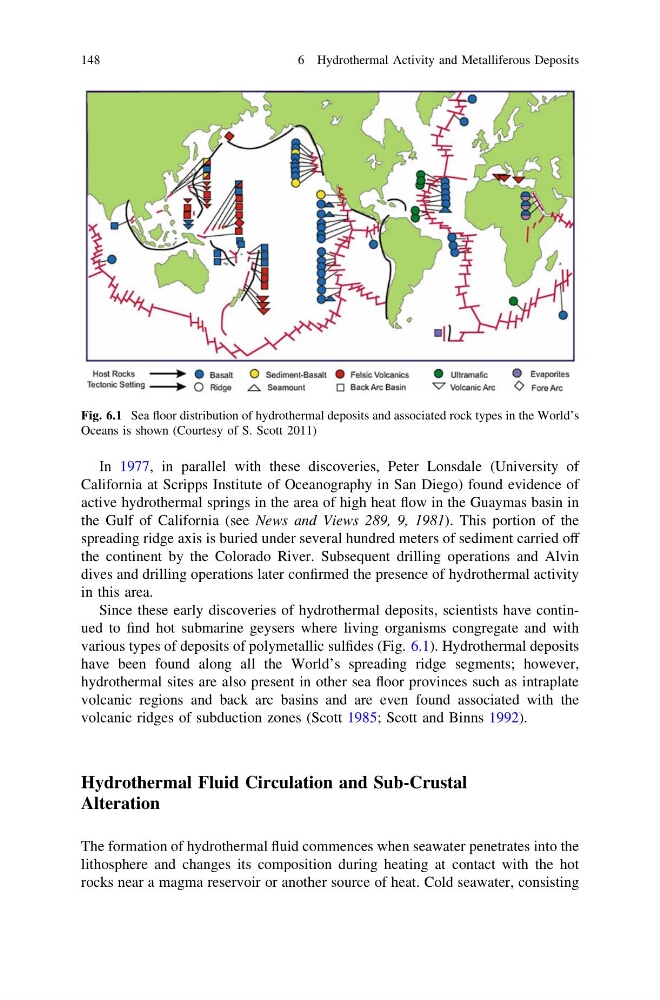
Since these early discoveries of hydrothermal deposits, scientists have continued to find hot submarine geysers where living organisms congregate and with
various types of deposits of polymetallic sulfides (Fig. 6.1). Hydrothermal deposits
have been found along all the World’s spreading ridge segments; however,
hydrothermal sites are also present in other sea floor provinces such as intraplate
volcanic regions and back arc basins and are even found associated with the
volcanic ridges of subduction zones (Scott 1985; Scott and Binns 1992).
Hydrothermal Fluid Circulation and Sub-Crustal
Alteration
The formation of hydrothermal fluid commences when seawater penetrates into the
lithosphere and changes its composition during heating at contact with the hot
rocks near a magma reservoir or another source of heat. Cold seawater, consisting
Fig. 6.1 Sea floor distribution of hydrothermal deposits and associated rock types in the World’s
Oceans is shown (Courtesy of S. Scott 2011)
148
6 Hydrothermal Activity and Metalliferous Deposits
California at Scripps Institute of Oceanography in San Diego) found evidence of
active hydrothermal springs in the area of high heat flow in the Guaymas basin in
the Gulf of California (see News and Views 289, 9, 1981). This portion of the
spreading ridge axis is buried under several hundred meters of sediment carried off
the continent by the Colorado River. Subsequent drilling operations and Alvin
dives and drilling operations later confirmed the presence of hydrothermal activity
in this area.
Since these early discoveries of hydrothermal deposits, scientists have continued to find hot submarine geysers where living organisms congregate and with
various types of deposits of polymetallic sulfides (Fig. 6.1). Hydrothermal deposits
have been found along all the World’s spreading ridge segments; however,
hydrothermal sites are also present in other sea floor provinces such as intraplate
volcanic regions and back arc basins and are even found associated with the
volcanic ridges of subduction zones (Scott 1985; Scott and Binns 1992).
Hydrothermal Fluid Circulation and Sub-Crustal
Alteration
The formation of hydrothermal fluid commences when seawater penetrates into the
lithosphere and changes its composition during heating at contact with the hot
rocks near a magma reservoir or another source of heat. Cold seawater, consisting
Fig. 6.1 Sea floor distribution of hydrothermal deposits and associated rock types in the World’s
Oceans is shown (Courtesy of S. Scott 2011)
148
6 Hydrothermal Activity and Metalliferous Deposits