

MAR axis at 550–1750 m depths. The summit of these edifices had been cut by a
graben about 2 km wide and 350 m deep (Ondreas et al. 1997) showing altered,
coarse-grained pyroclastic flows covering basaltic pillow lava.
The second pyroclastic deposit, also discovered by the submersible Nautile
during the Oceanaut cruise, forms the crater of a volcanic cone that had collapsed
during an explosive eruption that took place at about 1400–1900 m depth near
34°50
0 N on the MAR (Hekinian et al. 2000; Bideau et al. 1998) (see Chap. 7).
These deposits were collected from the Median Ridge located on the axis of the
MAR at 34°50
0 –35°N that was formed by several volcanic cones which had
coalesced together to form a volcanic ridge. Two of the edifices that were visited
contained poorly cemented fragmented rocks of pyroclasts and layered glass
shards of hyaloclastites forming the upper part the volcanic structures.
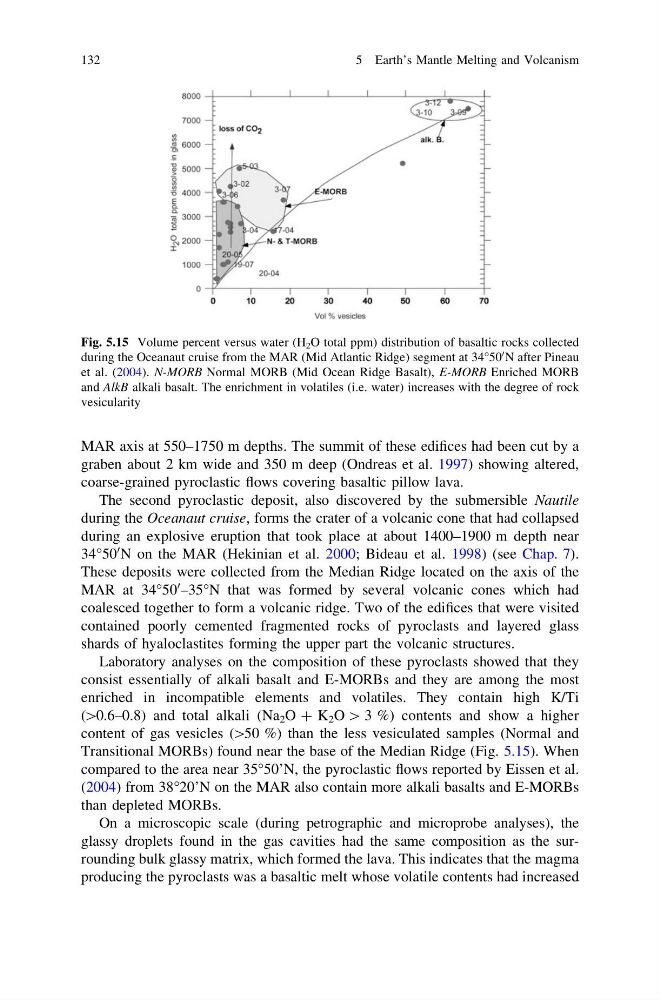
Laboratory analyses on the composition of these pyroclasts showed that they
consist essentially of alkali basalt and E-MORBs and they are among the most
enriched in incompatible elements and volatiles. They contain high K/Ti
([0.6–0.8) and total alkali (Na 2 O ? K 2 O [ 3 %) contents and show a higher
content of gas vesicles ([50 %) than the less vesiculated samples (Normal and
Transitional MORBs) found near the base of the Median Ridge (Fig. 5.15). When
compared to the area near 35°50’N, the pyroclastic flows reported by Eissen et al.
(2004) from 38°20’N on the MAR also contain more alkali basalts and E-MORBs
than depleted MORBs.
On a microscopic scale (during petrographic and microprobe analyses), the
glassy droplets found in the gas cavities had the same composition as the surrounding bulk glassy matrix, which formed the lava. This indicates that the magma
producing the pyroclasts was a basaltic melt whose volatile contents had increased
Fig. 5.15 Volume percent versus water (H 2 O total ppm) distribution of basaltic rocks collected
during the Oceanaut cruise from the MAR (Mid Atlantic Ridge) segment at 34°50
0 N after Pineau
et al. (2004). N-MORB Normal MORB (Mid Ocean Ridge Basalt), E-MORB Enriched MORB
and AlkB alkali basalt. The enrichment in volatiles (i.e. water) increases with the degree of rock
vesicularity
132
5 Earth’s Mantle Melting and Volcanism
graben about 2 km wide and 350 m deep (Ondreas et al. 1997) showing altered,
coarse-grained pyroclastic flows covering basaltic pillow lava.
The second pyroclastic deposit, also discovered by the submersible Nautile
during the Oceanaut cruise, forms the crater of a volcanic cone that had collapsed
during an explosive eruption that took place at about 1400–1900 m depth near
34°50
0 N on the MAR (Hekinian et al. 2000; Bideau et al. 1998) (see Chap. 7).
These deposits were collected from the Median Ridge located on the axis of the
MAR at 34°50
0 –35°N that was formed by several volcanic cones which had
coalesced together to form a volcanic ridge. Two of the edifices that were visited
contained poorly cemented fragmented rocks of pyroclasts and layered glass
shards of hyaloclastites forming the upper part the volcanic structures.
Laboratory analyses on the composition of these pyroclasts showed that they
consist essentially of alkali basalt and E-MORBs and they are among the most
enriched in incompatible elements and volatiles. They contain high K/Ti
([0.6–0.8) and total alkali (Na 2 O ? K 2 O [ 3 %) contents and show a higher
content of gas vesicles ([50 %) than the less vesiculated samples (Normal and
Transitional MORBs) found near the base of the Median Ridge (Fig. 5.15). When
compared to the area near 35°50’N, the pyroclastic flows reported by Eissen et al.
(2004) from 38°20’N on the MAR also contain more alkali basalts and E-MORBs
than depleted MORBs.
On a microscopic scale (during petrographic and microprobe analyses), the
glassy droplets found in the gas cavities had the same composition as the surrounding bulk glassy matrix, which formed the lava. This indicates that the magma
producing the pyroclasts was a basaltic melt whose volatile contents had increased
Fig. 5.15 Volume percent versus water (H 2 O total ppm) distribution of basaltic rocks collected
during the Oceanaut cruise from the MAR (Mid Atlantic Ridge) segment at 34°50
0 N after Pineau
et al. (2004). N-MORB Normal MORB (Mid Ocean Ridge Basalt), E-MORB Enriched MORB
and AlkB alkali basalt. The enrichment in volatiles (i.e. water) increases with the degree of rock
vesicularity
132
5 Earth’s Mantle Melting and Volcanism