

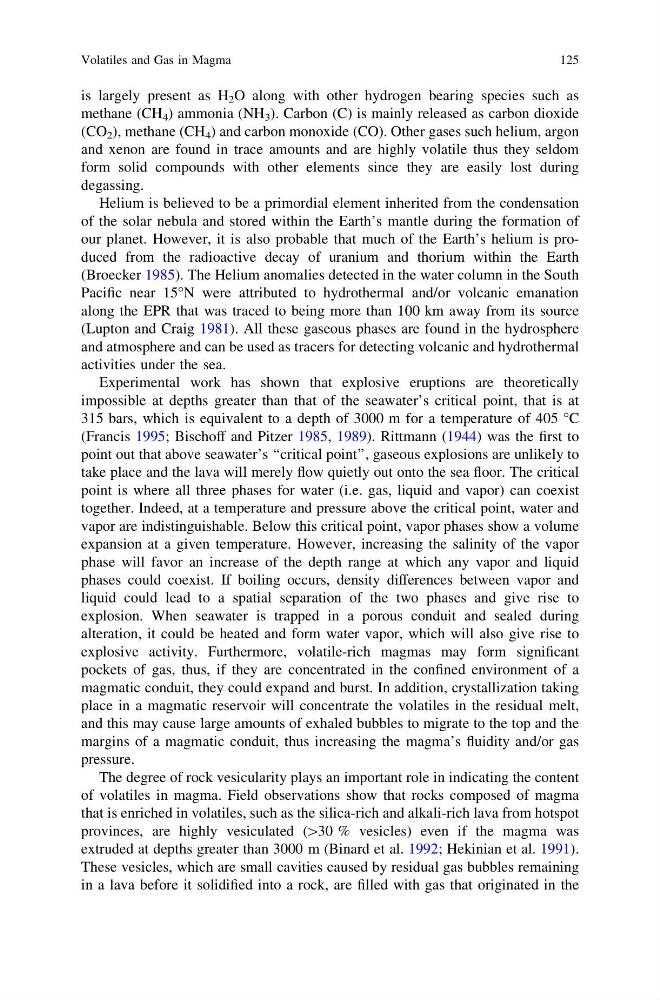
is largely present as H 2 O along with other hydrogen bearing species such as
methane (CH 4 ) ammonia (NH 3 ). Carbon (C) is mainly released as carbon dioxide
(CO 2 ), methane (CH 4 ) and carbon monoxide (CO). Other gases such helium, argon
and xenon are found in trace amounts and are highly volatile thus they seldom
form solid compounds with other elements since they are easily lost during
degassing.
Helium is believed to be a primordial element inherited from the condensation
of the solar nebula and stored within the Earth’s mantle during the formation of
our planet. However, it is also probable that much of the Earth’s helium is produced from the radioactive decay of uranium and thorium within the Earth
(Broecker 1985). The Helium anomalies detected in the water column in the South
Pacific near 15°N were attributed to hydrothermal and/or volcanic emanation
along the EPR that was traced to being more than 100 km away from its source
(Lupton and Craig 1981). All these gaseous phases are found in the hydrosphere
and atmosphere and can be used as tracers for detecting volcanic and hydrothermal
activities under the sea.
Experimental work has shown that explosive eruptions are theoretically
impossible at depths greater than that of the seawater’s critical point, that is at
315 bars, which is equivalent to a depth of 3000 m for a temperature of 405 °C
(Francis 1995; Bischoff and Pitzer 1985, 1989). Rittmann (1944) was the first to
point out that above seawater’s ‘‘critical point’’, gaseous explosions are unlikely to
take place and the lava will merely flow quietly out onto the sea floor. The critical
point is where all three phases for water (i.e. gas, liquid and vapor) can coexist
together. Indeed, at a temperature and pressure above the critical point, water and
vapor are indistinguishable. Below this critical point, vapor phases show a volume
expansion at a given temperature. However, increasing the salinity of the vapor
phase will favor an increase of the depth range at which any vapor and liquid
phases could coexist. If boiling occurs, density differences between vapor and
liquid could lead to a spatial separation of the two phases and give rise to
explosion. When seawater is trapped in a porous conduit and sealed during
alteration, it could be heated and form water vapor, which will also give rise to
explosive activity. Furthermore, volatile-rich magmas may form significant
pockets of gas, thus, if they are concentrated in the confined environment of a
magmatic conduit, they could expand and burst. In addition, crystallization taking
place in a magmatic reservoir will concentrate the volatiles in the residual melt,
and this may cause large amounts of exhaled bubbles to migrate to the top and the
margins of a magmatic conduit, thus increasing the magma’s fluidity and/or gas
pressure.
The degree of rock vesicularity plays an important role in indicating the content
of volatiles in magma. Field observations show that rocks composed of magma
that is enriched in volatiles, such as the silica-rich and alkali-rich lava from hotspot
provinces, are highly vesiculated ([30 % vesicles) even if the magma was
extruded at depths greater than 3000 m (Binard et al. 1992; Hekinian et al. 1991).
These vesicles, which are small cavities caused by residual gas bubbles remaining
in a lava before it solidified into a rock, are filled with gas that originated in the
Volatiles and Gas in Magma
125
methane (CH 4 ) ammonia (NH 3 ). Carbon (C) is mainly released as carbon dioxide
(CO 2 ), methane (CH 4 ) and carbon monoxide (CO). Other gases such helium, argon
and xenon are found in trace amounts and are highly volatile thus they seldom
form solid compounds with other elements since they are easily lost during
degassing.
Helium is believed to be a primordial element inherited from the condensation
of the solar nebula and stored within the Earth’s mantle during the formation of
our planet. However, it is also probable that much of the Earth’s helium is produced from the radioactive decay of uranium and thorium within the Earth
(Broecker 1985). The Helium anomalies detected in the water column in the South
Pacific near 15°N were attributed to hydrothermal and/or volcanic emanation
along the EPR that was traced to being more than 100 km away from its source
(Lupton and Craig 1981). All these gaseous phases are found in the hydrosphere
and atmosphere and can be used as tracers for detecting volcanic and hydrothermal
activities under the sea.
Experimental work has shown that explosive eruptions are theoretically
impossible at depths greater than that of the seawater’s critical point, that is at
315 bars, which is equivalent to a depth of 3000 m for a temperature of 405 °C
(Francis 1995; Bischoff and Pitzer 1985, 1989). Rittmann (1944) was the first to
point out that above seawater’s ‘‘critical point’’, gaseous explosions are unlikely to
take place and the lava will merely flow quietly out onto the sea floor. The critical
point is where all three phases for water (i.e. gas, liquid and vapor) can coexist
together. Indeed, at a temperature and pressure above the critical point, water and
vapor are indistinguishable. Below this critical point, vapor phases show a volume
expansion at a given temperature. However, increasing the salinity of the vapor
phase will favor an increase of the depth range at which any vapor and liquid
phases could coexist. If boiling occurs, density differences between vapor and
liquid could lead to a spatial separation of the two phases and give rise to
explosion. When seawater is trapped in a porous conduit and sealed during
alteration, it could be heated and form water vapor, which will also give rise to
explosive activity. Furthermore, volatile-rich magmas may form significant
pockets of gas, thus, if they are concentrated in the confined environment of a
magmatic conduit, they could expand and burst. In addition, crystallization taking
place in a magmatic reservoir will concentrate the volatiles in the residual melt,
and this may cause large amounts of exhaled bubbles to migrate to the top and the
margins of a magmatic conduit, thus increasing the magma’s fluidity and/or gas
pressure.
The degree of rock vesicularity plays an important role in indicating the content
of volatiles in magma. Field observations show that rocks composed of magma
that is enriched in volatiles, such as the silica-rich and alkali-rich lava from hotspot
provinces, are highly vesiculated ([30 % vesicles) even if the magma was
extruded at depths greater than 3000 m (Binard et al. 1992; Hekinian et al. 1991).
These vesicles, which are small cavities caused by residual gas bubbles remaining
in a lava before it solidified into a rock, are filled with gas that originated in the
Volatiles and Gas in Magma
125