

of pyroxene and garnet, such as spinel-peridotite and garnet-peridotite. The rock
was melted at temperatures near the solidus up to 2000 °C above and within the
pressure range of 0–15 kilobars (55 km depth) during experiments carried out by
Green and Ringwood (1967). The results of these studies have shown that with
decreasing pressure, rock melting can and will take place, and the portion of the
melt obtained experimentally was similar to basaltic lava erupted on the sea floor.
This melting experiment yielded tholeiite basalt (similar in composition to a
MORB), at a pressure less than 15 kilobars corresponding to about 47 km depth in
the lithosphere, and alkali-olivine basalt, at pressure greater than 15 kilobars.
Garnet-peridotite is stable only in the upper mantle, and it could be yet another
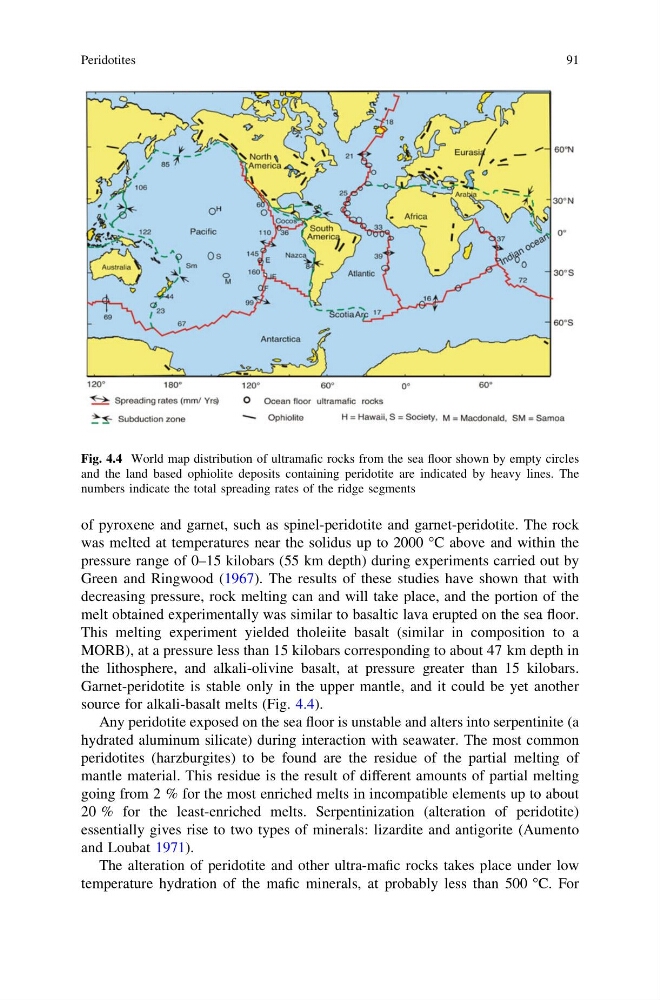
source for alkali-basalt melts (Fig. 4.4).
Any peridotite exposed on the sea floor is unstable and alters into serpentinite (a
hydrated aluminum silicate) during interaction with seawater. The most common
peridotites (harzburgites) to be found are the residue of the partial melting of
mantle material. This residue is the result of different amounts of partial melting
going from 2 % for the most enriched melts in incompatible elements up to about
20 % for the least-enriched melts. Serpentinization (alteration of peridotite)
essentially gives rise to two types of minerals: lizardite and antigorite (Aumento
and Loubat 1971).
The alteration of peridotite and other ultra-mafic rocks takes place under low
temperature hydration of the mafic minerals, at probably less than 500 °C. For
Fig. 4.4 World map distribution of ultramafic rocks from the sea floor shown by empty circles
and the land based ophiolite deposits containing peridotite are indicated by heavy lines. The
numbers indicate the total spreading rates of the ridge segments
Peridotites
91
was melted at temperatures near the solidus up to 2000 °C above and within the
pressure range of 0–15 kilobars (55 km depth) during experiments carried out by
Green and Ringwood (1967). The results of these studies have shown that with
decreasing pressure, rock melting can and will take place, and the portion of the
melt obtained experimentally was similar to basaltic lava erupted on the sea floor.
This melting experiment yielded tholeiite basalt (similar in composition to a
MORB), at a pressure less than 15 kilobars corresponding to about 47 km depth in
the lithosphere, and alkali-olivine basalt, at pressure greater than 15 kilobars.
Garnet-peridotite is stable only in the upper mantle, and it could be yet another
source for alkali-basalt melts (Fig. 4.4).
Any peridotite exposed on the sea floor is unstable and alters into serpentinite (a
hydrated aluminum silicate) during interaction with seawater. The most common
peridotites (harzburgites) to be found are the residue of the partial melting of
mantle material. This residue is the result of different amounts of partial melting
going from 2 % for the most enriched melts in incompatible elements up to about
20 % for the least-enriched melts. Serpentinization (alteration of peridotite)
essentially gives rise to two types of minerals: lizardite and antigorite (Aumento
and Loubat 1971).
The alteration of peridotite and other ultra-mafic rocks takes place under low
temperature hydration of the mafic minerals, at probably less than 500 °C. For
Fig. 4.4 World map distribution of ultramafic rocks from the sea floor shown by empty circles
and the land based ophiolite deposits containing peridotite are indicated by heavy lines. The
numbers indicate the total spreading rates of the ridge segments
Peridotites
91