

52
G. Lagerloef and J. Font
3.5.3 Basic Aquarius Algorithm Approach
The Aquarius retrieval algorithm is being developed using very thorough simulation
to test and quantify errors in the retrievals prior to launch. Starting with the dielectric model of equations (3.1) and (3.2), the Aquarius science simulator generates a
forward computation of the top of the atmosphere brightness temperatures based on
an ocean model SSS and SST field. The simulator adds all the geophysical radiative sources described in Section 3.3, convolves the Aquarius antenna gain patterns
and thus derives the brightness temperature input to the three individual radiometers
(called antenna temperatures). Estimated errors for the sensor and geophysical corrections are added, and then the inverse calculation is performed to compare with
the input SSS field. A 30-day simulation and retrieval analysis shows worst-case
salinity errors ∼0.5 in high latitudes and <0.2 in the latitude range 40N–40S for
point measurements (5.76s integration time), which would be further reduced by
monthly averaging. See also Lagerloef et al. (2008, 2010) and Kim et al. (2010) for
more simulator details. A new 1-year simulation is now being computed and will be
available at the time of the Oceans from Space 2010 meeting.
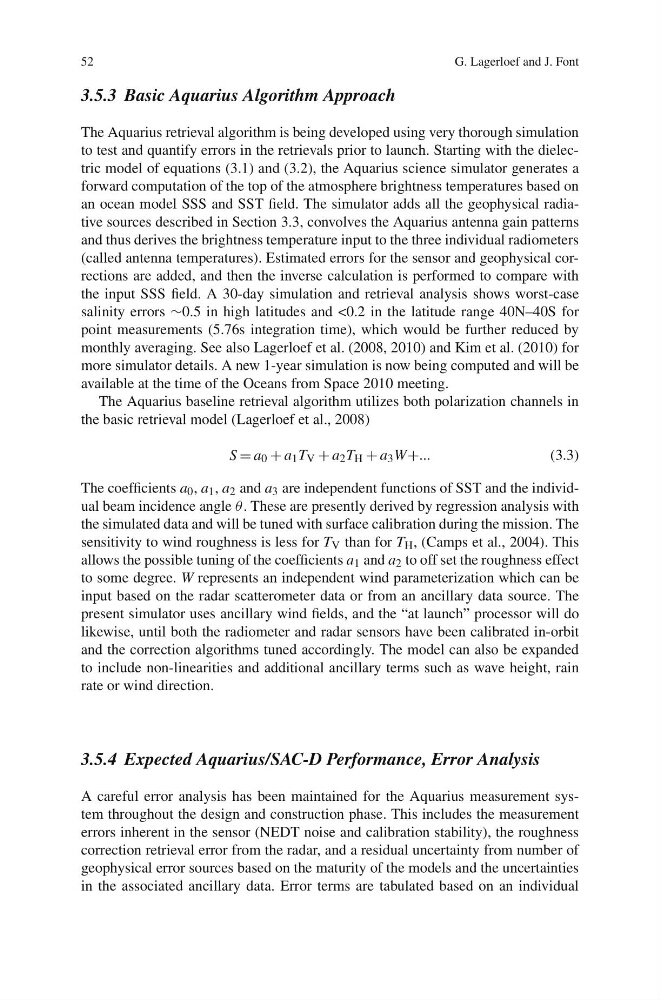
The Aquarius baseline retrieval algorithm utilizes both polarization channels in
the basic retrieval model (Lagerloef et al., 2008)
S = a 0 + a 1 T V + a 2 T H + a 3 W+...
(3.3)
The coefficients a 0 , a 1 , a 2 and a 3 are independent functions of SST and the individual beam incidence angle θ. These are presently derived by regression analysis with
the simulated data and will be tuned with surface calibration during the mission. The
sensitivity to wind roughness is less for T V than for T H , (Camps et al., 2004). This
allows the possible tuning of the coefficients a 1 and a 2 to off set the roughness effect
to some degree. W represents an independent wind parameterization which can be
input based on the radar scatterometer data or from an ancillary data source. The
present simulator uses ancillary wind fields, and the “at launch” processor will do
likewise, until both the radiometer and radar sensors have been calibrated in-orbit
and the correction algorithms tuned accordingly. The model can also be expanded
to include non-linearities and additional ancillary terms such as wave height, rain
rate or wind direction.
3.5.4 Expected Aquarius/SAC-D Performance, Error Analysis
A careful error analysis has been maintained for the Aquarius measurement system throughout the design and construction phase. This includes the measurement
errors inherent in the sensor (NEDT noise and calibration stability), the roughness
correction retrieval error from the radar, and a residual uncertainty from number of
geophysical error sources based on the maturity of the models and the uncertainties
in the associated ancillary data. Error terms are tabulated based on an individual
G. Lagerloef and J. Font
3.5.3 Basic Aquarius Algorithm Approach
The Aquarius retrieval algorithm is being developed using very thorough simulation
to test and quantify errors in the retrievals prior to launch. Starting with the dielectric model of equations (3.1) and (3.2), the Aquarius science simulator generates a
forward computation of the top of the atmosphere brightness temperatures based on
an ocean model SSS and SST field. The simulator adds all the geophysical radiative sources described in Section 3.3, convolves the Aquarius antenna gain patterns
and thus derives the brightness temperature input to the three individual radiometers
(called antenna temperatures). Estimated errors for the sensor and geophysical corrections are added, and then the inverse calculation is performed to compare with
the input SSS field. A 30-day simulation and retrieval analysis shows worst-case
salinity errors ∼0.5 in high latitudes and <0.2 in the latitude range 40N–40S for
point measurements (5.76s integration time), which would be further reduced by
monthly averaging. See also Lagerloef et al. (2008, 2010) and Kim et al. (2010) for
more simulator details. A new 1-year simulation is now being computed and will be
available at the time of the Oceans from Space 2010 meeting.
The Aquarius baseline retrieval algorithm utilizes both polarization channels in
the basic retrieval model (Lagerloef et al., 2008)
S = a 0 + a 1 T V + a 2 T H + a 3 W+...
(3.3)
The coefficients a 0 , a 1 , a 2 and a 3 are independent functions of SST and the individual beam incidence angle θ. These are presently derived by regression analysis with
the simulated data and will be tuned with surface calibration during the mission. The
sensitivity to wind roughness is less for T V than for T H , (Camps et al., 2004). This
allows the possible tuning of the coefficients a 1 and a 2 to off set the roughness effect
to some degree. W represents an independent wind parameterization which can be
input based on the radar scatterometer data or from an ancillary data source. The
present simulator uses ancillary wind fields, and the “at launch” processor will do
likewise, until both the radiometer and radar sensors have been calibrated in-orbit
and the correction algorithms tuned accordingly. The model can also be expanded
to include non-linearities and additional ancillary terms such as wave height, rain
rate or wind direction.
3.5.4 Expected Aquarius/SAC-D Performance, Error Analysis
A careful error analysis has been maintained for the Aquarius measurement system throughout the design and construction phase. This includes the measurement
errors inherent in the sensor (NEDT noise and calibration stability), the roughness
correction retrieval error from the radar, and a residual uncertainty from number of
geophysical error sources based on the maturity of the models and the uncertainties
in the associated ancillary data. Error terms are tabulated based on an individual