

3 SMOS and Aquarius/SAC-D Missions
41
of low microwave passive remote sensing for the measurement of these two geophysical variables (Kerr et al., 1995). Besides confirming L-band radiometry as a
viable option, it was concluded that the most promising technique to address the
requirements for a simultaneous acquisition of both parameters was interferometric
aperture synthesis radiometry, a concept developed in the 1950s to obtain high resolution radio images of celestial bodies and that had been demonstrated to be useful
for Earth observation (Ruf et al., 1988). The interferometry design, inspired from the
very large baseline antenna concept, consists of deploying small receivers in space,
then reconstructing a brightness temperature (T B ) field through Fourier synthesis in
a snapshot basis with a resolution corresponding to the spacing between the outmost
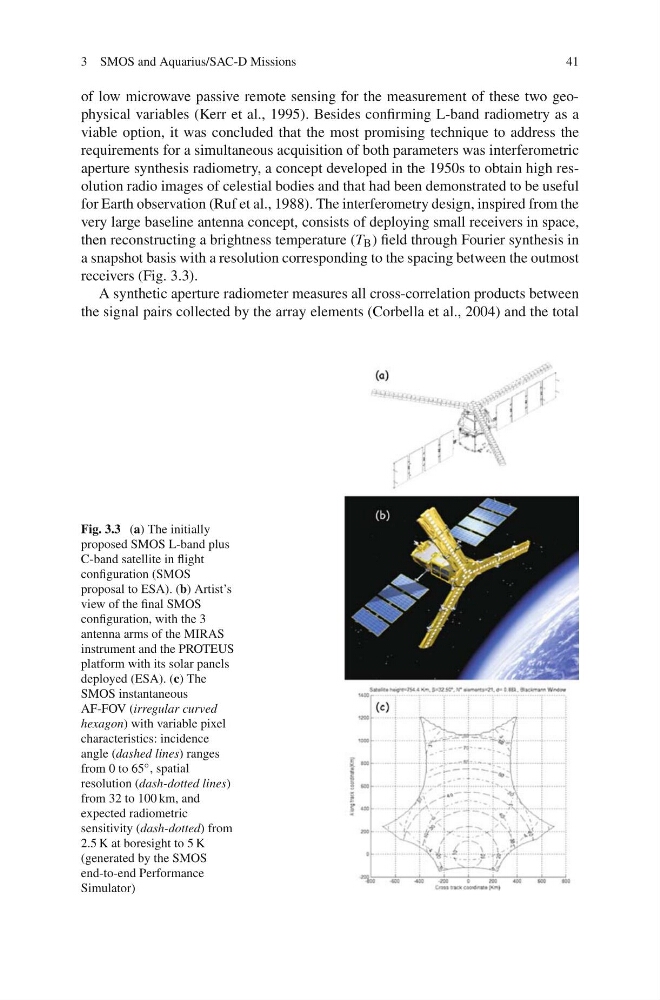
receivers (Fig. 3.3).
A synthetic aperture radiometer measures all cross-correlation products between
the signal pairs collected by the array elements (Corbella et al., 2004) and the total
Fig. 3.3 (a) The initially
proposed SMOS L-band plus
C-band satellite in flight
configuration (SMOS
proposal to ESA). (b) Artist’s
view of the final SMOS
configuration, with the 3
antenna arms of the MIRAS
instrument and the PROTEUS
platform with its solar panels
deployed (ESA). (c) The
SMOS instantaneous
AF-FOV (irregular curved
hexagon) with variable pixel
characteristics: incidence
angle (dashed lines) ranges
from 0 to 65 ◦ , spatial
resolution (dash-dotted lines)
from 32 to 100 km, and
expected radiometric
sensitivity (dash-dotted) from
2.5 K at boresight to 5 K
(generated by the SMOS
end-to-end Performance
Simulator)
41
of low microwave passive remote sensing for the measurement of these two geophysical variables (Kerr et al., 1995). Besides confirming L-band radiometry as a
viable option, it was concluded that the most promising technique to address the
requirements for a simultaneous acquisition of both parameters was interferometric
aperture synthesis radiometry, a concept developed in the 1950s to obtain high resolution radio images of celestial bodies and that had been demonstrated to be useful
for Earth observation (Ruf et al., 1988). The interferometry design, inspired from the
very large baseline antenna concept, consists of deploying small receivers in space,
then reconstructing a brightness temperature (T B ) field through Fourier synthesis in
a snapshot basis with a resolution corresponding to the spacing between the outmost
receivers (Fig. 3.3).
A synthetic aperture radiometer measures all cross-correlation products between
the signal pairs collected by the array elements (Corbella et al., 2004) and the total
Fig. 3.3 (a) The initially
proposed SMOS L-band plus
C-band satellite in flight
configuration (SMOS
proposal to ESA). (b) Artist’s
view of the final SMOS
configuration, with the 3
antenna arms of the MIRAS
instrument and the PROTEUS
platform with its solar panels
deployed (ESA). (c) The
SMOS instantaneous
AF-FOV (irregular curved
hexagon) with variable pixel
characteristics: incidence
angle (dashed lines) ranges
from 0 to 65 ◦ , spatial
resolution (dash-dotted lines)
from 32 to 100 km, and
expected radiometric
sensitivity (dash-dotted) from
2.5 K at boresight to 5 K
(generated by the SMOS
end-to-end Performance
Simulator)