

20
C.L. Gentemann et al.
2.4 Retrieval Algorithm
Geophysical retrievals from PMW radiometers are commonly determined using
a radiative transfer model to derive a regression algorithm (Wentz and Meissner,
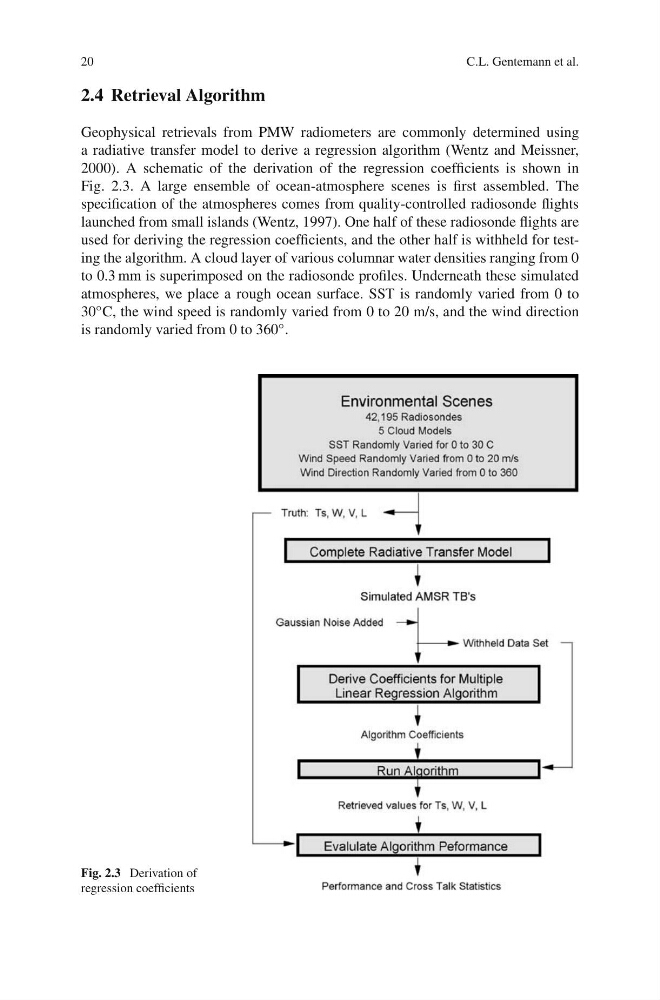
2000). A schematic of the derivation of the regression coefficients is shown in
Fig. 2.3. A large ensemble of ocean-atmosphere scenes is first assembled. The
specification of the atmospheres comes from quality-controlled radiosonde flights
launched from small islands (Wentz, 1997). One half of these radiosonde flights are
used for deriving the regression coefficients, and the other half is withheld for testing the algorithm. A cloud layer of various columnar water densities ranging from 0
to 0.3 mm is superimposed on the radiosonde profiles. Underneath these simulated
atmospheres, we place a rough ocean surface. SST is randomly varied from 0 to
30 ◦ C, the wind speed is randomly varied from 0 to 20 m/s, and the wind direction
is randomly varied from 0 to 360 ◦ .
Fig. 2.3 Derivation of
regression coefficients
C.L. Gentemann et al.
2.4 Retrieval Algorithm
Geophysical retrievals from PMW radiometers are commonly determined using
a radiative transfer model to derive a regression algorithm (Wentz and Meissner,
2000). A schematic of the derivation of the regression coefficients is shown in
Fig. 2.3. A large ensemble of ocean-atmosphere scenes is first assembled. The
specification of the atmospheres comes from quality-controlled radiosonde flights
launched from small islands (Wentz, 1997). One half of these radiosonde flights are
used for deriving the regression coefficients, and the other half is withheld for testing the algorithm. A cloud layer of various columnar water densities ranging from 0
to 0.3 mm is superimposed on the radiosonde profiles. Underneath these simulated
atmospheres, we place a rough ocean surface. SST is randomly varied from 0 to
30 ◦ C, the wind speed is randomly varied from 0 to 20 m/s, and the wind direction
is randomly varied from 0 to 360 ◦ .
Fig. 2.3 Derivation of
regression coefficients