

290
H.R. Gordon
Probably the most important event in establishing the potential of ocean color
observations, and leading directly to CZCS, was the work of Clarke et al. (1970).
They used a spectroradiometer mounted on an airplane to measure the radiance
backscattered from the water, and the intervening atmosphere, off Georges Bank at
an altitude of 305 m. Contemporaneous measurements of the chlorophyll a concentration were made in the surface waters along the airplane’s flight track. The results
provided a clear indication that the modification to the spectrum of upwelling radiance by chlorophyll variations, over the range 0.1–3.0 mg/m 3 , could be observed at
aircraft altitudes. The authors also pointed out that backscattering from the atmosphere between the sensor and the surface added light that seriously degraded the
quality of the spectra. Referring to such “air light,” they stated at the close of their
paper: “If such interference can be eliminated or identified and allowed for, spectroscopic procedures from aircraft (and perhaps from satellites) will be of great value
in the rapid investigation of oceanic conditions, including conditions important for
biological productivity.”
This work initiated several studies in which aircraft measurements of color were
combined with surface radiometry, further demonstrating the potential of ocean
color remote sensing, and resulting in the approval of the CZCS in 1973. Although
the experiments did confirm the serious degrading effect on the apparent color of the
water by the intervening atmosphere on aircraft spectra, insufficient data were collected for development of analysis algorithms. The development of such algorithms
became the first task of the CZCS Experiment Team.
17.2 The CZCS Nimbus Experiment Team (NET)
The CZCS Nimbus Experiment Team (NET) was formed in mid-1975 based on
competitive proposals for membership. Its primary responsibility in the prelaunch
era was to develop algorithms for the processing of CZCS imagery. The team
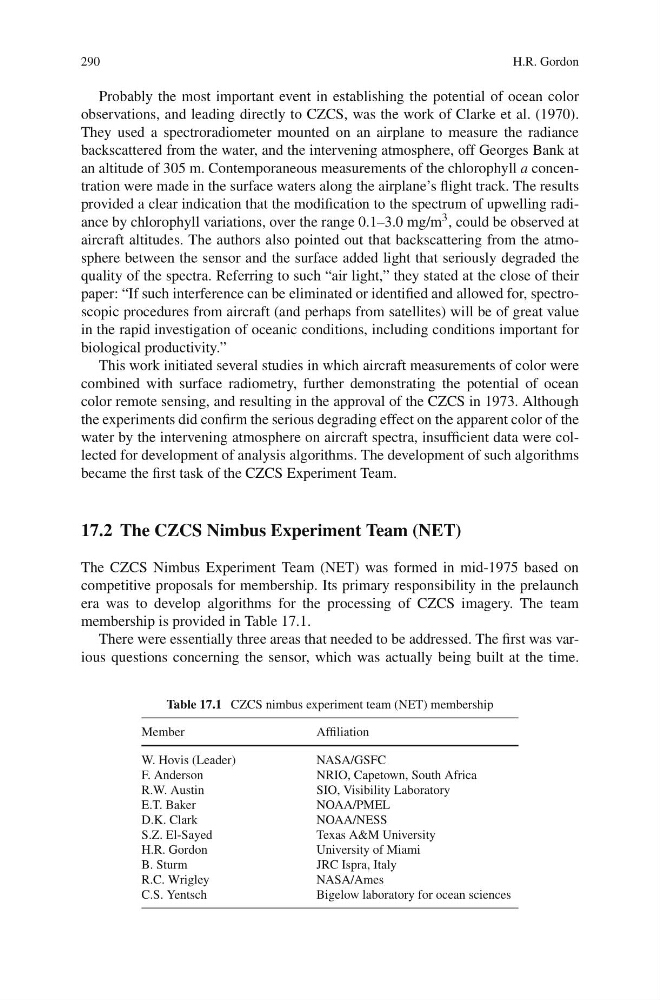
membership is provided in Table 17.1.
There were essentially three areas that needed to be addressed. The first was various questions concerning the sensor, which was actually being built at the time.
Table 17.1 CZCS nimbus experiment team (NET) membership
Member
Affiliation
W. Hovis (Leader)
NASA/GSFC
F. Anderson
NRIO, Capetown, South Africa
R.W. Austin
SIO, Visibility Laboratory
E.T. Baker
NOAA/PMEL
D.K. Clark
NOAA/NESS
S.Z. El-Sayed
Texas A&M University
H.R. Gordon
University of Miami
B. Sturm
JRC Ispra, Italy
R.C. Wrigley
NASA/Ames
C.S. Yentsch
Bigelow laboratory for ocean sciences
H.R. Gordon
Probably the most important event in establishing the potential of ocean color
observations, and leading directly to CZCS, was the work of Clarke et al. (1970).
They used a spectroradiometer mounted on an airplane to measure the radiance
backscattered from the water, and the intervening atmosphere, off Georges Bank at
an altitude of 305 m. Contemporaneous measurements of the chlorophyll a concentration were made in the surface waters along the airplane’s flight track. The results
provided a clear indication that the modification to the spectrum of upwelling radiance by chlorophyll variations, over the range 0.1–3.0 mg/m 3 , could be observed at
aircraft altitudes. The authors also pointed out that backscattering from the atmosphere between the sensor and the surface added light that seriously degraded the
quality of the spectra. Referring to such “air light,” they stated at the close of their
paper: “If such interference can be eliminated or identified and allowed for, spectroscopic procedures from aircraft (and perhaps from satellites) will be of great value
in the rapid investigation of oceanic conditions, including conditions important for
biological productivity.”
This work initiated several studies in which aircraft measurements of color were
combined with surface radiometry, further demonstrating the potential of ocean
color remote sensing, and resulting in the approval of the CZCS in 1973. Although
the experiments did confirm the serious degrading effect on the apparent color of the
water by the intervening atmosphere on aircraft spectra, insufficient data were collected for development of analysis algorithms. The development of such algorithms
became the first task of the CZCS Experiment Team.
17.2 The CZCS Nimbus Experiment Team (NET)
The CZCS Nimbus Experiment Team (NET) was formed in mid-1975 based on
competitive proposals for membership. Its primary responsibility in the prelaunch
era was to develop algorithms for the processing of CZCS imagery. The team
membership is provided in Table 17.1.
There were essentially three areas that needed to be addressed. The first was various questions concerning the sensor, which was actually being built at the time.
Table 17.1 CZCS nimbus experiment team (NET) membership
Member
Affiliation
W. Hovis (Leader)
NASA/GSFC
F. Anderson
NRIO, Capetown, South Africa
R.W. Austin
SIO, Visibility Laboratory
E.T. Baker
NOAA/PMEL
D.K. Clark
NOAA/NESS
S.Z. El-Sayed
Texas A&M University
H.R. Gordon
University of Miami
B. Sturm
JRC Ispra, Italy
R.C. Wrigley
NASA/Ames
C.S. Yentsch
Bigelow laboratory for ocean sciences