

16 The Past, Present, and Future of the AVHRR Pathfinder SST Program
275
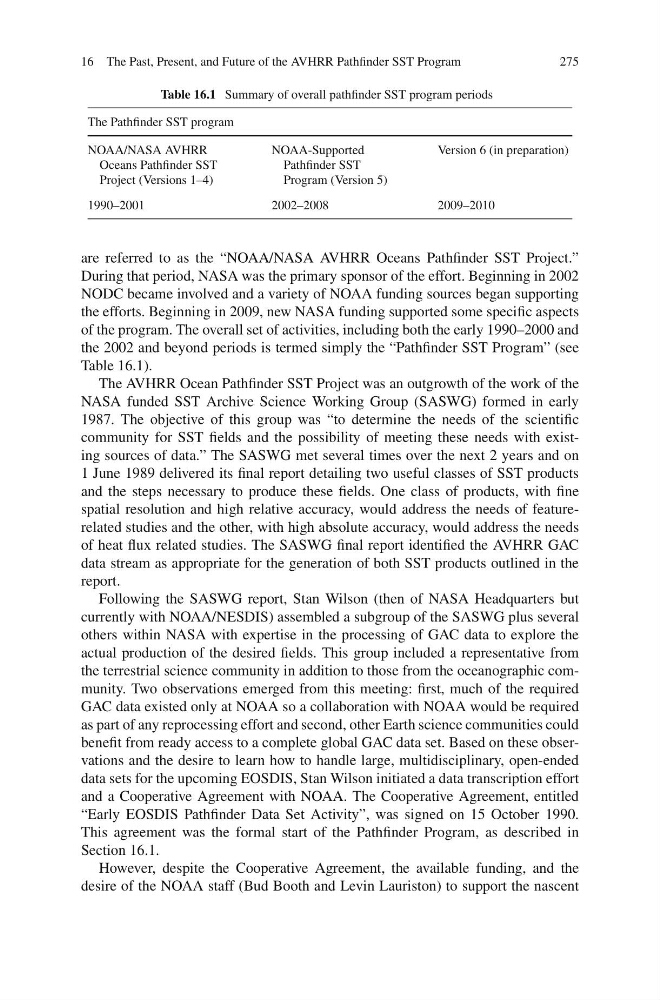
Table 16.1 Summary of overall pathfinder SST program periods
The Pathfinder SST program
NOAA/NASA AVHRR
Oceans Pathfinder SST
Project (Versions 1–4)
NOAA-Supported
Pathfinder SST
Program (Version 5)
Version 6 (in preparation)
1990–2001
2002–2008
2009–2010
are referred to as the “NOAA/NASA AVHRR Oceans Pathfinder SST Project.”
During that period, NASA was the primary sponsor of the effort. Beginning in 2002
NODC became involved and a variety of NOAA funding sources began supporting
the efforts. Beginning in 2009, new NASA funding supported some specific aspects
of the program. The overall set of activities, including both the early 1990–2000 and
the 2002 and beyond periods is termed simply the “Pathfinder SST Program” (see
Table 16.1).
The AVHRR Ocean Pathfinder SST Project was an outgrowth of the work of the
NASA funded SST Archive Science Working Group (SASWG) formed in early
1987. The objective of this group was “to determine the needs of the scientific
community for SST fields and the possibility of meeting these needs with existing sources of data.” The SASWG met several times over the next 2 years and on
1 June 1989 delivered its final report detailing two useful classes of SST products
and the steps necessary to produce these fields. One class of products, with fine
spatial resolution and high relative accuracy, would address the needs of featurerelated studies and the other, with high absolute accuracy, would address the needs
of heat flux related studies. The SASWG final report identified the AVHRR GAC
data stream as appropriate for the generation of both SST products outlined in the
report.
Following the SASWG report, Stan Wilson (then of NASA Headquarters but
currently with NOAA/NESDIS) assembled a subgroup of the SASWG plus several
others within NASA with expertise in the processing of GAC data to explore the
actual production of the desired fields. This group included a representative from
the terrestrial science community in addition to those from the oceanographic community. Two observations emerged from this meeting: first, much of the required
GAC data existed only at NOAA so a collaboration with NOAA would be required
as part of any reprocessing effort and second, other Earth science communities could
benefit from ready access to a complete global GAC data set. Based on these observations and the desire to learn how to handle large, multidisciplinary, open-ended
data sets for the upcoming EOSDIS, Stan Wilson initiated a data transcription effort
and a Cooperative Agreement with NOAA. The Cooperative Agreement, entitled
“Early EOSDIS Pathfinder Data Set Activity”, was signed on 15 October 1990.
This agreement was the formal start of the Pathfinder Program, as described in
Section 16.1.
However, despite the Cooperative Agreement, the available funding, and the
desire of the NOAA staff (Bud Booth and Levin Lauriston) to support the nascent
275
Table 16.1 Summary of overall pathfinder SST program periods
The Pathfinder SST program
NOAA/NASA AVHRR
Oceans Pathfinder SST
Project (Versions 1–4)
NOAA-Supported
Pathfinder SST
Program (Version 5)
Version 6 (in preparation)
1990–2001
2002–2008
2009–2010
are referred to as the “NOAA/NASA AVHRR Oceans Pathfinder SST Project.”
During that period, NASA was the primary sponsor of the effort. Beginning in 2002
NODC became involved and a variety of NOAA funding sources began supporting
the efforts. Beginning in 2009, new NASA funding supported some specific aspects
of the program. The overall set of activities, including both the early 1990–2000 and
the 2002 and beyond periods is termed simply the “Pathfinder SST Program” (see
Table 16.1).
The AVHRR Ocean Pathfinder SST Project was an outgrowth of the work of the
NASA funded SST Archive Science Working Group (SASWG) formed in early
1987. The objective of this group was “to determine the needs of the scientific
community for SST fields and the possibility of meeting these needs with existing sources of data.” The SASWG met several times over the next 2 years and on
1 June 1989 delivered its final report detailing two useful classes of SST products
and the steps necessary to produce these fields. One class of products, with fine
spatial resolution and high relative accuracy, would address the needs of featurerelated studies and the other, with high absolute accuracy, would address the needs
of heat flux related studies. The SASWG final report identified the AVHRR GAC
data stream as appropriate for the generation of both SST products outlined in the
report.
Following the SASWG report, Stan Wilson (then of NASA Headquarters but
currently with NOAA/NESDIS) assembled a subgroup of the SASWG plus several
others within NASA with expertise in the processing of GAC data to explore the
actual production of the desired fields. This group included a representative from
the terrestrial science community in addition to those from the oceanographic community. Two observations emerged from this meeting: first, much of the required
GAC data existed only at NOAA so a collaboration with NOAA would be required
as part of any reprocessing effort and second, other Earth science communities could
benefit from ready access to a complete global GAC data set. Based on these observations and the desire to learn how to handle large, multidisciplinary, open-ended
data sets for the upcoming EOSDIS, Stan Wilson initiated a data transcription effort
and a Cooperative Agreement with NOAA. The Cooperative Agreement, entitled
“Early EOSDIS Pathfinder Data Set Activity”, was signed on 15 October 1990.
This agreement was the formal start of the Pathfinder Program, as described in
Section 16.1.
However, despite the Cooperative Agreement, the available funding, and the
desire of the NOAA staff (Bud Booth and Levin Lauriston) to support the nascent