

15 Use of TIR from Space in Operational Systems
265
15.9.2 TIR Requirements
The quality of the coupled models used for seasonal and interannual forecasting has
reached the stage where they are now sensitive to the quality of the initial conditions.
It is therefore important to have SST analyses that are unbiased, accurate and stable over time-scales of years to weeks, especially in the tropics. Ships and moored
and drifting buoys provide observations of good temporal frequency and acceptable
accuracy, but coverage is marginal or worse over large areas of the Earth. There is a
WMO goal requirement for high quality, fast delivery bulk SST (ideally with accuracy <0.1 ◦ C on the 100 km spatial scale and <0.25 ◦ C on the 10 km spatial scale,
available within 24 h. 12
15.10 Summary of TIR Requirements
Operational systems require timely, accurate, reliable and robust SST level 2, 3 and
4 products in consistent, well-described formats. The specific requirements of each
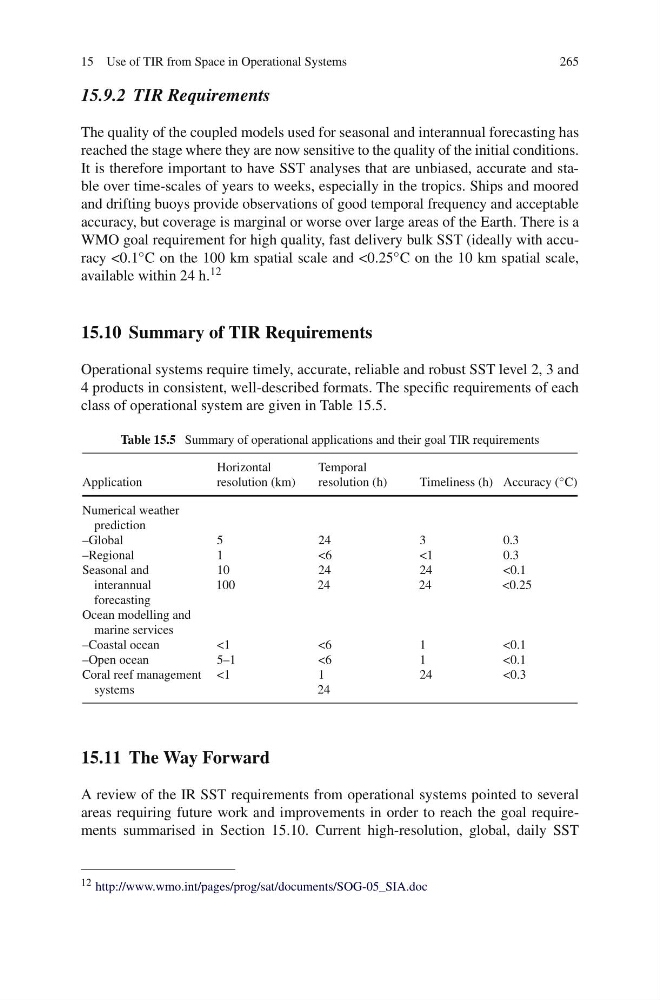
class of operational system are given in Table 15.5.
Table 15.5 Summary of operational applications and their goal TIR requirements
Application
Horizontal
resolution (km)
Temporal
resolution (h)
Timeliness (h) Accuracy ( ◦ C)
Numerical weather
prediction
–Global
5
24
3
0.3
–Regional
1
<6
<1
0.3
Seasonal and
interannual
forecasting
10
100
24
24
24
24
<0.1
<0.25
Ocean modelling and
marine services
–Coastal ocean
<1
<6
1
<0.1
–Open ocean
5–1
<6
1
<0.1
Coral reef management
systems
<1
1
24
24
<0.3
15.11 The Way Forward
A review of the IR SST requirements from operational systems pointed to several
areas requiring future work and improvements in order to reach the goal requirements summarised in Section 15.10. Current high-resolution, global, daily SST
12 http://www.wmo.int/pages/prog/sat/documents/SOG-05_SIA.doc
265
15.9.2 TIR Requirements
The quality of the coupled models used for seasonal and interannual forecasting has
reached the stage where they are now sensitive to the quality of the initial conditions.
It is therefore important to have SST analyses that are unbiased, accurate and stable over time-scales of years to weeks, especially in the tropics. Ships and moored
and drifting buoys provide observations of good temporal frequency and acceptable
accuracy, but coverage is marginal or worse over large areas of the Earth. There is a
WMO goal requirement for high quality, fast delivery bulk SST (ideally with accuracy <0.1 ◦ C on the 100 km spatial scale and <0.25 ◦ C on the 10 km spatial scale,
available within 24 h. 12
15.10 Summary of TIR Requirements
Operational systems require timely, accurate, reliable and robust SST level 2, 3 and
4 products in consistent, well-described formats. The specific requirements of each
class of operational system are given in Table 15.5.
Table 15.5 Summary of operational applications and their goal TIR requirements
Application
Horizontal
resolution (km)
Temporal
resolution (h)
Timeliness (h) Accuracy ( ◦ C)
Numerical weather
prediction
–Global
5
24
3
0.3
–Regional
1
<6
<1
0.3
Seasonal and
interannual
forecasting
10
100
24
24
24
24
<0.1
<0.25
Ocean modelling and
marine services
–Coastal ocean
<1
<6
1
<0.1
–Open ocean
5–1
<6
1
<0.1
Coral reef management
systems
<1
1
24
24
<0.3
15.11 The Way Forward
A review of the IR SST requirements from operational systems pointed to several
areas requiring future work and improvements in order to reach the goal requirements summarised in Section 15.10. Current high-resolution, global, daily SST
12 http://www.wmo.int/pages/prog/sat/documents/SOG-05_SIA.doc