

230
P.J. Minnett
which is measured by in-situ thermometers below the surface. The near-surface temperature gradients result from three distinct processes: the absorption of insolation,
the heat exchange with the atmosphere and levels of subsurface turbulent mixing. In
conditions of low wind speed, the heat generated in the upper ocean by the absorption of solar radiation is not well mixed through the surface layer, but causes thermal
stratification with temperature differences between the uppermost layer of the ocean
and the water below. There is a strong diurnal component to the magnitude of these
temperature gradients, as well as a dependence on cloud cover, which modulates the
insolation, and, importantly, wind speed which influences the turbulent mixing (e.g.
Price et al., 1986; Fairall et al., 1996; Gentemann and Minnett, 2008).
The surface, skin layer of the ocean, much less than 1 mm thick (Hanafin, 2002;
Hanafin and Minnett, 2001), is nearly always cooler than the underlying water
because the heat flux is nearly always from the ocean to the atmosphere. The heat
flow, supplying energy for both the turbulent and radiant heat loss to the atmosphere, is accomplished by molecular conduction through the aqueous side of the
interface and this is associated with a temperature gradient in the surface skin layer.
The relationship between skin and bulk SSTs just below the surface (at ∼5 cm) is
reasonably well behaved (Minnett et al., 2010). The relationship with deeper bulk
temperature, at depths of a few meters where many bulk SST measurements are
taken, is the same on average during the night, and during the day for wind speed
conditions of >∼6 m/s (Donlon et al., 2002). But under low winds the relationship is
very variable – vertically, horizontally and temporally (Minnett, 2003; Ward, 2006).
The difference between the skin temperature and that measured by a bulk, in-situ
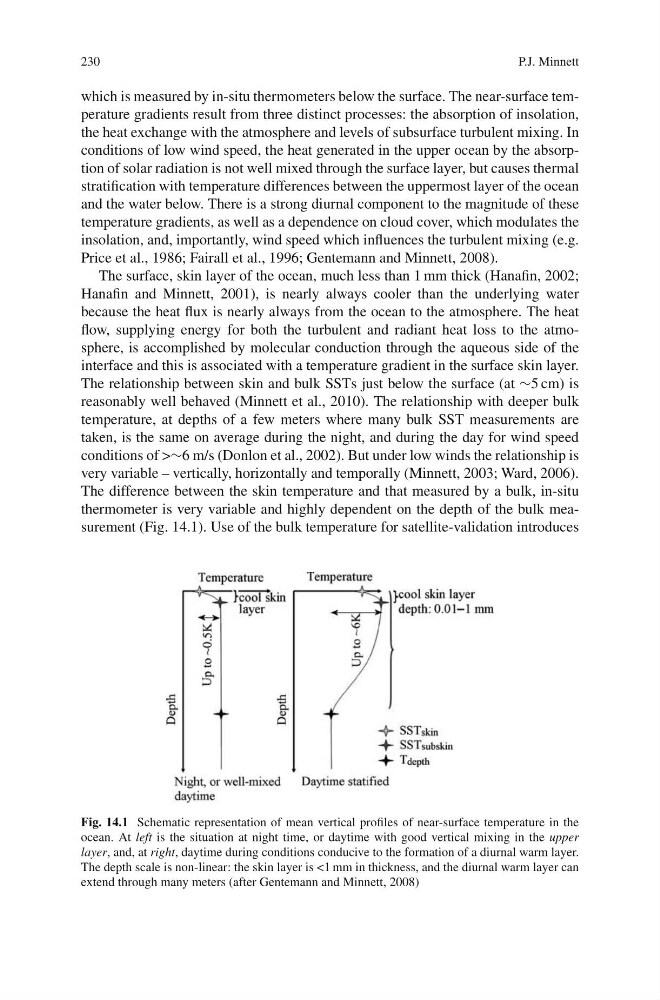
thermometer is very variable and highly dependent on the depth of the bulk measurement (Fig. 14.1). Use of the bulk temperature for satellite-validation introduces
Fig. 14.1 Schematic representation of mean vertical profiles of near-surface temperature in the
ocean. At left is the situation at night time, or daytime with good vertical mixing in the upper
layer, and, at right, daytime during conditions conducive to the formation of a diurnal warm layer.
The depth scale is non-linear: the skin layer is <1 mm in thickness, and the diurnal warm layer can
extend through many meters (after Gentemann and Minnett, 2008)
P.J. Minnett
which is measured by in-situ thermometers below the surface. The near-surface temperature gradients result from three distinct processes: the absorption of insolation,
the heat exchange with the atmosphere and levels of subsurface turbulent mixing. In
conditions of low wind speed, the heat generated in the upper ocean by the absorption of solar radiation is not well mixed through the surface layer, but causes thermal
stratification with temperature differences between the uppermost layer of the ocean
and the water below. There is a strong diurnal component to the magnitude of these
temperature gradients, as well as a dependence on cloud cover, which modulates the
insolation, and, importantly, wind speed which influences the turbulent mixing (e.g.
Price et al., 1986; Fairall et al., 1996; Gentemann and Minnett, 2008).
The surface, skin layer of the ocean, much less than 1 mm thick (Hanafin, 2002;
Hanafin and Minnett, 2001), is nearly always cooler than the underlying water
because the heat flux is nearly always from the ocean to the atmosphere. The heat
flow, supplying energy for both the turbulent and radiant heat loss to the atmosphere, is accomplished by molecular conduction through the aqueous side of the
interface and this is associated with a temperature gradient in the surface skin layer.
The relationship between skin and bulk SSTs just below the surface (at ∼5 cm) is
reasonably well behaved (Minnett et al., 2010). The relationship with deeper bulk
temperature, at depths of a few meters where many bulk SST measurements are
taken, is the same on average during the night, and during the day for wind speed
conditions of >∼6 m/s (Donlon et al., 2002). But under low winds the relationship is
very variable – vertically, horizontally and temporally (Minnett, 2003; Ward, 2006).
The difference between the skin temperature and that measured by a bulk, in-situ
thermometer is very variable and highly dependent on the depth of the bulk measurement (Fig. 14.1). Use of the bulk temperature for satellite-validation introduces
Fig. 14.1 Schematic representation of mean vertical profiles of near-surface temperature in the
ocean. At left is the situation at night time, or daytime with good vertical mixing in the upper
layer, and, at right, daytime during conditions conducive to the formation of a diurnal warm layer.
The depth scale is non-linear: the skin layer is <1 mm in thickness, and the diurnal warm layer can
extend through many meters (after Gentemann and Minnett, 2008)