

206
P. Cipollini et al.
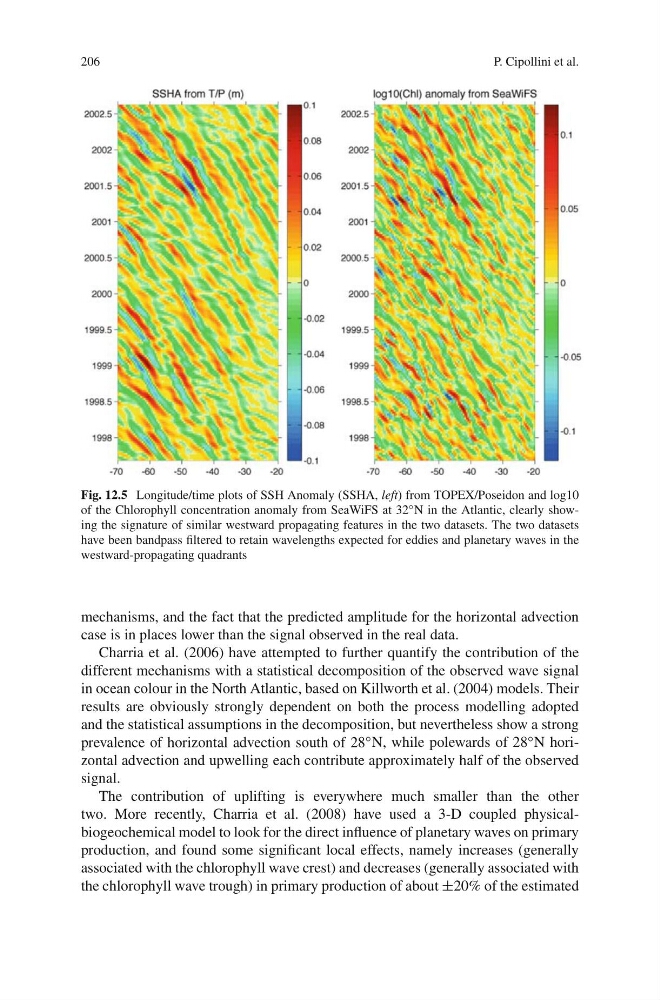
Fig. 12.5 Longitude/time plots of SSH Anomaly (SSHA, left) from TOPEX/Poseidon and log10
of the Chlorophyll concentration anomaly from SeaWiFS at 32 ◦ N in the Atlantic, clearly showing the signature of similar westward propagating features in the two datasets. The two datasets
have been bandpass filtered to retain wavelengths expected for eddies and planetary waves in the
westward-propagating quadrants
mechanisms, and the fact that the predicted amplitude for the horizontal advection
case is in places lower than the signal observed in the real data.
Charria et al. (2006) have attempted to further quantify the contribution of the
different mechanisms with a statistical decomposition of the observed wave signal
in ocean colour in the North Atlantic, based on Killworth et al. (2004) models. Their
results are obviously strongly dependent on both the process modelling adopted
and the statistical assumptions in the decomposition, but nevertheless show a strong
prevalence of horizontal advection south of 28 ◦ N, while polewards of 28 ◦ N horizontal advection and upwelling each contribute approximately half of the observed
signal.
The contribution of uplifting is everywhere much smaller than the other
two. More recently, Charria et al. (2008) have used a 3-D coupled physicalbiogeochemical model to look for the direct influence of planetary waves on primary
production, and found some significant local effects, namely increases (generally
associated with the chlorophyll wave crest) and decreases (generally associated with
the chlorophyll wave trough) in primary production of about ±20% of the estimated
P. Cipollini et al.
Fig. 12.5 Longitude/time plots of SSH Anomaly (SSHA, left) from TOPEX/Poseidon and log10
of the Chlorophyll concentration anomaly from SeaWiFS at 32 ◦ N in the Atlantic, clearly showing the signature of similar westward propagating features in the two datasets. The two datasets
have been bandpass filtered to retain wavelengths expected for eddies and planetary waves in the
westward-propagating quadrants
mechanisms, and the fact that the predicted amplitude for the horizontal advection
case is in places lower than the signal observed in the real data.
Charria et al. (2006) have attempted to further quantify the contribution of the
different mechanisms with a statistical decomposition of the observed wave signal
in ocean colour in the North Atlantic, based on Killworth et al. (2004) models. Their
results are obviously strongly dependent on both the process modelling adopted
and the statistical assumptions in the decomposition, but nevertheless show a strong
prevalence of horizontal advection south of 28 ◦ N, while polewards of 28 ◦ N horizontal advection and upwelling each contribute approximately half of the observed
signal.
The contribution of uplifting is everywhere much smaller than the other
two. More recently, Charria et al. (2008) have used a 3-D coupled physicalbiogeochemical model to look for the direct influence of planetary waves on primary
production, and found some significant local effects, namely increases (generally
associated with the chlorophyll wave crest) and decreases (generally associated with
the chlorophyll wave trough) in primary production of about ±20% of the estimated