

12 Oceanic Planetary Waves and Eddies
201
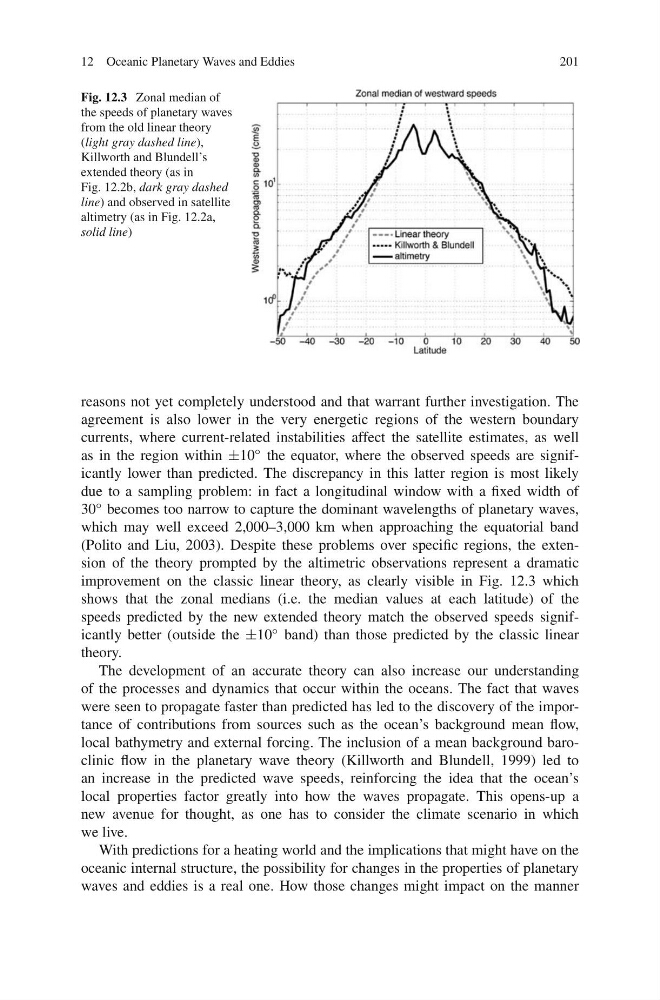
Fig. 12.3 Zonal median of
the speeds of planetary waves
from the old linear theory
(light gray dashed line),
Killworth and Blundell’s
extended theory (as in
Fig. 12.2b, dark gray dashed
line) and observed in satellite
altimetry (as in Fig. 12.2a,
solid line)
reasons not yet completely understood and that warrant further investigation. The
agreement is also lower in the very energetic regions of the western boundary
currents, where current-related instabilities affect the satellite estimates, as well
as in the region within ±10 ◦ the equator, where the observed speeds are significantly lower than predicted. The discrepancy in this latter region is most likely
due to a sampling problem: in fact a longitudinal window with a fixed width of
30 ◦ becomes too narrow to capture the dominant wavelengths of planetary waves,
which may well exceed 2,000–3,000 km when approaching the equatorial band
(Polito and Liu, 2003). Despite these problems over specific regions, the extension of the theory prompted by the altimetric observations represent a dramatic
improvement on the classic linear theory, as clearly visible in Fig. 12.3 which
shows that the zonal medians (i.e. the median values at each latitude) of the
speeds predicted by the new extended theory match the observed speeds significantly better (outside the ±10 ◦ band) than those predicted by the classic linear
theory.
The development of an accurate theory can also increase our understanding
of the processes and dynamics that occur within the oceans. The fact that waves
were seen to propagate faster than predicted has led to the discovery of the importance of contributions from sources such as the ocean’s background mean flow,
local bathymetry and external forcing. The inclusion of a mean background baroclinic flow in the planetary wave theory (Killworth and Blundell, 1999) led to
an increase in the predicted wave speeds, reinforcing the idea that the ocean’s
local properties factor greatly into how the waves propagate. This opens-up a
new avenue for thought, as one has to consider the climate scenario in which
we live.
With predictions for a heating world and the implications that might have on the
oceanic internal structure, the possibility for changes in the properties of planetary
waves and eddies is a real one. How those changes might impact on the manner
201
Fig. 12.3 Zonal median of
the speeds of planetary waves
from the old linear theory
(light gray dashed line),
Killworth and Blundell’s
extended theory (as in
Fig. 12.2b, dark gray dashed
line) and observed in satellite
altimetry (as in Fig. 12.2a,
solid line)
reasons not yet completely understood and that warrant further investigation. The
agreement is also lower in the very energetic regions of the western boundary
currents, where current-related instabilities affect the satellite estimates, as well
as in the region within ±10 ◦ the equator, where the observed speeds are significantly lower than predicted. The discrepancy in this latter region is most likely
due to a sampling problem: in fact a longitudinal window with a fixed width of
30 ◦ becomes too narrow to capture the dominant wavelengths of planetary waves,
which may well exceed 2,000–3,000 km when approaching the equatorial band
(Polito and Liu, 2003). Despite these problems over specific regions, the extension of the theory prompted by the altimetric observations represent a dramatic
improvement on the classic linear theory, as clearly visible in Fig. 12.3 which
shows that the zonal medians (i.e. the median values at each latitude) of the
speeds predicted by the new extended theory match the observed speeds significantly better (outside the ±10 ◦ band) than those predicted by the classic linear
theory.
The development of an accurate theory can also increase our understanding
of the processes and dynamics that occur within the oceans. The fact that waves
were seen to propagate faster than predicted has led to the discovery of the importance of contributions from sources such as the ocean’s background mean flow,
local bathymetry and external forcing. The inclusion of a mean background baroclinic flow in the planetary wave theory (Killworth and Blundell, 1999) led to
an increase in the predicted wave speeds, reinforcing the idea that the ocean’s
local properties factor greatly into how the waves propagate. This opens-up a
new avenue for thought, as one has to consider the climate scenario in which
we live.
With predictions for a heating world and the implications that might have on the
oceanic internal structure, the possibility for changes in the properties of planetary
waves and eddies is a real one. How those changes might impact on the manner