

186
W.H.F. Smith
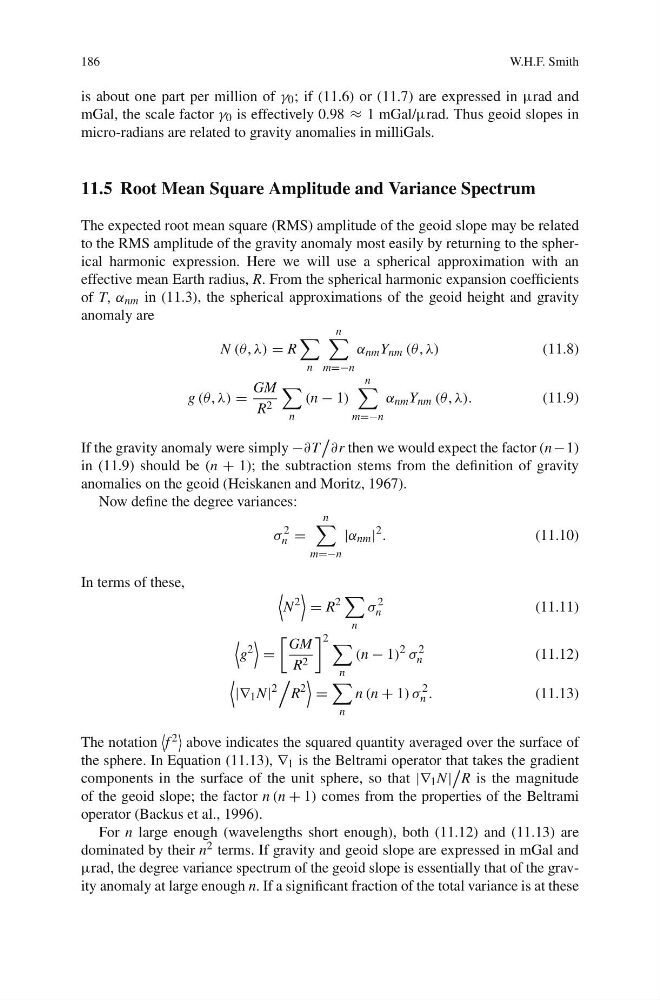
is about one part per million of γ 0 ; if (11.6) or (11.7) are expressed in μrad and
mGal, the scale factor γ 0 is effectively 0.98 ≈ 1 mGal/μrad. Thus geoid slopes in
micro-radians are related to gravity anomalies in milliGals.
11.5 Root Mean Square Amplitude and Variance Spectrum
The expected root mean square (RMS) amplitude of the geoid slope may be related
to the RMS amplitude of the gravity anomaly most easily by returning to the spherical harmonic expression. Here we will use a spherical approximation with an
effective mean Earth radius, R. From the spherical harmonic expansion coefficients
of T, α nm in (11.3), the spherical approximations of the geoid height and gravity
anomaly are
N (θ , λ) = R
n
n
m=−n
α nm Y nm (θ , λ)
(11.8)
g (θ , λ) =
GM
R 2
n
(n − 1)
n
m=−n
α nm Y nm (θ , λ).
(11.9)
If the gravity anomaly were simply −∂T
∂r then we would expect the factor (n−1)
in (11.9) should be (n + 1); the subtraction stems from the definition of gravity
anomalies on the geoid (Heiskanen and Moritz, 1967).
Now define the degree variances:
σ
2
n =
n
m=−n
|α nm |
2 .
(11.10)
In terms of these,
N
2
= R
2
n
σ
2
n
(11.11)
g
2
=
GM
R 2
2
n
(n − 1)
2
σ
2
n
(11.12)
|∇ 1 N|
2
R
2
=
n
n (n + 1) σ
2
n .
(11.13)
The notation
f 2
above indicates the squared quantity averaged over the surface of
the sphere. In Equation (11.13), ∇ 1 is the Beltrami operator that takes the gradient
components in the surface of the unit sphere, so that |∇ 1 N|
R is the magnitude
of the geoid slope; the factor n (n + 1) comes from the properties of the Beltrami
operator (Backus et al., 1996).
For n large enough (wavelengths short enough), both (11.12) and (11.13) are
dominated by their n 2 terms. If gravity and geoid slope are expressed in mGal and
μrad, the degree variance spectrum of the geoid slope is essentially that of the gravity anomaly at large enough n. If a significant fraction of the total variance is at these
W.H.F. Smith
is about one part per million of γ 0 ; if (11.6) or (11.7) are expressed in μrad and
mGal, the scale factor γ 0 is effectively 0.98 ≈ 1 mGal/μrad. Thus geoid slopes in
micro-radians are related to gravity anomalies in milliGals.
11.5 Root Mean Square Amplitude and Variance Spectrum
The expected root mean square (RMS) amplitude of the geoid slope may be related
to the RMS amplitude of the gravity anomaly most easily by returning to the spherical harmonic expression. Here we will use a spherical approximation with an
effective mean Earth radius, R. From the spherical harmonic expansion coefficients
of T, α nm in (11.3), the spherical approximations of the geoid height and gravity
anomaly are
N (θ , λ) = R
n
n
m=−n
α nm Y nm (θ , λ)
(11.8)
g (θ , λ) =
GM
R 2
n
(n − 1)
n
m=−n
α nm Y nm (θ , λ).
(11.9)
If the gravity anomaly were simply −∂T
∂r then we would expect the factor (n−1)
in (11.9) should be (n + 1); the subtraction stems from the definition of gravity
anomalies on the geoid (Heiskanen and Moritz, 1967).
Now define the degree variances:
σ
2
n =
n
m=−n
|α nm |
2 .
(11.10)
In terms of these,
N
2
= R
2
n
σ
2
n
(11.11)
g
2
=
GM
R 2
2
n
(n − 1)
2
σ
2
n
(11.12)
|∇ 1 N|
2
R
2
=
n
n (n + 1) σ
2
n .
(11.13)
The notation
f 2
above indicates the squared quantity averaged over the surface of
the sphere. In Equation (11.13), ∇ 1 is the Beltrami operator that takes the gradient
components in the surface of the unit sphere, so that |∇ 1 N|
R is the magnitude
of the geoid slope; the factor n (n + 1) comes from the properties of the Beltrami
operator (Backus et al., 1996).
For n large enough (wavelengths short enough), both (11.12) and (11.13) are
dominated by their n 2 terms. If gravity and geoid slope are expressed in mGal and
μrad, the degree variance spectrum of the geoid slope is essentially that of the gravity anomaly at large enough n. If a significant fraction of the total variance is at these