

184
W.H.F. Smith
coordinates in the east, north and upward directions, and assuming the sources of
the field are confined to the half-space z < 0, the potential may be written:
T (x,y,z) =
˜
T
0
(u,v) exp
i2π (ux + vy) − 2π z
u 2 + v 2
du dv.
(11.4)
In (11.4), u, v are spatial wavenumbers in the x and y directions with units of cycles
per length, and ˜
T 0 is the Fourier transform of T in the z = 0 plane.
Equations (11.3) and (11.4) are examples of solutions to boundary value problems for Laplace’s equation. Each of these equations includes a term that diminishes
the amplitude of T as one moves farther away from the source of the field. This
diminishing of the field as one moves away from the source is scale, or wavelength,
dependent in each case. This phenomenon is called “upward continuation”.
In (11.3), a component with spherical harmonic degree n is diminished by an
amount (a/r)
n when r > a. In (11.4), a component with wavenumber q =
√
u 2 + v 2
is diminished by an amount exp (−2πzq). The wavelength associated with q is
L = 1/q. The wavelength associated with a spherical harmonic of degree n is
L = 2π R
√
n (n + 1), where R is a mean radius for the Earth (Backus et al.,
1996). Expressing the upward continuation factors in terms of these wavelengths
the spherical and flat-Earth formulae give essentially the same results.
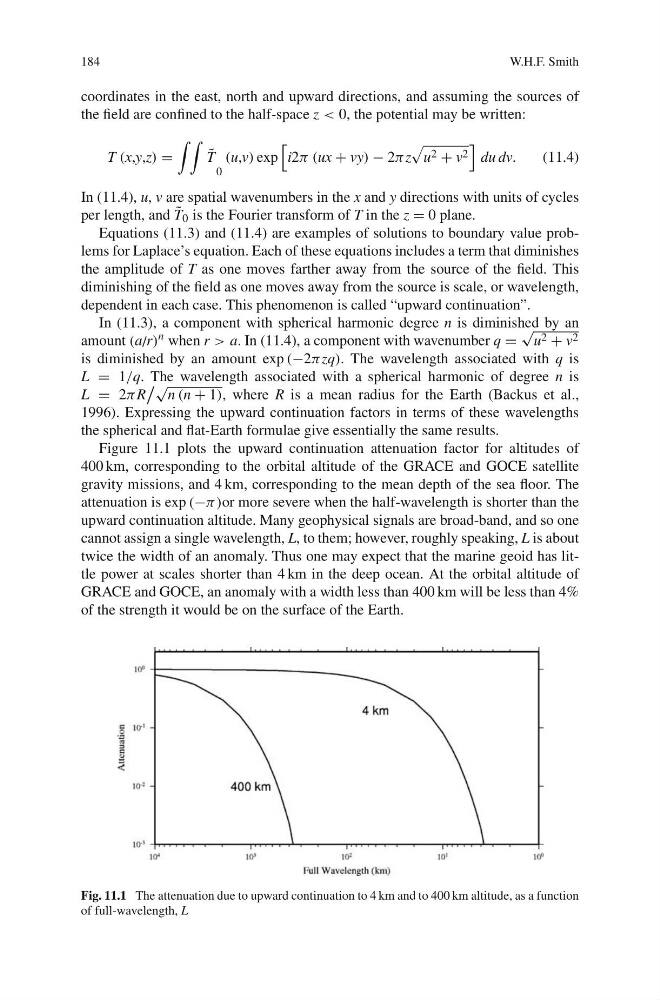
Figure 11.1 plots the upward continuation attenuation factor for altitudes of
400 km, corresponding to the orbital altitude of the GRACE and GOCE satellite
gravity missions, and 4 km, corresponding to the mean depth of the sea floor. The
attenuation is exp (−π )or more severe when the half-wavelength is shorter than the
upward continuation altitude. Many geophysical signals are broad-band, and so one
cannot assign a single wavelength, L, to them; however, roughly speaking, L is about
twice the width of an anomaly. Thus one may expect that the marine geoid has little power at scales shorter than 4 km in the deep ocean. At the orbital altitude of
GRACE and GOCE, an anomaly with a width less than 400 km will be less than 4%
of the strength it would be on the surface of the Earth.
Fig. 11.1 The attenuation due to upward continuation to 4 km and to 400 km altitude, as a function
of full-wavelength, L
W.H.F. Smith
coordinates in the east, north and upward directions, and assuming the sources of
the field are confined to the half-space z < 0, the potential may be written:
T (x,y,z) =
˜
T
0
(u,v) exp
i2π (ux + vy) − 2π z
u 2 + v 2
du dv.
(11.4)
In (11.4), u, v are spatial wavenumbers in the x and y directions with units of cycles
per length, and ˜
T 0 is the Fourier transform of T in the z = 0 plane.
Equations (11.3) and (11.4) are examples of solutions to boundary value problems for Laplace’s equation. Each of these equations includes a term that diminishes
the amplitude of T as one moves farther away from the source of the field. This
diminishing of the field as one moves away from the source is scale, or wavelength,
dependent in each case. This phenomenon is called “upward continuation”.
In (11.3), a component with spherical harmonic degree n is diminished by an
amount (a/r)
n when r > a. In (11.4), a component with wavenumber q =
√
u 2 + v 2
is diminished by an amount exp (−2πzq). The wavelength associated with q is
L = 1/q. The wavelength associated with a spherical harmonic of degree n is
L = 2π R
√
n (n + 1), where R is a mean radius for the Earth (Backus et al.,
1996). Expressing the upward continuation factors in terms of these wavelengths
the spherical and flat-Earth formulae give essentially the same results.
Figure 11.1 plots the upward continuation attenuation factor for altitudes of
400 km, corresponding to the orbital altitude of the GRACE and GOCE satellite
gravity missions, and 4 km, corresponding to the mean depth of the sea floor. The
attenuation is exp (−π )or more severe when the half-wavelength is shorter than the
upward continuation altitude. Many geophysical signals are broad-band, and so one
cannot assign a single wavelength, L, to them; however, roughly speaking, L is about
twice the width of an anomaly. Thus one may expect that the marine geoid has little power at scales shorter than 4 km in the deep ocean. At the orbital altitude of
GRACE and GOCE, an anomaly with a width less than 400 km will be less than 4%
of the strength it would be on the surface of the Earth.
Fig. 11.1 The attenuation due to upward continuation to 4 km and to 400 km altitude, as a function
of full-wavelength, L