

6 Scatterometer’s Unique Capability in Measuring Ocean Surface Stress
107
stress field that depends not only on the fast and large-scale atmospheric circulation
but also on the small scale and slow ocean processes as reflected in surface current
and temperature will enable new studies from new perspective in the near future.
6.6 Satellite Constellations
One polar-orbiting scatterometer at a low altitude (e.g. 800 km) orbit, can sample
at a location on Earth not more than two times a day. The temporal sampling may
not be sufficient to monitor wind/stress with high frequencies. Meso-scale weather
system, such as hurricane may be missed through orbit gaps. Additional instrument
flying in tandem will allow the description of higher temporal variability and the
reduction of the aliasing (bias introduced by sub-sampling) of the mean wind/stress,
as described by Lee and Liu (2005) in their study on the impact on ocean mixed
layer depth.
Besides QuikSCAT, there are two more scatterometers in operation. One is the
C-band and fan-beam ASCAT on board the Meteorological Operational Satellite
(METOP), launched in October 2006 by the European Space Agency. It has dual
swath separated by a broad nadir gap. The other is a Ku-band, pencil beam, conically
scanning scatterometer on Oceansat-2, launched in September 2009 by the Indian
Space Agency.
The local time of ascending node for the three scatterometers is 5:54 AM,
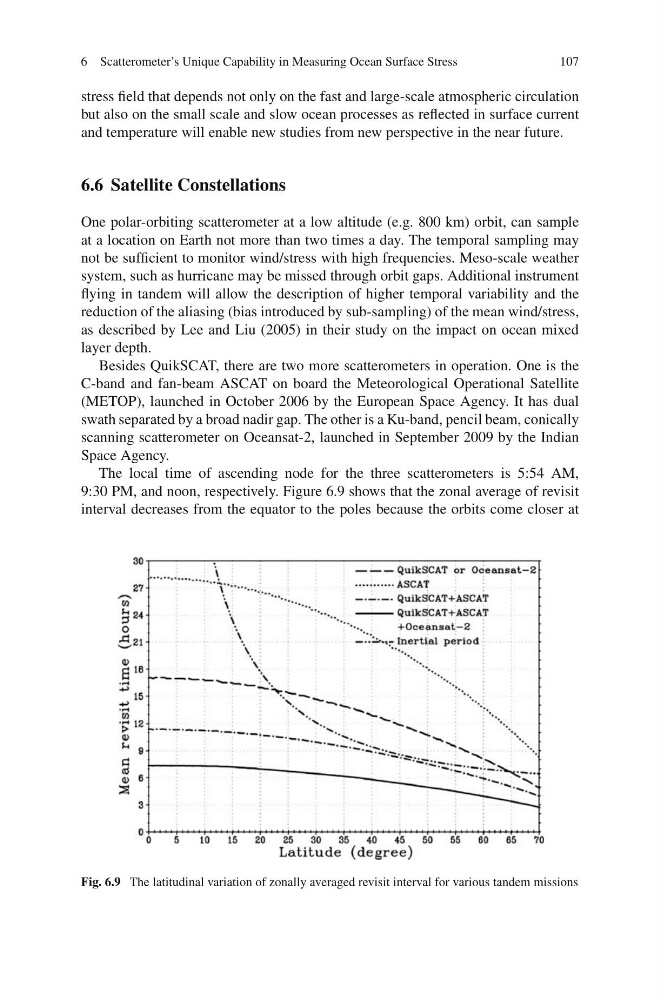
9:30 PM, and noon, respectively. Figure 6.9 shows that the zonal average of revisit
interval decreases from the equator to the poles because the orbits come closer at
Fig. 6.9 The latitudinal variation of zonally averaged revisit interval for various tandem missions
107
stress field that depends not only on the fast and large-scale atmospheric circulation
but also on the small scale and slow ocean processes as reflected in surface current
and temperature will enable new studies from new perspective in the near future.
6.6 Satellite Constellations
One polar-orbiting scatterometer at a low altitude (e.g. 800 km) orbit, can sample
at a location on Earth not more than two times a day. The temporal sampling may
not be sufficient to monitor wind/stress with high frequencies. Meso-scale weather
system, such as hurricane may be missed through orbit gaps. Additional instrument
flying in tandem will allow the description of higher temporal variability and the
reduction of the aliasing (bias introduced by sub-sampling) of the mean wind/stress,
as described by Lee and Liu (2005) in their study on the impact on ocean mixed
layer depth.
Besides QuikSCAT, there are two more scatterometers in operation. One is the
C-band and fan-beam ASCAT on board the Meteorological Operational Satellite
(METOP), launched in October 2006 by the European Space Agency. It has dual
swath separated by a broad nadir gap. The other is a Ku-band, pencil beam, conically
scanning scatterometer on Oceansat-2, launched in September 2009 by the Indian
Space Agency.
The local time of ascending node for the three scatterometers is 5:54 AM,
9:30 PM, and noon, respectively. Figure 6.9 shows that the zonal average of revisit
interval decreases from the equator to the poles because the orbits come closer at
Fig. 6.9 The latitudinal variation of zonally averaged revisit interval for various tandem missions