

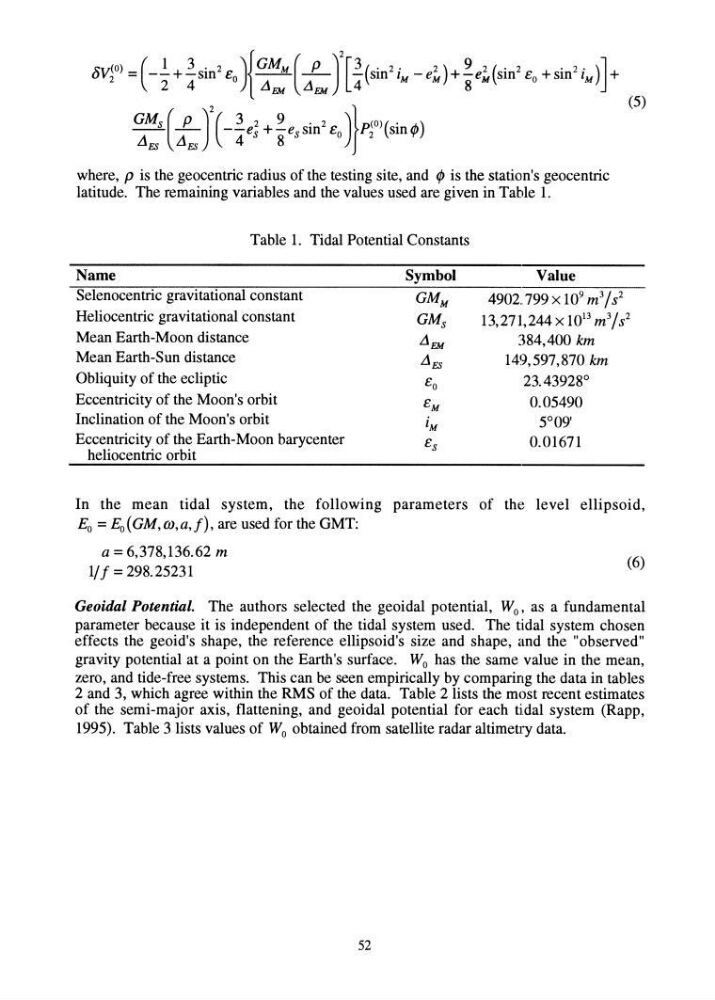
8~0) = (-.!.. + lsin 2 eo){GM M (L)2[1(sin2 iM - e~) + 2.e~(sin2 eo + sin 2 i M )] +
2 4
..1E\( ..1E\(
4
8
(5)
~s (:& J (-! e; +: essin' Eo )}p:O)(sin~)
where, p is the geocentric radius of the testing site, and l /J is the station's geocentric
latitude. The remaining variables and the values used are given in Table 1.
Table 1. Tidal Potential Constants
Name
Selenocentric gravitational constant
Heliocentric gravitational constant
Mean Earth-Moon distance
Mean Earth-Sun distance
Obliquity of the ecliptic
Eccentricity of the Moon's orbit
Inclination of the Moon's orbit
Eccentricity of the Earth-Moon barycenter
heliocentric orbit
In the mean tidal system, the following
Eo = Eo(GM,m,a,f), are used for the GMT:
a = 6,378,136.62 m
1/ f = 298.25231
Symbol
GM M
GM s
..1E\(
..1ES
eo
eM
iM
e s
Value
4902 . . 799 x 10 9 m 3 / S2
13,271,244 x 1013 m 3 / S2
384,400 km
149,597,870 km
23.43928°
0.05490
5°09'
0.01671
parameters of the level ellipsoid,
(6)
Geoidal Potential. The authors selected the geoidal potential, W o ' as a fundamental
parameter because it is independent of the tidal system used. The tidal system chosen
effects the geoid's shape, the reference ellipsoid's size and shape, and the "observed"
gravity potential at a point on the Earth's surface. Wo has the same value in the mean,
zero, and tide-free systems. This can be seen empirically by comparing the data in tables
2 and 3, which agree within the RMS of the data. Table 2 lists the most recent estimates
of the semi-major axis, flattening, and geoidal potential for each tidal system (Rapp,
1995). Table 3 lists values of Wo obtained from satellite radar altimetry data.
52
2 4
..1E\( ..1E\(
4
8
(5)
~s (:& J (-! e; +: essin' Eo )}p:O)(sin~)
where, p is the geocentric radius of the testing site, and l /J is the station's geocentric
latitude. The remaining variables and the values used are given in Table 1.
Table 1. Tidal Potential Constants
Name
Selenocentric gravitational constant
Heliocentric gravitational constant
Mean Earth-Moon distance
Mean Earth-Sun distance
Obliquity of the ecliptic
Eccentricity of the Moon's orbit
Inclination of the Moon's orbit
Eccentricity of the Earth-Moon barycenter
heliocentric orbit
In the mean tidal system, the following
Eo = Eo(GM,m,a,f), are used for the GMT:
a = 6,378,136.62 m
1/ f = 298.25231
Symbol
GM M
GM s
..1E\(
..1ES
eo
eM
iM
e s
Value
4902 . . 799 x 10 9 m 3 / S2
13,271,244 x 1013 m 3 / S2
384,400 km
149,597,870 km
23.43928°
0.05490
5°09'
0.01671
parameters of the level ellipsoid,
(6)
Geoidal Potential. The authors selected the geoidal potential, W o ' as a fundamental
parameter because it is independent of the tidal system used. The tidal system chosen
effects the geoid's shape, the reference ellipsoid's size and shape, and the "observed"
gravity potential at a point on the Earth's surface. Wo has the same value in the mean,
zero, and tide-free systems. This can be seen empirically by comparing the data in tables
2 and 3, which agree within the RMS of the data. Table 2 lists the most recent estimates
of the semi-major axis, flattening, and geoidal potential for each tidal system (Rapp,
1995). Table 3 lists values of Wo obtained from satellite radar altimetry data.
52