

~
~c::i
~8
a: .
o
Smith&Dahlen Limits
from CW Penod
o
0.121 0.138 0.152
c::i ~------~~----------~----------~------~
0.05
0.10
0.15
~ ~-------r----------------r ! ----------------~
I
o c::i
TI
ll ~
~
I
9~------~~----------~~~------~~----~
0.05
0.10
alpha (rad)
0.15
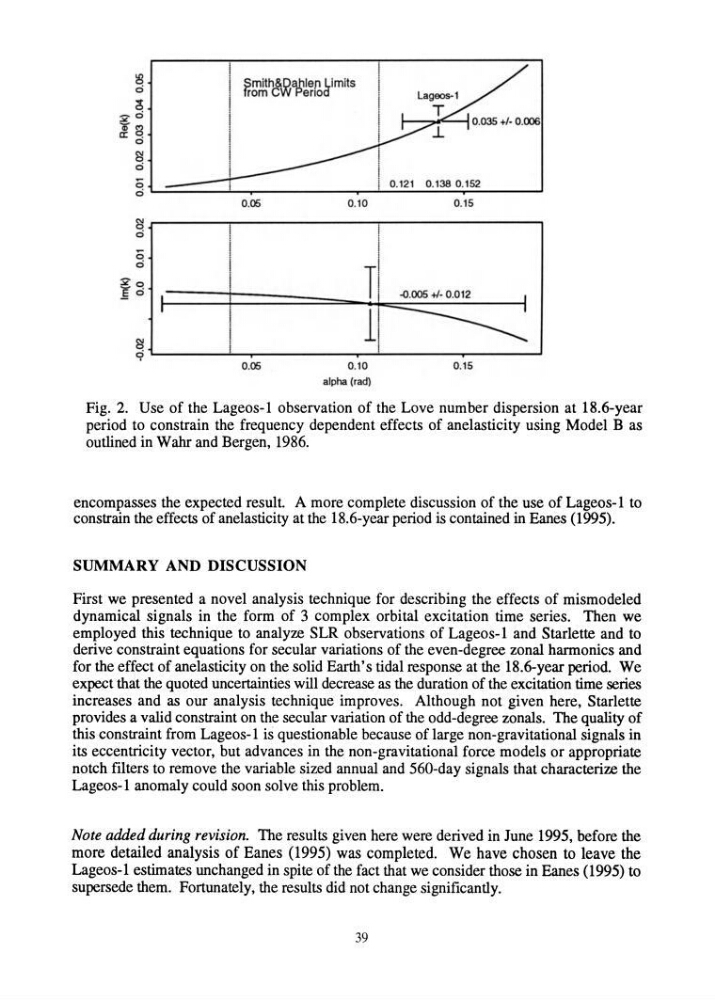
Fig. 2. Use of the Lageos-l observation of the Love number dispersion at 18.6-year
period to constrain the frequency dependent effects of anelasticity using Model B as
outlined in Wahr and Bergen, 1986.
encompasses the expected result. A more complete discussion of the use of Lageos-l to
constrain the effects of anelasticity at the 18.6-year period is contained in Eanes (1995).
SUMMARY AND DISCUSSION
First we presented a novel analysis technique for describing the effects of mismodeled
dynamical signals in the form of 3 complex orbital excitation time series. Then we
employed this technique to analyze SLR observations of Lageos-l and Starlette and to
derive constraint equations for secular variations of the even-degree zonal harmonics and
for the effect of anelasticity on the solid Earth's tidal response at the 18.6-year period. We
expect that the quoted uncertainties will decrease as the duration of the excitation time series
increases and as our analysis technique improves. Although not given here, Starlette
provides a valid constraint on the secular variation of the odd-degree zonals. The quality of
this constraint from Lageos-l is questionable because of large non-gravitational signals in
its eccentricity vector, but advances in the non-gravitational force models or appropriate
notch filters to remove the variable sized annual and 560-day signals that characterize the
Lageos-l anomaly could soon solve this problem.
Note added during revision. The results given here were derived in June 1995, before the
more detailed analysis of Eanes (1995) was completed. We have chosen to leave the
Lageos-l estimates unchanged in spite of the fact that we consider those in Eanes (1995) to
supersede them. Fortunately, the results did not change significantly.
39
~c::i
~8
a: .
o
Smith&Dahlen Limits
from CW Penod
o
0.121 0.138 0.152
c::i ~------~~----------~----------~------~
0.05
0.10
0.15
~ ~-------r----------------r ! ----------------~
I
o c::i
TI
ll ~
~
I
9~------~~----------~~~------~~----~
0.05
0.10
alpha (rad)
0.15
Fig. 2. Use of the Lageos-l observation of the Love number dispersion at 18.6-year
period to constrain the frequency dependent effects of anelasticity using Model B as
outlined in Wahr and Bergen, 1986.
encompasses the expected result. A more complete discussion of the use of Lageos-l to
constrain the effects of anelasticity at the 18.6-year period is contained in Eanes (1995).
SUMMARY AND DISCUSSION
First we presented a novel analysis technique for describing the effects of mismodeled
dynamical signals in the form of 3 complex orbital excitation time series. Then we
employed this technique to analyze SLR observations of Lageos-l and Starlette and to
derive constraint equations for secular variations of the even-degree zonal harmonics and
for the effect of anelasticity on the solid Earth's tidal response at the 18.6-year period. We
expect that the quoted uncertainties will decrease as the duration of the excitation time series
increases and as our analysis technique improves. Although not given here, Starlette
provides a valid constraint on the secular variation of the odd-degree zonals. The quality of
this constraint from Lageos-l is questionable because of large non-gravitational signals in
its eccentricity vector, but advances in the non-gravitational force models or appropriate
notch filters to remove the variable sized annual and 560-day signals that characterize the
Lageos-l anomaly could soon solve this problem.
Note added during revision. The results given here were derived in June 1995, before the
more detailed analysis of Eanes (1995) was completed. We have chosen to leave the
Lageos-l estimates unchanged in spite of the fact that we consider those in Eanes (1995) to
supersede them. Fortunately, the results did not change significantly.
39