

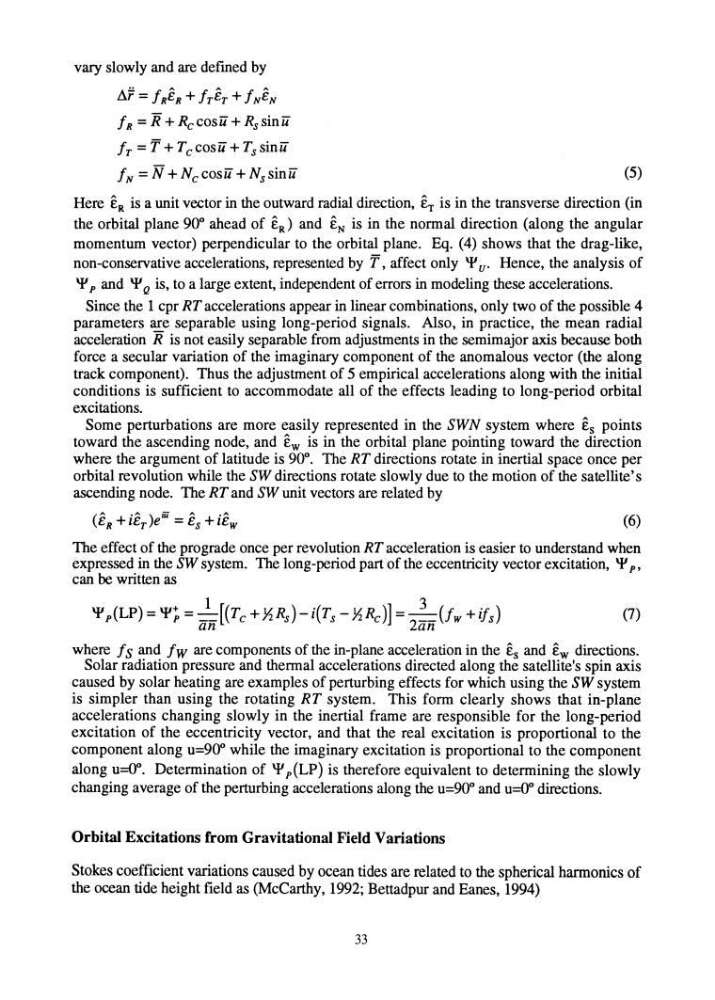
vary slowly and are defmed by
Il.F = IRER + ITET + INEN
IR = R + Recosu + Rssinu
IT = T + Tc cosu + Ts sin u
IN =N+Nccosu+Nssinu
(5)
Here ER is a unit vector in the outward radial direction, ET is in the transverse direction (in
the orbital plane 900 ahead of E R ) and EN is in the normal direction (along the angular
momentum vector) perpendicular to the orbital plane. Eq. (4) shows that the drag-like,
non-conservative accelerations, represented by T, affect only '¥ u' Hence, the analysis of
'¥ p and '¥ Q is, to a large extent, independent of errors in modeling these accelerations.
Since the 1 cpr RT accelerations appear in linear combinations, only two of the possible 4
parameters are separable using long-period signals. Also, in practice, the mean radial
acceleration R is not easily separable from adjustments in the semimajor axis because both
force a secular variation of the imaginary component of the anomalous vector (the along
track component). Thus the adjustment of 5 empirical accelerations along with the initial
conditions is sufficient to accommodate all of the effects leading to long-period orbital
excitations.
Some perturbations are more easily represented in the SWN system where Es points
toward the ascending node, and Ew is in the orbital plane pointing toward the direction
where the argument of latitude is 90°. The RT directions rotate in inertial space once per
orbital revolution while the SW directions rotate slowly due to the motion of the satellite's
ascending node. The RT and SW unit vectors are related by
(6)
The effect of the prograde once per revolution RT acceleration is easier to understand when
expressed in the SW system. The long-period part of the eccentricity vector excitation, '¥ p,
can be written as
(7)
where Is and Iw are components of the in-plane acceleration in the Es and £w directions.
Solar radiation pressure and thermal accelerations directed along the satellite's spin axis
caused by solar heating are examples of perturbing effects for which using the SW system
is simpler than using the rotating RT system. This form clearly shows that in-plane
accelerations changing slowly in the inertial frame are responsible for the long-period
excitation of the eccentricity vector, and that the real excitation is proportional to the
component along u=9oo while the imaginary excitation is proportional to the component
along u=OO. Determination of '¥ p{LP) is therefore equivalent to determining the slowly
changing average of the perturbing accelerations along the u=90° and u=O° directions.
Orbital Excitations from Gravitational Field Variations
Stokes coefficient variations caused by ocean tides are related to the spherical harmonics of
the ocean tide height field as (McCarthy, 1992; Bettadpur and Eanes, 1994)
33
Il.F = IRER + ITET + INEN
IR = R + Recosu + Rssinu
IT = T + Tc cosu + Ts sin u
IN =N+Nccosu+Nssinu
(5)
Here ER is a unit vector in the outward radial direction, ET is in the transverse direction (in
the orbital plane 900 ahead of E R ) and EN is in the normal direction (along the angular
momentum vector) perpendicular to the orbital plane. Eq. (4) shows that the drag-like,
non-conservative accelerations, represented by T, affect only '¥ u' Hence, the analysis of
'¥ p and '¥ Q is, to a large extent, independent of errors in modeling these accelerations.
Since the 1 cpr RT accelerations appear in linear combinations, only two of the possible 4
parameters are separable using long-period signals. Also, in practice, the mean radial
acceleration R is not easily separable from adjustments in the semimajor axis because both
force a secular variation of the imaginary component of the anomalous vector (the along
track component). Thus the adjustment of 5 empirical accelerations along with the initial
conditions is sufficient to accommodate all of the effects leading to long-period orbital
excitations.
Some perturbations are more easily represented in the SWN system where Es points
toward the ascending node, and Ew is in the orbital plane pointing toward the direction
where the argument of latitude is 90°. The RT directions rotate in inertial space once per
orbital revolution while the SW directions rotate slowly due to the motion of the satellite's
ascending node. The RT and SW unit vectors are related by
(6)
The effect of the prograde once per revolution RT acceleration is easier to understand when
expressed in the SW system. The long-period part of the eccentricity vector excitation, '¥ p,
can be written as
(7)
where Is and Iw are components of the in-plane acceleration in the Es and £w directions.
Solar radiation pressure and thermal accelerations directed along the satellite's spin axis
caused by solar heating are examples of perturbing effects for which using the SW system
is simpler than using the rotating RT system. This form clearly shows that in-plane
accelerations changing slowly in the inertial frame are responsible for the long-period
excitation of the eccentricity vector, and that the real excitation is proportional to the
component along u=9oo while the imaginary excitation is proportional to the component
along u=OO. Determination of '¥ p{LP) is therefore equivalent to determining the slowly
changing average of the perturbing accelerations along the u=90° and u=O° directions.
Orbital Excitations from Gravitational Field Variations
Stokes coefficient variations caused by ocean tides are related to the spherical harmonics of
the ocean tide height field as (McCarthy, 1992; Bettadpur and Eanes, 1994)
33