

being analyzed. The SLR residuals with respect to this best-fit orbit contain information
about the mismodeled and unmodeled perturbing accelerations. The analytical treatment of
these residuals is facilitated by linearizing the dynamics about a secularly precessing ellipse,
which is a good approximation to the evolution of the mean elements of the best-fit orbit.
The secularly precessing ellipse is defined by constant values of semimajor axis (a),
eccentricity (e) and inclination (I) and linearly varying longitude of the ascending node
( 0), argument of perigee (m) and argument of latitude (ii). The equations of motion
given below depend weakly on these mean elements, hence high accuracy or frequent
updating is not required.
Definition of the Non-singular Orbital Vectors
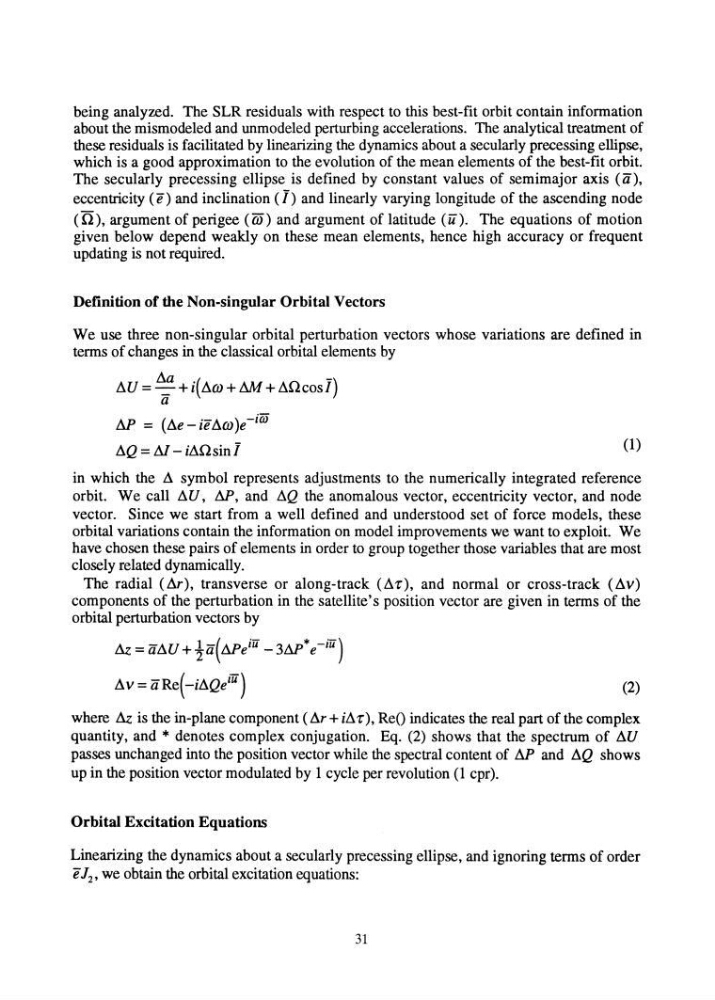
We use three non-singular orbital perturbation vectors whose variations are defined in
terms of changes in the classical orbital elements by
Aa (
-)
AU = -=-+ i Am + AM + AOcos]
a
AP = (Ae-ieAm)e- iro
AQ = AI - iAOsinl
(1)
in which the A symbol represents adjustments to the numerically integrated reference
orbit. We call AU, AP, and AQ the anomalous vector, eccentricity vector, and node
vector. Since we start from a well defined and understood set of force models, these
orbital variations contain the information on model improvements we want to exploit. We
have chosen these pairs of elements in order to group together those variables that are most
closely related dynamically.
The radial (Ar), transverse or along-track (A-r), and normal or cross-track (Av)
components of the perturbation in the satellite's position vector are given in terms of the
orbital perturbation vectors by
Az = liAU + !li( APi" - 3AP* e -iii)
A v = aRe( -iAQe rii )
(2)
where Az is the in-plane component (Ar + iA -r), ReO indicates the real part of the complex
quantity, and * denotes complex conjugation. Eq. (2) shows that the spectrum of AU
passes unchanged into the position vector while the spectral content of AP and AQ shows
up in the position vector modulated by 1 cycle per revolution (1 cpr).
Orbital Excitation Equations
Linearizing the dynamics about a secularly precessing ellipse, and ignoring terms of order
el 2 , we obtain the orbital excitation equations:
31
about the mismodeled and unmodeled perturbing accelerations. The analytical treatment of
these residuals is facilitated by linearizing the dynamics about a secularly precessing ellipse,
which is a good approximation to the evolution of the mean elements of the best-fit orbit.
The secularly precessing ellipse is defined by constant values of semimajor axis (a),
eccentricity (e) and inclination (I) and linearly varying longitude of the ascending node
( 0), argument of perigee (m) and argument of latitude (ii). The equations of motion
given below depend weakly on these mean elements, hence high accuracy or frequent
updating is not required.
Definition of the Non-singular Orbital Vectors
We use three non-singular orbital perturbation vectors whose variations are defined in
terms of changes in the classical orbital elements by
Aa (
-)
AU = -=-+ i Am + AM + AOcos]
a
AP = (Ae-ieAm)e- iro
AQ = AI - iAOsinl
(1)
in which the A symbol represents adjustments to the numerically integrated reference
orbit. We call AU, AP, and AQ the anomalous vector, eccentricity vector, and node
vector. Since we start from a well defined and understood set of force models, these
orbital variations contain the information on model improvements we want to exploit. We
have chosen these pairs of elements in order to group together those variables that are most
closely related dynamically.
The radial (Ar), transverse or along-track (A-r), and normal or cross-track (Av)
components of the perturbation in the satellite's position vector are given in terms of the
orbital perturbation vectors by
Az = liAU + !li( APi" - 3AP* e -iii)
A v = aRe( -iAQe rii )
(2)
where Az is the in-plane component (Ar + iA -r), ReO indicates the real part of the complex
quantity, and * denotes complex conjugation. Eq. (2) shows that the spectrum of AU
passes unchanged into the position vector while the spectral content of AP and AQ shows
up in the position vector modulated by 1 cycle per revolution (1 cpr).
Orbital Excitation Equations
Linearizing the dynamics about a secularly precessing ellipse, and ignoring terms of order
el 2 , we obtain the orbital excitation equations:
31