

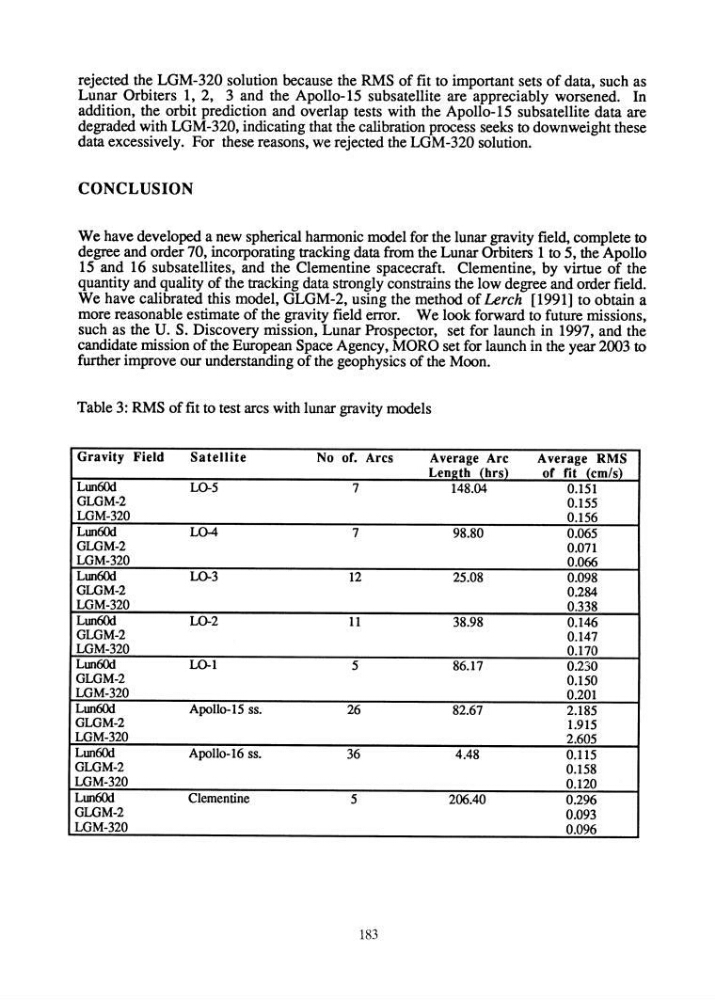
rejected the LGM-320 solution because the RMS of fit to important sets of data, such as
Lunar Orbiters 1, 2, 3 and the Apollo-IS subsatellite are appreciably worsened. In
addition, the orbit prediction and overlap tests with the Apollo-IS subsatellite data are
degraded with LGM-320, indicating that the calibration process seeks to downweight these
data excessively. For these reasons, we rejected the LGM-320 solution.
CONCLUSION
We have developed a new spherical hannonic model for the lunar gravity field, complete to
degree and order 70, incorporating tracking data from the Lunar Orbiters 1 to 5, the Apollo
15 and 16 subsatellites, and the Clementine spacecraft. Clementine, by virtue of the
quantity and quality of the tracking data strongly constrains the low degree and order field.
We have calibrated this model, GLGM-2, using the method of Lerch [1991] to obtain a
more reasonable estimate of the gravity field error. We look forward to future missions,
such as the U. S. Discovery mission, Lunar Prospector, set for launch in 1997, and the
candidate mission of the European Space Agency, MORO set for launch in the year 2003 to
further improve our understanding of the geophysics of the Moon.
Table 3: RMS of fit to test arcs with lunar gravity models
Gravity Field
Satellite
No of. Arcs
Average Arc
Average RMS
Len2th (hrs)
of fit (em's)
LWl60d
L0-5
7
148.04
0.151
GLGM-2
0.155
LGM-320
0.156
LWl60d
LO-4
7
98.80
0.065
GLGM-2
0.071
LGM-320
0.066
LWl60d
LO-3
12
25.08
0.098
GLGM-2
0.284
LGM-320
0.338
LWl60d
LO-2
11
38.98
0.146
GLGM-2
0.147
LGM-320
0.170
LWl60d
LO-1
5
86.17
0.230
GLGM-2
0.150
LGM-320
0.201
LWl60d
Apollo-15 SSe
26
82.67
2.185
GLGM-2
1.915
LGM-320
2.605
LWl60d
Apollo-16 SSe
36
4.48
0.115
GLGM-2
0.158
LGM-320
0.120
LWl60d
Clementine
5
206.40
0.296
GLGM-2
0.093
LGM-320
0.096
183
Lunar Orbiters 1, 2, 3 and the Apollo-IS subsatellite are appreciably worsened. In
addition, the orbit prediction and overlap tests with the Apollo-IS subsatellite data are
degraded with LGM-320, indicating that the calibration process seeks to downweight these
data excessively. For these reasons, we rejected the LGM-320 solution.
CONCLUSION
We have developed a new spherical hannonic model for the lunar gravity field, complete to
degree and order 70, incorporating tracking data from the Lunar Orbiters 1 to 5, the Apollo
15 and 16 subsatellites, and the Clementine spacecraft. Clementine, by virtue of the
quantity and quality of the tracking data strongly constrains the low degree and order field.
We have calibrated this model, GLGM-2, using the method of Lerch [1991] to obtain a
more reasonable estimate of the gravity field error. We look forward to future missions,
such as the U. S. Discovery mission, Lunar Prospector, set for launch in 1997, and the
candidate mission of the European Space Agency, MORO set for launch in the year 2003 to
further improve our understanding of the geophysics of the Moon.
Table 3: RMS of fit to test arcs with lunar gravity models
Gravity Field
Satellite
No of. Arcs
Average Arc
Average RMS
Len2th (hrs)
of fit (em's)
LWl60d
L0-5
7
148.04
0.151
GLGM-2
0.155
LGM-320
0.156
LWl60d
LO-4
7
98.80
0.065
GLGM-2
0.071
LGM-320
0.066
LWl60d
LO-3
12
25.08
0.098
GLGM-2
0.284
LGM-320
0.338
LWl60d
LO-2
11
38.98
0.146
GLGM-2
0.147
LGM-320
0.170
LWl60d
LO-1
5
86.17
0.230
GLGM-2
0.150
LGM-320
0.201
LWl60d
Apollo-15 SSe
26
82.67
2.185
GLGM-2
1.915
LGM-320
2.605
LWl60d
Apollo-16 SSe
36
4.48
0.115
GLGM-2
0.158
LGM-320
0.120
LWl60d
Clementine
5
206.40
0.296
GLGM-2
0.093
LGM-320
0.096
183