

remaining data - over one year of tracking - remains archived at the National Space Science
Data Center (NSSDC). Substantial effort would be required to salvage these data. Yet as
discussed by Ferrari [1977] and Ananda [1977], the data provide a long time series in the
histories of the orbit elements, from whose longer period variations, valuable gravity field
information can be derived.
Two other U.S. spacecraft, Explorers 35 and 49, were placed in lunar orbit and tracked
for extended periods. The former had a semimajor axis of 6000 km, and the latter was
located in a circular orbit at a mean altitude of 1065 km, and an inclination of 610. These
satellites were placed in lunar orbit to avoid terrestrial background interference, and observe
low frequency galactic radio signals [Bryant and Williamson, 1974]. These data were not
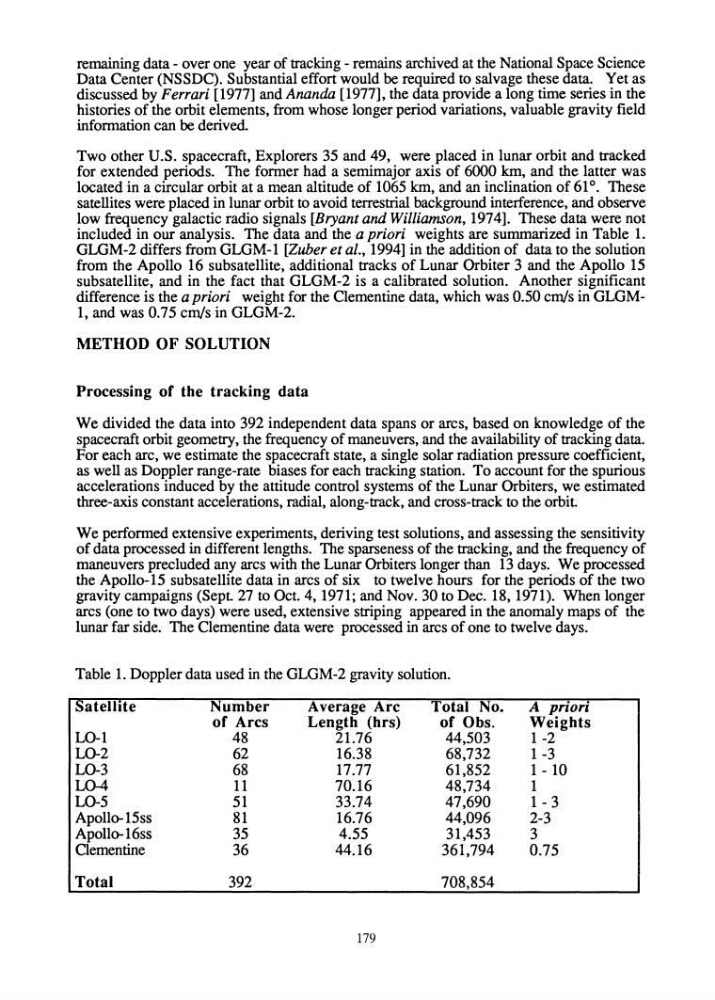
included in our analysis. The data and the a priori weights are summarized in Table 1.
GLGM-2 differs from GLGM-l [Zuber et al., 1994] in the addition of data to the solution
from the Apollo 16 sub satellite, additional tracks of Lunar Orbiter 3 and the Apollo 15
sub satellite, and in the fact that GLGM-2 is a calibrated solution. Another significant
difference is the a priori weight for the Clementine data, which was 0.50 cm/s in GLGM1, and was 0.75 cm/s in GLGM-2.
METHOD OF SOLUTION
Processing of the tracking data
We divided the data into 392 independent data spans or arcs, based on knowledge of the
spacecraft orbit geometry, the frequency of maneuvers, and the availability of tracking data.
For each arc, we estimate the spacecraft state, a single solar radiation pressure coefficient,
as well as Doppler range-rate biases for each tracking station. To account for the spurious
accelerations induced by the attitude control systems of the Lunar Orbiters, we estimated
three-axis constant accelerations, radial, along-track, and cross-track to the orbit
We performed extensive experiments, deriving test solutions, and assessing the sensitivity
of data processed in different lengths. The sparseness of the tracking, and the frequency of
maneuvers precluded any arcs with the Lunar Orbiters longer than 13 days. We processed
the Apollo-15 sub satellite data in arcs of six to twelve hours for the periods of the two
gravity campaigns (Sept 27 to Oct. 4, 1971; and Nov. 30 to Dec. 18, 1971). When longer
arcs (one to two days) were used, extensive striping appeared in the anomaly maps of the
lunar far side. The Clementine data were processed in arcs of one to twelve days.
Table 1. Doppler data used in the GLGM-2 gravity solution.
Satellite
Number
Average Arc
Total No.
A priori
of Arcs
Length (hrs)
of Obs.
Weights
LO-l
48
21.76
44,503
1-2
LO-2
62
16.38
68,732
1 -3
LO-3
68
17.77
61,852
1 - 10
LO-4
11
70.16
48,734
1
LO-5
51
33.74
47,690
1-3
Apollo-15ss
81
16.76
44,096
2-3
Apollo-16ss
35
4.55
31,453
3
Clementine
36
44.16
361,794
0.75
Total
392
708,854
179
Data Center (NSSDC). Substantial effort would be required to salvage these data. Yet as
discussed by Ferrari [1977] and Ananda [1977], the data provide a long time series in the
histories of the orbit elements, from whose longer period variations, valuable gravity field
information can be derived.
Two other U.S. spacecraft, Explorers 35 and 49, were placed in lunar orbit and tracked
for extended periods. The former had a semimajor axis of 6000 km, and the latter was
located in a circular orbit at a mean altitude of 1065 km, and an inclination of 610. These
satellites were placed in lunar orbit to avoid terrestrial background interference, and observe
low frequency galactic radio signals [Bryant and Williamson, 1974]. These data were not
included in our analysis. The data and the a priori weights are summarized in Table 1.
GLGM-2 differs from GLGM-l [Zuber et al., 1994] in the addition of data to the solution
from the Apollo 16 sub satellite, additional tracks of Lunar Orbiter 3 and the Apollo 15
sub satellite, and in the fact that GLGM-2 is a calibrated solution. Another significant
difference is the a priori weight for the Clementine data, which was 0.50 cm/s in GLGM1, and was 0.75 cm/s in GLGM-2.
METHOD OF SOLUTION
Processing of the tracking data
We divided the data into 392 independent data spans or arcs, based on knowledge of the
spacecraft orbit geometry, the frequency of maneuvers, and the availability of tracking data.
For each arc, we estimate the spacecraft state, a single solar radiation pressure coefficient,
as well as Doppler range-rate biases for each tracking station. To account for the spurious
accelerations induced by the attitude control systems of the Lunar Orbiters, we estimated
three-axis constant accelerations, radial, along-track, and cross-track to the orbit
We performed extensive experiments, deriving test solutions, and assessing the sensitivity
of data processed in different lengths. The sparseness of the tracking, and the frequency of
maneuvers precluded any arcs with the Lunar Orbiters longer than 13 days. We processed
the Apollo-15 sub satellite data in arcs of six to twelve hours for the periods of the two
gravity campaigns (Sept 27 to Oct. 4, 1971; and Nov. 30 to Dec. 18, 1971). When longer
arcs (one to two days) were used, extensive striping appeared in the anomaly maps of the
lunar far side. The Clementine data were processed in arcs of one to twelve days.
Table 1. Doppler data used in the GLGM-2 gravity solution.
Satellite
Number
Average Arc
Total No.
A priori
of Arcs
Length (hrs)
of Obs.
Weights
LO-l
48
21.76
44,503
1-2
LO-2
62
16.38
68,732
1 -3
LO-3
68
17.77
61,852
1 - 10
LO-4
11
70.16
48,734
1
LO-5
51
33.74
47,690
1-3
Apollo-15ss
81
16.76
44,096
2-3
Apollo-16ss
35
4.55
31,453
3
Clementine
36
44.16
361,794
0.75
Total
392
708,854
179