

10 .-----------:'(a-:-)-.
8
RMS =2.38
6
]' 4
......
'"
::l
]
0
ex: -2
ex: -6
-8
-10 L-_--'-_--:...L _ _ ---' _ _ - '
o
3
6
9
12
Months Past 1 January 1986
10 .-----------=(b-:-")..,
8
RMS = 1.12
6
:[ 4
'"
::l
] 0
0:: -2
G)
~ -4
ex: -6
-8
-10 L - _ - - ' -_ _ -'--_ _ _ _ - '
o
3
6
9
12
Months Past I January 1986
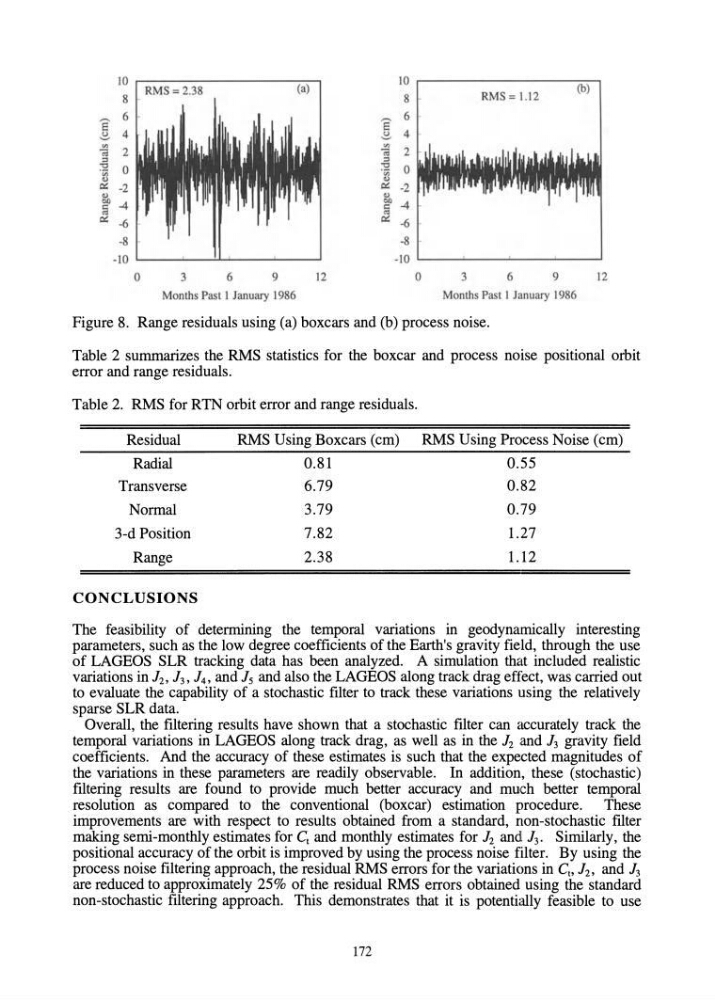
Figure 8. Range residuals using (a) boxcars and (b) process noise.
Table 2 summarizes the RMS statistics for the boxcar and process noise positional orbit
error and range residuals.
Table 2. RMS for RTN orbit error and range residuals.
Residual
Radial
Transverse
Normal
3-d Position
Range
CONCLUSIONS
RMS Using Boxcars (cm)
0.81
6.79
3.79
7.82
2.38
RMS Using Process Noise (cm)
0.55
0.82
0.79
1.27
1.12
The feasibility of determining the temporal varIatlOns in geodynamically interesting
parameters, such as the low degree coefficients of the Earth's gravity field, through the use
of LAGEOS SLR tracking data has been analyzed. A simulation that included realistic
variations in 1 2 ,1 3 ,1 4 , and 15 and also the LAGEOS along track drag effect, was carried out
to evaluate the capability of a stochastic filter to track these variations using the relatively
sparse SLR data.
Overall, the filtering results have shown that a stochastic filter can accurately track the
temporal variations in LAGEOS along track drag, as well as in the 12 and 13 gravity field
coefficients. And the accuracy of these estimates is such that the expected magnitudes of
the variations in these parameters are readily observable. In addition, these (stochastic)
filtering results are found to provide much better accuracy and much better temporal
resolution as compared to the conventional (boxcar) estimation procedure. These
improvements are with respect to results obtained from a standard, non-stochastic filter
making semi-monthly estimates for Ct and monthly estimates for 12 and 1 3 , Similarly, the
positional accuracy of the orbit is improved by using the process noise filter. By using the
process noise filtering approach, the residual RMS errors for the variations in C t , 1 2 , and 13
are reduced to approximately 25% of the residual RMS errors obtained using the standard
non-stochastic filtering approach. This demonstrates that it is potentially feasible to use
172
8
RMS =2.38
6
]' 4
......
'"
::l
]
0
ex: -2
ex: -6
-8
-10 L-_--'-_--:...L _ _ ---' _ _ - '
o
3
6
9
12
Months Past 1 January 1986
10 .-----------=(b-:-")..,
8
RMS = 1.12
6
:[ 4
'"
::l
] 0
0:: -2
G)
~ -4
ex: -6
-8
-10 L - _ - - ' -_ _ -'--_ _ _ _ - '
o
3
6
9
12
Months Past I January 1986
Figure 8. Range residuals using (a) boxcars and (b) process noise.
Table 2 summarizes the RMS statistics for the boxcar and process noise positional orbit
error and range residuals.
Table 2. RMS for RTN orbit error and range residuals.
Residual
Radial
Transverse
Normal
3-d Position
Range
CONCLUSIONS
RMS Using Boxcars (cm)
0.81
6.79
3.79
7.82
2.38
RMS Using Process Noise (cm)
0.55
0.82
0.79
1.27
1.12
The feasibility of determining the temporal varIatlOns in geodynamically interesting
parameters, such as the low degree coefficients of the Earth's gravity field, through the use
of LAGEOS SLR tracking data has been analyzed. A simulation that included realistic
variations in 1 2 ,1 3 ,1 4 , and 15 and also the LAGEOS along track drag effect, was carried out
to evaluate the capability of a stochastic filter to track these variations using the relatively
sparse SLR data.
Overall, the filtering results have shown that a stochastic filter can accurately track the
temporal variations in LAGEOS along track drag, as well as in the 12 and 13 gravity field
coefficients. And the accuracy of these estimates is such that the expected magnitudes of
the variations in these parameters are readily observable. In addition, these (stochastic)
filtering results are found to provide much better accuracy and much better temporal
resolution as compared to the conventional (boxcar) estimation procedure. These
improvements are with respect to results obtained from a standard, non-stochastic filter
making semi-monthly estimates for Ct and monthly estimates for 12 and 1 3 , Similarly, the
positional accuracy of the orbit is improved by using the process noise filter. By using the
process noise filtering approach, the residual RMS errors for the variations in C t , 1 2 , and 13
are reduced to approximately 25% of the residual RMS errors obtained using the standard
non-stochastic filtering approach. This demonstrates that it is potentially feasible to use
172