

contribution of the mountain glaciers. The form of the observation equations used for the
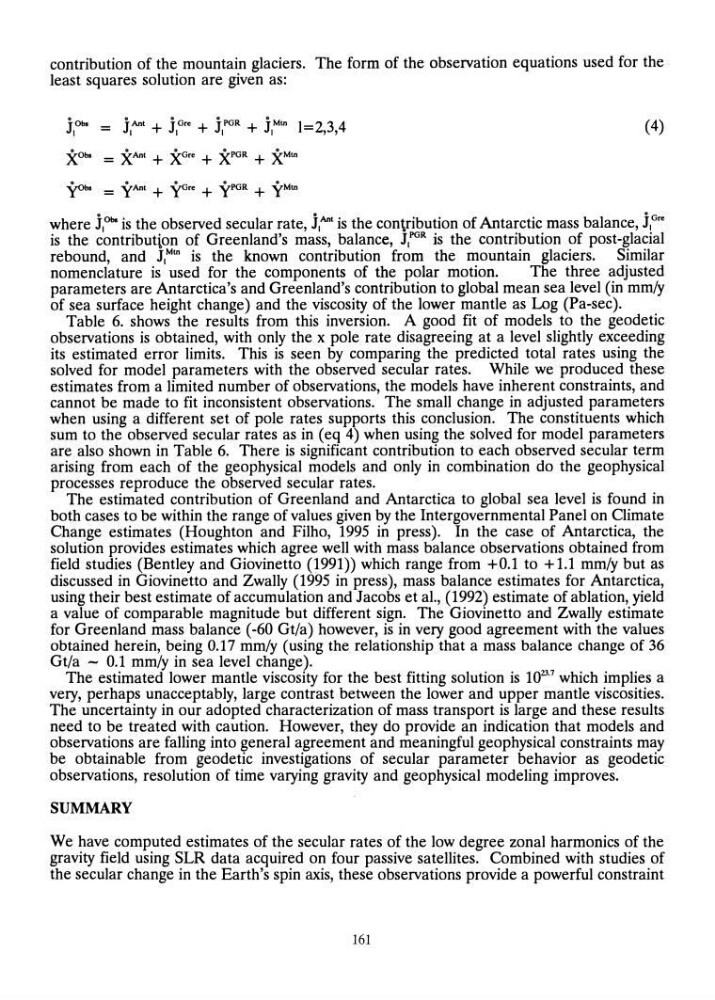
least squares solution are given as:
jl0bs = jlAnt + jlGre + j t GR + jlMtn 1=2,3,4
X 0bs = x Ant + X Gre + X PGR + X Mtn
YObs = yAnt + yore + yPGR + yMtn
(4)
where jl°bs is the observed secular rate, jlAnt is the contribution of Antarctic mass balance, jlGre
is the contribution of Greenland's mass, balance, J 1
PGR is the contribution of post-glacial
rebound, and J 1
Mtn is the known contribution from the mountain glaciers. Similar
nomenclature is used for the components of the polar motion.
The three adjusted
parameters are Antarctica's and Greenland's contribution to global mean sea level (in mm/y
of sea surface height change) and the viscosity of the lower mantle as Log (Pa-sec).
Table 6. shows the results from this inversion. A good fit of models to the geodetic
observations is obtained, with only the x pole rate disagreeing at a level slightly exceeding
its estimated error limits. This is seen by comparing the predicted total rates using the
solved for model parameters with the observed secular rates. While we produced these
estimates from a limited number of observations, the models have inherent constraints, and
cannot be made to fit inconsistent observations. The small change in adjusted parameters
when using a different set of pole rates supports this conclusion. The constituents which
sum to the observed secular rates as in (eq 4) when using the solved for model parameters
are also shown in Table 6. There is significant contribution to each observed secular term
arising from each of the geophysical models and only in combination do the geophysical
processes reproduce the observed secular rates.
The estimated contribution of Greenland and Antarctica to global sea level is found in
both cases to be within the range of values given by the Intergovernmental Panel on Climate
Change estimates (Houghton and Filho, 1995 in press). In the case of Antarctica, the
solution provides estimates which agree well with mass balance observations obtained from
field studies (Bentley and Giovinetto (1991)) which range from +0.1 to + 1.1 mm/y but as
discussed in Giovinetto and Zwally (1995 in press), mass balance estimates for Antarctica,
using their best estimate of accumulation and Jacobs et al., (1992) estimate of ablation, yield
a value of comparable magnitude but different sign. The Giovinetto and Zwally estimate
for Greenland mass balance (-60 Gt/a) however, is in very good agreement with the values
obtained herein, being 0.17 mm/y (using the relationship that a mass balance change of 36
Gt/a - 0.1 mmly in sea level change).
The estimated lower mantle viscosity for the best fitting solution is 10 23 . 7 which implies a
very, perhaps unacceptably, large contrast between the lower and upper mantle viscosities.
The uncertainty in our adopted characterization of mass transport is large and these results
need to be treated with caution. However, they do provide an indication that models and
observations are falling into general agreement and meaningful geophysical constraints may
be obtainable from geodetic investigations of secular parameter behavior as geodetic
observations, resolution of time varying gravity and geophysical modeling improves.
SUMMARY
We have computed estimates of the secular rates of the low degree zonal harmonics of the
gravity field using SLR data acquired on four passive satellites. Combined with studies of
the secular change in the Earth's spin axis, these observations provide a powerful constraint
161
least squares solution are given as:
jl0bs = jlAnt + jlGre + j t GR + jlMtn 1=2,3,4
X 0bs = x Ant + X Gre + X PGR + X Mtn
YObs = yAnt + yore + yPGR + yMtn
(4)
where jl°bs is the observed secular rate, jlAnt is the contribution of Antarctic mass balance, jlGre
is the contribution of Greenland's mass, balance, J 1
PGR is the contribution of post-glacial
rebound, and J 1
Mtn is the known contribution from the mountain glaciers. Similar
nomenclature is used for the components of the polar motion.
The three adjusted
parameters are Antarctica's and Greenland's contribution to global mean sea level (in mm/y
of sea surface height change) and the viscosity of the lower mantle as Log (Pa-sec).
Table 6. shows the results from this inversion. A good fit of models to the geodetic
observations is obtained, with only the x pole rate disagreeing at a level slightly exceeding
its estimated error limits. This is seen by comparing the predicted total rates using the
solved for model parameters with the observed secular rates. While we produced these
estimates from a limited number of observations, the models have inherent constraints, and
cannot be made to fit inconsistent observations. The small change in adjusted parameters
when using a different set of pole rates supports this conclusion. The constituents which
sum to the observed secular rates as in (eq 4) when using the solved for model parameters
are also shown in Table 6. There is significant contribution to each observed secular term
arising from each of the geophysical models and only in combination do the geophysical
processes reproduce the observed secular rates.
The estimated contribution of Greenland and Antarctica to global sea level is found in
both cases to be within the range of values given by the Intergovernmental Panel on Climate
Change estimates (Houghton and Filho, 1995 in press). In the case of Antarctica, the
solution provides estimates which agree well with mass balance observations obtained from
field studies (Bentley and Giovinetto (1991)) which range from +0.1 to + 1.1 mm/y but as
discussed in Giovinetto and Zwally (1995 in press), mass balance estimates for Antarctica,
using their best estimate of accumulation and Jacobs et al., (1992) estimate of ablation, yield
a value of comparable magnitude but different sign. The Giovinetto and Zwally estimate
for Greenland mass balance (-60 Gt/a) however, is in very good agreement with the values
obtained herein, being 0.17 mm/y (using the relationship that a mass balance change of 36
Gt/a - 0.1 mmly in sea level change).
The estimated lower mantle viscosity for the best fitting solution is 10 23 . 7 which implies a
very, perhaps unacceptably, large contrast between the lower and upper mantle viscosities.
The uncertainty in our adopted characterization of mass transport is large and these results
need to be treated with caution. However, they do provide an indication that models and
observations are falling into general agreement and meaningful geophysical constraints may
be obtainable from geodetic investigations of secular parameter behavior as geodetic
observations, resolution of time varying gravity and geophysical modeling improves.
SUMMARY
We have computed estimates of the secular rates of the low degree zonal harmonics of the
gravity field using SLR data acquired on four passive satellites. Combined with studies of
the secular change in the Earth's spin axis, these observations provide a powerful constraint
161