

QUADRA TURE FORMULAS
The function (e.g., the gravity anomaly) is supposed to be given on a regular grid; and the
linear estimates of its Legendre spectrum are assumed to have the form of so-called
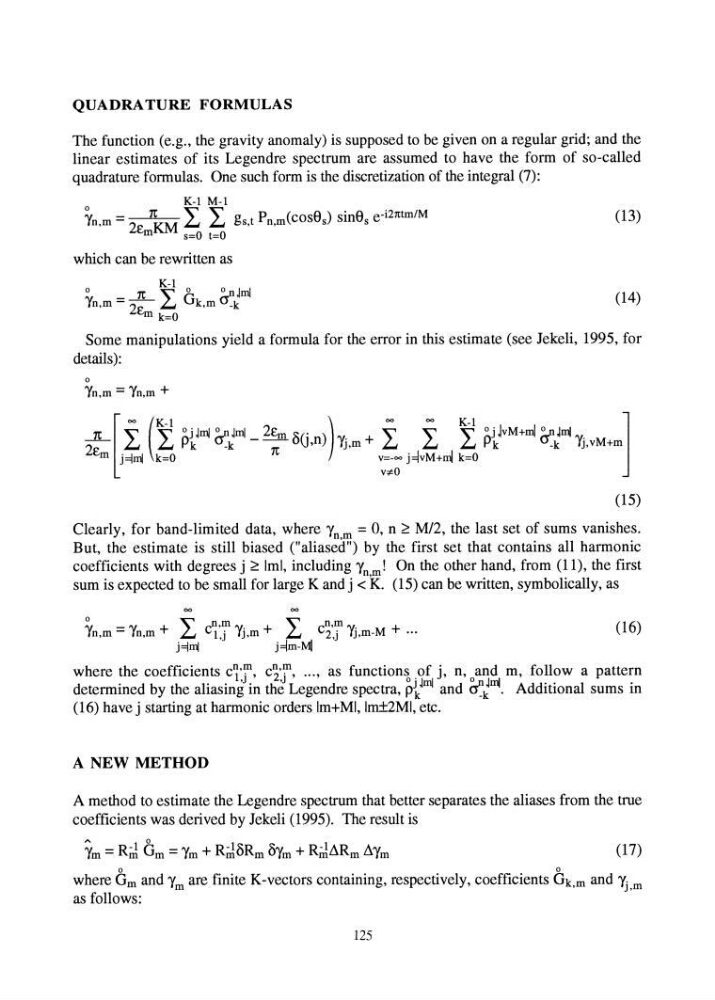
quadrature formulas. One such form is the discretization of the integral (7):
K-l M-l
~ =
It
' " ' " g t P (cosS) sinS e-i21ttm/M
m,m 2£ KM £.... £.... s, n,m
s
s
m
s=O t=O
which can be rewritten as
K-l
o
_
It ' " G (f,JmI
1n,m - 2£ £.... k,m -k
m k=O
(13)
(14)
Some manipulations yield a formula for the error in this estimate (see lekeli, 1995, for
details):
o
1n,m = 1n,m +
--1L[~ (~ pO jJmI (f,JmI_ 2Em bG n»)~. + ~ ~ ~ pO jJvM+mI (f,JmI~. ]
2£
£.... £.... k
-k
"J,m £....
£.... £.... k
-k IJ,vM+m
m j=lml k=O
It
v=-oo j=lvM+m k=O
v;tO
(15)
Clearly, for band-limited data, where 1n m = 0, n;;:: Ml2, the last set of sums vanishes.
But, the estimate is still biased ("aliased") by the first set that contains all harmonic
coefficients with degrees j ;;:: Iml, including 1 n ,m! On the other hand, from (11), the first
sum is expected to be small for large K and j < K. (15) can be written, symbolically, as
00
00
1n,m = "{n,m + L c~',j "{j,m + L c~',j Yi,m-M + ...
(16)
j=lml
j=lm-Ml
where the coefficients ctj, c~',j, ... , as function~ .of j, n, oand m, follow a pattern
determined by the aliasing in the Legendre spectra, pi JmI and ~~mI. Additional sums in
(16) have j starting at harmonic orders Im+MI, 1m±2MI, etc.
A NEW METHOD
A method to estimate the Legendre spectrum that better separates the aliases from the true
coefficients was derived by lekeli (1995). The result is
(17)
o
0
where Om and 1m are finite K-vectors containing, respectively, coefficients Ok,m and 'Yj,m
as follows:
125
The function (e.g., the gravity anomaly) is supposed to be given on a regular grid; and the
linear estimates of its Legendre spectrum are assumed to have the form of so-called
quadrature formulas. One such form is the discretization of the integral (7):
K-l M-l
~ =
It
' " ' " g t P (cosS) sinS e-i21ttm/M
m,m 2£ KM £.... £.... s, n,m
s
s
m
s=O t=O
which can be rewritten as
K-l
o
_
It ' " G (f,JmI
1n,m - 2£ £.... k,m -k
m k=O
(13)
(14)
Some manipulations yield a formula for the error in this estimate (see lekeli, 1995, for
details):
o
1n,m = 1n,m +
--1L[~ (~ pO jJmI (f,JmI_ 2Em bG n»)~. + ~ ~ ~ pO jJvM+mI (f,JmI~. ]
2£
£.... £.... k
-k
"J,m £....
£.... £.... k
-k IJ,vM+m
m j=lml k=O
It
v=-oo j=lvM+m k=O
v;tO
(15)
Clearly, for band-limited data, where 1n m = 0, n;;:: Ml2, the last set of sums vanishes.
But, the estimate is still biased ("aliased") by the first set that contains all harmonic
coefficients with degrees j ;;:: Iml, including 1 n ,m! On the other hand, from (11), the first
sum is expected to be small for large K and j < K. (15) can be written, symbolically, as
00
00
1n,m = "{n,m + L c~',j "{j,m + L c~',j Yi,m-M + ...
(16)
j=lml
j=lm-Ml
where the coefficients ctj, c~',j, ... , as function~ .of j, n, oand m, follow a pattern
determined by the aliasing in the Legendre spectra, pi JmI and ~~mI. Additional sums in
(16) have j starting at harmonic orders Im+MI, 1m±2MI, etc.
A NEW METHOD
A method to estimate the Legendre spectrum that better separates the aliases from the true
coefficients was derived by lekeli (1995). The result is
(17)
o
0
where Om and 1m are finite K-vectors containing, respectively, coefficients Ok,m and 'Yj,m
as follows:
125