

3. Terrain corrections were calculated for all Bouguer anomalies worldwide. This
consisted of developing a l' detailed elevation fIle from DMA's DTED fIle to complement
the master 5' mean elevation file developed for this project
4. The mean of the reduced gravity anomalies in each 1 0 cell was subtracted to center the
data before covariance modeling and collocation.
5. Accurate analytical covariance models of local gravity fields in l O x 1 0 cells with overlap
depending on the cosine of the latitude were developed. The covariance modeling
consisted of calculating an empirical covariance model for the reduced point gravity
anomalies and then fitting the Forsberg analytical covariance model for local regions. The
Forsberg model consists of parameters D ,T, and Co and these are defined as:
The high frequency attenuation parameter, D, is chosen to satisfy the curvature of the
empirical covariance near the origin. The parameter D describes the depth to the
Bjerhammar sphere as outlined in Tscherning/Rapp model (Tscherning and Rapp, 1974).
The low frequency attenuation parameter T is chosen to satisfy the correlation length of the
model. The third parameter Co is the variance of the point gravity anomalies in a local
region. The basic covariance between gravity anomalies in the Forsberg model is:
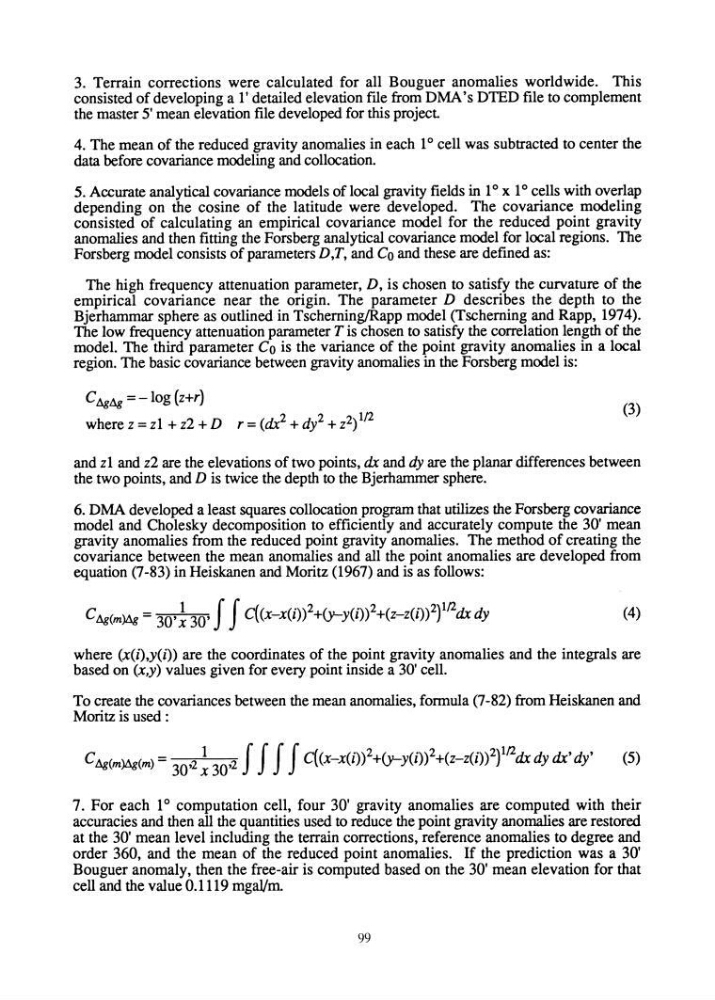
C llgllg = -log (z+r)
where z = zl + z2 + D r = (dx 2 + dy2 + z2)112
(3)
and zl and z2 are the elevations of two points, dx and dy are the planar differences between
the two points, and D is twice the depth to the Bjerhammer sphere.
6. DMA developed a least squares collocation program that utilizes the Forsberg covariance
model and Cholesky decomposition to efficiently and accurately compute the 30' mean
gravity anomalies from the reduced point gravity anomalies. The method of creating the
covariance between the mean anomalies and all the point anomalies are developed from
equation (7-83) in Heiskanen and Moritz (1967) and is as follows:
(4)
where (x(i),y(i» are the coordinates of the point gravity anomalies and the integrals are
based on (x,y) values given for every point inside a 30' cell.
To create the covariances between the mean anomalies, formula (7-82) from Heiskanen and
Moritz is used :
7. For each 1 0 computation cell, four 30' gravity anomalies are computed with their
accuracies and then all the quantities used to reduce the point gravity anomalies are restored
at the 30' mean level including the terrain corrections, reference anomalies to degree and
order 360, and the mean of the reduced point anomalies. If the prediction was a 30'
Bouguer anomaly, then the free-air is computed based on the 30' mean elevation for that
cell and the value 0.1119 mgaVm.
99
consisted of developing a l' detailed elevation fIle from DMA's DTED fIle to complement
the master 5' mean elevation file developed for this project
4. The mean of the reduced gravity anomalies in each 1 0 cell was subtracted to center the
data before covariance modeling and collocation.
5. Accurate analytical covariance models of local gravity fields in l O x 1 0 cells with overlap
depending on the cosine of the latitude were developed. The covariance modeling
consisted of calculating an empirical covariance model for the reduced point gravity
anomalies and then fitting the Forsberg analytical covariance model for local regions. The
Forsberg model consists of parameters D ,T, and Co and these are defined as:
The high frequency attenuation parameter, D, is chosen to satisfy the curvature of the
empirical covariance near the origin. The parameter D describes the depth to the
Bjerhammar sphere as outlined in Tscherning/Rapp model (Tscherning and Rapp, 1974).
The low frequency attenuation parameter T is chosen to satisfy the correlation length of the
model. The third parameter Co is the variance of the point gravity anomalies in a local
region. The basic covariance between gravity anomalies in the Forsberg model is:
C llgllg = -log (z+r)
where z = zl + z2 + D r = (dx 2 + dy2 + z2)112
(3)
and zl and z2 are the elevations of two points, dx and dy are the planar differences between
the two points, and D is twice the depth to the Bjerhammer sphere.
6. DMA developed a least squares collocation program that utilizes the Forsberg covariance
model and Cholesky decomposition to efficiently and accurately compute the 30' mean
gravity anomalies from the reduced point gravity anomalies. The method of creating the
covariance between the mean anomalies and all the point anomalies are developed from
equation (7-83) in Heiskanen and Moritz (1967) and is as follows:
(4)
where (x(i),y(i» are the coordinates of the point gravity anomalies and the integrals are
based on (x,y) values given for every point inside a 30' cell.
To create the covariances between the mean anomalies, formula (7-82) from Heiskanen and
Moritz is used :
7. For each 1 0 computation cell, four 30' gravity anomalies are computed with their
accuracies and then all the quantities used to reduce the point gravity anomalies are restored
at the 30' mean level including the terrain corrections, reference anomalies to degree and
order 360, and the mean of the reduced point anomalies. If the prediction was a 30'
Bouguer anomaly, then the free-air is computed based on the 30' mean elevation for that
cell and the value 0.1119 mgaVm.
99