

76
4 Transoceanic Trade and Migration (1)
In the Holocene sailing rafts almost certainly had daggerboards and/or a steering oar and a sail to exploit a following wind or, in the case of the Cinnamon
Route, to exploit monsoonal winds driving westwards across the Indian Ocean. The
bas-relief depiction of a sailing raft from the 8th century temple of Borobudur in
Java shows a daggerboard, a steering oar and sail. Given the conservatism of ship
design, this depiction probably shows sailing rafts as they had been for thousands
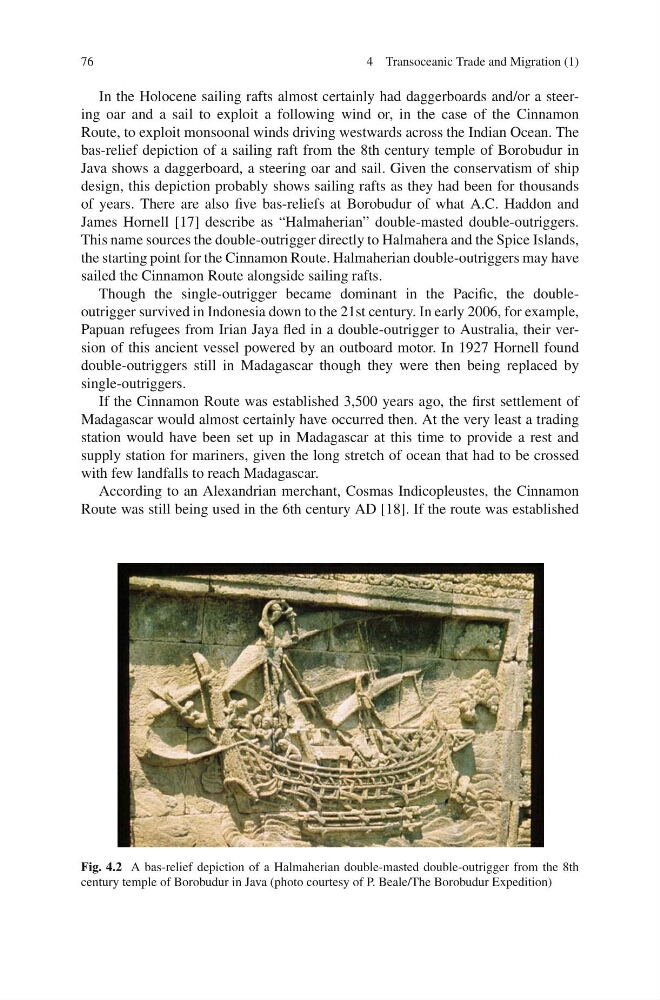
of years. There are also five bas-reliefs at Borobudur of what A.C. Haddon and
James Hornell [17] describe as “Halmaherian” double-masted double-outriggers.
This name sources the double-outrigger directly to Halmahera and the Spice Islands,
the starting point for the Cinnamon Route. Halmaherian double-outriggers may have
sailed the Cinnamon Route alongside sailing rafts.
Though the single-outrigger became dominant in the Pacific, the doubleoutrigger survived in Indonesia down to the 21st century. In early 2006, for example,
Papuan refugees from Irian Jaya fled in a double-outrigger to Australia, their version of this ancient vessel powered by an outboard motor. In 1927 Hornell found
double-outriggers still in Madagascar though they were then being replaced by
single-outriggers.
If the Cinnamon Route was established 3,500 years ago, the first settlement of
Madagascar would almost certainly have occurred then. At the very least a trading
station would have been set up in Madagascar at this time to provide a rest and
supply station for mariners, given the long stretch of ocean that had to be crossed
with few landfalls to reach Madagascar.
According to an Alexandrian merchant, Cosmas Indicopleustes, the Cinnamon
Route was still being used in the 6th century AD [18]. If the route was established
Fig. 4.2 A bas-relief depiction of a Halmaherian double-masted double-outrigger from the 8th
century temple of Borobudur in Java (photo courtesy of P. Beale/The Borobudur Expedition)
4 Transoceanic Trade and Migration (1)
In the Holocene sailing rafts almost certainly had daggerboards and/or a steering oar and a sail to exploit a following wind or, in the case of the Cinnamon
Route, to exploit monsoonal winds driving westwards across the Indian Ocean. The
bas-relief depiction of a sailing raft from the 8th century temple of Borobudur in
Java shows a daggerboard, a steering oar and sail. Given the conservatism of ship
design, this depiction probably shows sailing rafts as they had been for thousands
of years. There are also five bas-reliefs at Borobudur of what A.C. Haddon and
James Hornell [17] describe as “Halmaherian” double-masted double-outriggers.
This name sources the double-outrigger directly to Halmahera and the Spice Islands,
the starting point for the Cinnamon Route. Halmaherian double-outriggers may have
sailed the Cinnamon Route alongside sailing rafts.
Though the single-outrigger became dominant in the Pacific, the doubleoutrigger survived in Indonesia down to the 21st century. In early 2006, for example,
Papuan refugees from Irian Jaya fled in a double-outrigger to Australia, their version of this ancient vessel powered by an outboard motor. In 1927 Hornell found
double-outriggers still in Madagascar though they were then being replaced by
single-outriggers.
If the Cinnamon Route was established 3,500 years ago, the first settlement of
Madagascar would almost certainly have occurred then. At the very least a trading
station would have been set up in Madagascar at this time to provide a rest and
supply station for mariners, given the long stretch of ocean that had to be crossed
with few landfalls to reach Madagascar.
According to an Alexandrian merchant, Cosmas Indicopleustes, the Cinnamon
Route was still being used in the 6th century AD [18]. If the route was established
Fig. 4.2 A bas-relief depiction of a Halmaherian double-masted double-outrigger from the 8th
century temple of Borobudur in Java (photo courtesy of P. Beale/The Borobudur Expedition)