

196
12 The Context of Global Climate Change: Climate-Driven Demography
12.2 Climate-Driven Demography
Studying the two juxtaposed periods of extreme warmth and extreme cold in Europe,
the Medieval Climatic Optimum and the Little Ice Age, makes particularly obvious
a context in which climate drives demography.
The prime requirement is a population nearing the limit of its resources, of its
ceiling of sustainability. To this add extreme, adverse, climatic conditions which
reduce the biota and/or destroy vital food resources and thus independently and
additionally lower the ceiling of sustainability. The inevitable result is starvation,
population collapse and, potentially, extinction.
In northern Europe thriving agriculture, prosperity and a dramatic population
increase during the Medieval Climatic Optimum were followed by crop losses,
widespread starvation and population decline caused by the climate extremes of
the Little Ice Age impacting on high populations. In New Zealand and in tropical
Polynesia, as we shall explain shortly, the picture is more complex. But to offer
first a simple, unambiguous example of climate-driven demography, we turn to
Iceland.
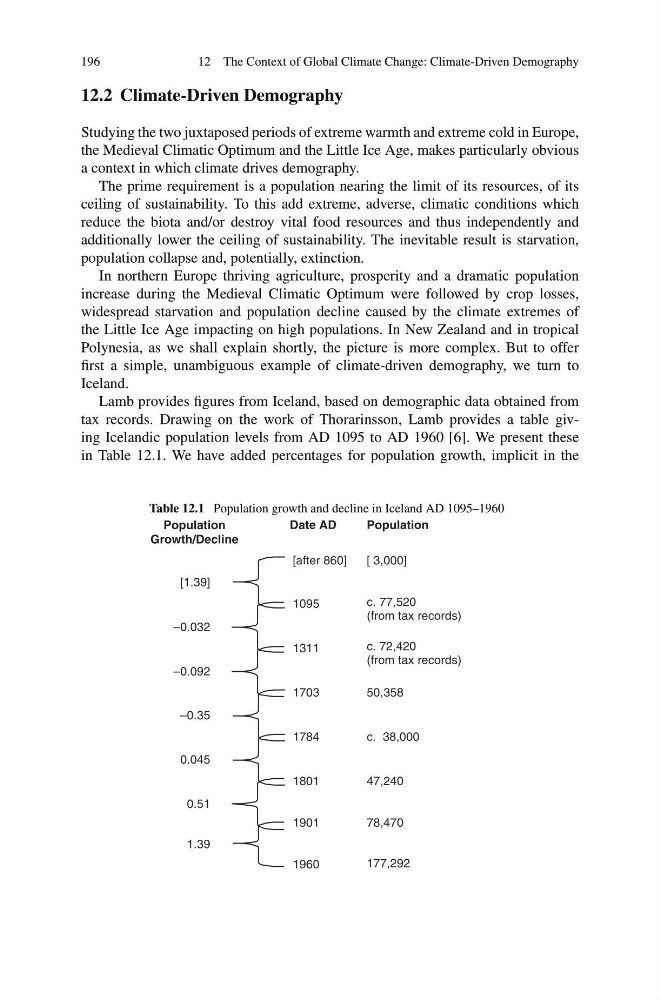
Lamb provides figures from Iceland, based on demographic data obtained from
tax records. Drawing on the work of Thorarinsson, Lamb provides a table giving Icelandic population levels from AD 1095 to AD 1960 [6]. We present these
in Table 12.1. We have added percentages for population growth, implicit in the
Table 12.1 Population growth and decline in Iceland AD 1095–1960
Population
Growth/Decline
[1.39]
–0.032
–0.092
–0.35
0.045
0.51
1.39
Date AD
[after 860]
1095
1311
1703
1784
1801
1901
1960
Population
[ 3,000]
c. 77,520
(from tax records)
c. 72,420
(from tax records)
50,358
c. 38,000
47,240
78,470
177,292
12 The Context of Global Climate Change: Climate-Driven Demography
12.2 Climate-Driven Demography
Studying the two juxtaposed periods of extreme warmth and extreme cold in Europe,
the Medieval Climatic Optimum and the Little Ice Age, makes particularly obvious
a context in which climate drives demography.
The prime requirement is a population nearing the limit of its resources, of its
ceiling of sustainability. To this add extreme, adverse, climatic conditions which
reduce the biota and/or destroy vital food resources and thus independently and
additionally lower the ceiling of sustainability. The inevitable result is starvation,
population collapse and, potentially, extinction.
In northern Europe thriving agriculture, prosperity and a dramatic population
increase during the Medieval Climatic Optimum were followed by crop losses,
widespread starvation and population decline caused by the climate extremes of
the Little Ice Age impacting on high populations. In New Zealand and in tropical
Polynesia, as we shall explain shortly, the picture is more complex. But to offer
first a simple, unambiguous example of climate-driven demography, we turn to
Iceland.
Lamb provides figures from Iceland, based on demographic data obtained from
tax records. Drawing on the work of Thorarinsson, Lamb provides a table giving Icelandic population levels from AD 1095 to AD 1960 [6]. We present these
in Table 12.1. We have added percentages for population growth, implicit in the
Table 12.1 Population growth and decline in Iceland AD 1095–1960
Population
Growth/Decline
[1.39]
–0.032
–0.092
–0.35
0.045
0.51
1.39
Date AD
[after 860]
1095
1311
1703
1784
1801
1901
1960
Population
[ 3,000]
c. 77,520
(from tax records)
c. 72,420
(from tax records)
50,358
c. 38,000
47,240
78,470
177,292