

10.1 Introduction
163
Western/Eastern Cultural Affiliations
0 5 10 15 20 25 30 35 40 45
Uvea
Tonga
Samoa
Futuna
Tokelaus
Niue
Ellice
Pukapuka
Tongareva
Manihiki-Rakahanga
New Zealand
Easter Island
Mangareva
Marquesas
Australs
Rapa
Tuamotus
Cook Islands
Hawaii
Society Islands
Western traits
Central-marginal traits
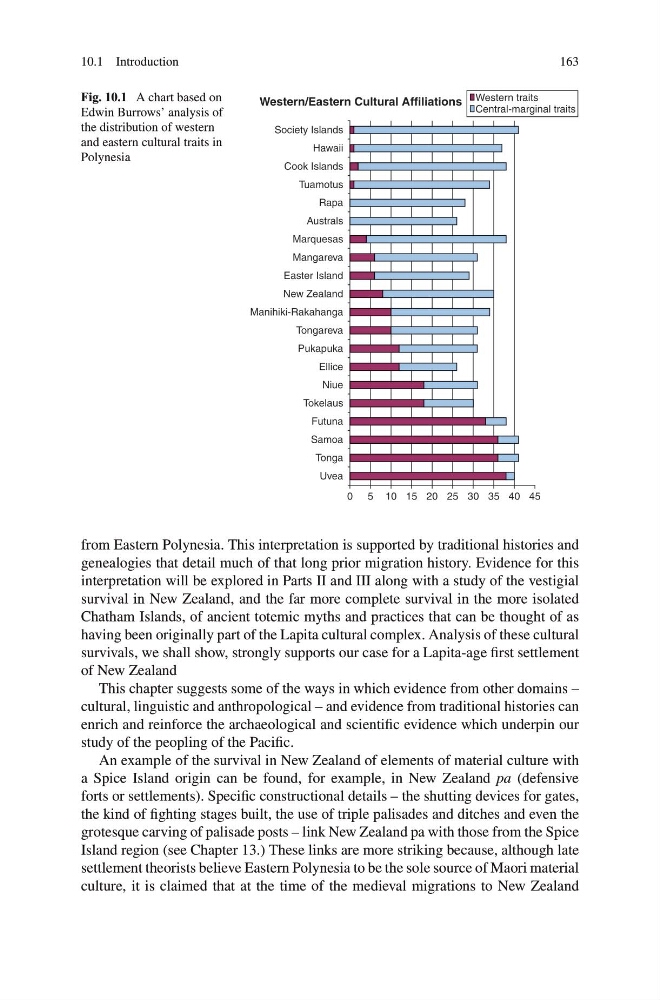
Fig. 10.1 A chart based on
Edwin Burrows’ analysis of
the distribution of western
and eastern cultural traits in
Polynesia
from Eastern Polynesia. This interpretation is supported by traditional histories and
genealogies that detail much of that long prior migration history. Evidence for this
interpretation will be explored in Parts II and III along with a study of the vestigial
survival in New Zealand, and the far more complete survival in the more isolated
Chatham Islands, of ancient totemic myths and practices that can be thought of as
having been originally part of the Lapita cultural complex. Analysis of these cultural
survivals, we shall show, strongly supports our case for a Lapita-age first settlement
of New Zealand
This chapter suggests some of the ways in which evidence from other domains –
cultural, linguistic and anthropological – and evidence from traditional histories can
enrich and reinforce the archaeological and scientific evidence which underpin our
study of the peopling of the Pacific.
An example of the survival in New Zealand of elements of material culture with
a Spice Island origin can be found, for example, in New Zealand pa (defensive
forts or settlements). Specific constructional details – the shutting devices for gates,
the kind of fighting stages built, the use of triple palisades and ditches and even the
grotesque carving of palisade posts – link New Zealand pa with those from the Spice
Island region (see Chapter 13.) These links are more striking because, although late
settlement theorists believe Eastern Polynesia to be the sole source of Maori material
culture, it is claimed that at the time of the medieval migrations to New Zealand
163
Western/Eastern Cultural Affiliations
0 5 10 15 20 25 30 35 40 45
Uvea
Tonga
Samoa
Futuna
Tokelaus
Niue
Ellice
Pukapuka
Tongareva
Manihiki-Rakahanga
New Zealand
Easter Island
Mangareva
Marquesas
Australs
Rapa
Tuamotus
Cook Islands
Hawaii
Society Islands
Western traits
Central-marginal traits
Fig. 10.1 A chart based on
Edwin Burrows’ analysis of
the distribution of western
and eastern cultural traits in
Polynesia
from Eastern Polynesia. This interpretation is supported by traditional histories and
genealogies that detail much of that long prior migration history. Evidence for this
interpretation will be explored in Parts II and III along with a study of the vestigial
survival in New Zealand, and the far more complete survival in the more isolated
Chatham Islands, of ancient totemic myths and practices that can be thought of as
having been originally part of the Lapita cultural complex. Analysis of these cultural
survivals, we shall show, strongly supports our case for a Lapita-age first settlement
of New Zealand
This chapter suggests some of the ways in which evidence from other domains –
cultural, linguistic and anthropological – and evidence from traditional histories can
enrich and reinforce the archaeological and scientific evidence which underpin our
study of the peopling of the Pacific.
An example of the survival in New Zealand of elements of material culture with
a Spice Island origin can be found, for example, in New Zealand pa (defensive
forts or settlements). Specific constructional details – the shutting devices for gates,
the kind of fighting stages built, the use of triple palisades and ditches and even the
grotesque carving of palisade posts – link New Zealand pa with those from the Spice
Island region (see Chapter 13.) These links are more striking because, although late
settlement theorists believe Eastern Polynesia to be the sole source of Maori material
culture, it is claimed that at the time of the medieval migrations to New Zealand