

88
5 Transoceanic Trade and Migration (2)
on the Malagasy’s possession of a near-coalescent Polynesian motif, of Spice Island
involvement with the route as early colonizers of Madagascar.
But the Cinnamon Route was probably not the first Spice Island transoceanic
route exploiting a major WPWP current. The most likely contender for this role was
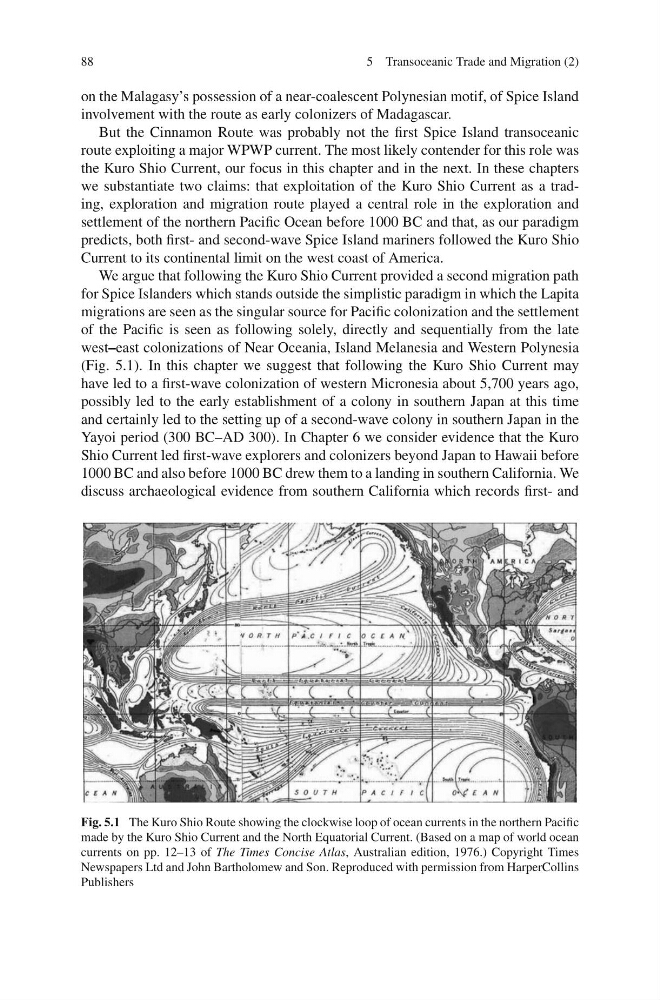
the Kuro Shio Current, our focus in this chapter and in the next. In these chapters
we substantiate two claims: that exploitation of the Kuro Shio Current as a trading, exploration and migration route played a central role in the exploration and
settlement of the northern Pacific Ocean before 1000 BC and that, as our paradigm
predicts, both first- and second-wave Spice Island mariners followed the Kuro Shio
Current to its continental limit on the west coast of America.
We argue that following the Kuro Shio Current provided a second migration path
for Spice Islanders which stands outside the simplistic paradigm in which the Lapita
migrations are seen as the singular source for Pacific colonization and the settlement
of the Pacific is seen as following solely, directly and sequentially from the late
west–east colonizations of Near Oceania, Island Melanesia and Western Polynesia
(Fig. 5.1). In this chapter we suggest that following the Kuro Shio Current may
have led to a first-wave colonization of western Micronesia about 5,700 years ago,
possibly led to the early establishment of a colony in southern Japan at this time
and certainly led to the setting up of a second-wave colony in southern Japan in the
Yayoi period (300 BC–AD 300). In Chapter 6 we consider evidence that the Kuro
Shio Current led first-wave explorers and colonizers beyond Japan to Hawaii before
1000 BC and also before 1000 BC drew them to a landing in southern California. We
discuss archaeological evidence from southern California which records first- and
Fig. 5.1 The Kuro Shio Route showing the clockwise loop of ocean currents in the northern Pacific
made by the Kuro Shio Current and the North Equatorial Current. (Based on a map of world ocean
currents on pp. 12–13 of The Times Concise Atlas, Australian edition, 1976.) Copyright Times
Newspapers Ltd and John Bartholomew and Son. Reproduced with permission from HarperCollins
Publishers
5 Transoceanic Trade and Migration (2)
on the Malagasy’s possession of a near-coalescent Polynesian motif, of Spice Island
involvement with the route as early colonizers of Madagascar.
But the Cinnamon Route was probably not the first Spice Island transoceanic
route exploiting a major WPWP current. The most likely contender for this role was
the Kuro Shio Current, our focus in this chapter and in the next. In these chapters
we substantiate two claims: that exploitation of the Kuro Shio Current as a trading, exploration and migration route played a central role in the exploration and
settlement of the northern Pacific Ocean before 1000 BC and that, as our paradigm
predicts, both first- and second-wave Spice Island mariners followed the Kuro Shio
Current to its continental limit on the west coast of America.
We argue that following the Kuro Shio Current provided a second migration path
for Spice Islanders which stands outside the simplistic paradigm in which the Lapita
migrations are seen as the singular source for Pacific colonization and the settlement
of the Pacific is seen as following solely, directly and sequentially from the late
west–east colonizations of Near Oceania, Island Melanesia and Western Polynesia
(Fig. 5.1). In this chapter we suggest that following the Kuro Shio Current may
have led to a first-wave colonization of western Micronesia about 5,700 years ago,
possibly led to the early establishment of a colony in southern Japan at this time
and certainly led to the setting up of a second-wave colony in southern Japan in the
Yayoi period (300 BC–AD 300). In Chapter 6 we consider evidence that the Kuro
Shio Current led first-wave explorers and colonizers beyond Japan to Hawaii before
1000 BC and also before 1000 BC drew them to a landing in southern California. We
discuss archaeological evidence from southern California which records first- and
Fig. 5.1 The Kuro Shio Route showing the clockwise loop of ocean currents in the northern Pacific
made by the Kuro Shio Current and the North Equatorial Current. (Based on a map of world ocean
currents on pp. 12–13 of The Times Concise Atlas, Australian edition, 1976.) Copyright Times
Newspapers Ltd and John Bartholomew and Son. Reproduced with permission from HarperCollins
Publishers