

86
Land-Ocean Systems in the Siberian Arctic: Dynamics and History
where b = 3.8, and Ft' is the heat flux through the boundary at a given temperature difference,
DT, which is determined in Fedorov (1976) as:
Ft' = 0.085 (g . a . Kt m 2/n)I/3 . (DT)4/3 = gm . (DT)4/3, (11)
where Ktm is the coefficient of molecular temperature conductivity, n is the kinematic coefficient
of molecular viscosity, and g is gravitational acceleration. It follows from (10) and (11) that:
Ft = b . gm . (DT)4/3 . Rr-2
(12)
Formula (12) has been used to estimate the heat fluxes when Rr<15.
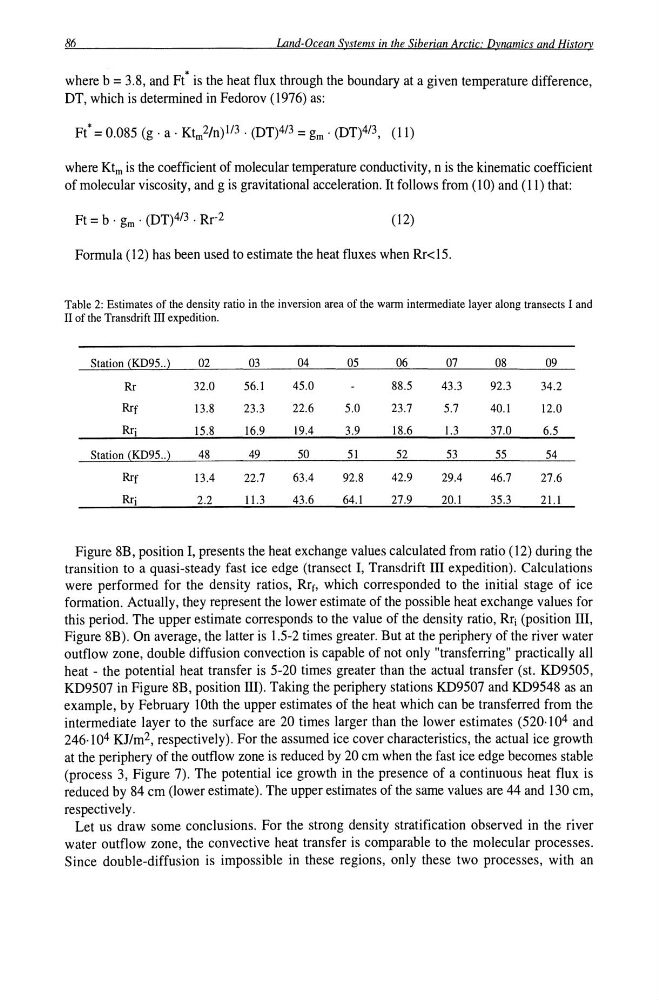
Table 2: Estimates of the density ratio in the inversion area of the warm intermediate layer along transects I and
II of the Transdrift III expedition.
Station (KD95 .. 2
02
03
04
05
06
07
08
09
Rr
32.0
56.1
45.0
88.5
43.3
92.3
34.2
Rrf
13.8
23.3
22.6
5.0
23.7
5.7
40.1
12.0
Rri
15.8
16.9
19.4
3.9
18.6
1.3
37.0
6.5
Station (KD95 .. 2
48
49
50
51
52
53
55
54
Rrf
13.4
22.7
63.4
92.8
42.9
29.4
46.7
27.6
Rri
2.2
11.3
43.6
64.1
27.9
20.1
35.3
21.1
Figure 8B, position I, presents the heat exchange values calculated from ratio (12) during the
transition to a quasi-steady fast ice edge (transect I, Transdrift III expedition). Calculations
were performed for the density ratios, Rrf, which corresponded to the initial stage of ice
formation. Actually, they represent the lower estimate of the possible heat exchange values for
this period. The upper estimate corresponds to the value of the density ratio, Rrj (position III,
Figure 8B). On average, the latter is 1.5-2 times greater. But at the periphery of the river water
outflow zone, double diffusion convection is capable of not only "transferring" practically all
heat - the potential heat transfer is 5-20 times greater than the actual transfer (st. KD9505,
KD9507 in Figure 8B, position III). Taking the periphery stations KD9507 and KD9548 as an
example, by February 10th the upper estimates of the heat which can be transferred from the
intermediate layer to the surface are 20 times larger than the lower estimates (520.104 and
246.104 KJ/m 2 , respectively). For the assumed ice cover characteristics, the actual ice growth
at the periphery of the outflow zone is reduced by 20 cm when the fast ice edge becomes stable
(process 3, Figure 7). The potential ice growth in the presence of a continuous heat flux is
reduced by 84 cm (lower estimate). The upper estimates of the same values are 44 and 130 cm,
respectively.
Let us draw some conclusions. For the strong density stratification observed in the river
water outflow zone, the convective heat transfer is comparable to the molecular processes.
Since double-diffusion is impossible in these regions, only these two processes, with an
Land-Ocean Systems in the Siberian Arctic: Dynamics and History
where b = 3.8, and Ft' is the heat flux through the boundary at a given temperature difference,
DT, which is determined in Fedorov (1976) as:
Ft' = 0.085 (g . a . Kt m 2/n)I/3 . (DT)4/3 = gm . (DT)4/3, (11)
where Ktm is the coefficient of molecular temperature conductivity, n is the kinematic coefficient
of molecular viscosity, and g is gravitational acceleration. It follows from (10) and (11) that:
Ft = b . gm . (DT)4/3 . Rr-2
(12)
Formula (12) has been used to estimate the heat fluxes when Rr<15.
Table 2: Estimates of the density ratio in the inversion area of the warm intermediate layer along transects I and
II of the Transdrift III expedition.
Station (KD95 .. 2
02
03
04
05
06
07
08
09
Rr
32.0
56.1
45.0
88.5
43.3
92.3
34.2
Rrf
13.8
23.3
22.6
5.0
23.7
5.7
40.1
12.0
Rri
15.8
16.9
19.4
3.9
18.6
1.3
37.0
6.5
Station (KD95 .. 2
48
49
50
51
52
53
55
54
Rrf
13.4
22.7
63.4
92.8
42.9
29.4
46.7
27.6
Rri
2.2
11.3
43.6
64.1
27.9
20.1
35.3
21.1
Figure 8B, position I, presents the heat exchange values calculated from ratio (12) during the
transition to a quasi-steady fast ice edge (transect I, Transdrift III expedition). Calculations
were performed for the density ratios, Rrf, which corresponded to the initial stage of ice
formation. Actually, they represent the lower estimate of the possible heat exchange values for
this period. The upper estimate corresponds to the value of the density ratio, Rrj (position III,
Figure 8B). On average, the latter is 1.5-2 times greater. But at the periphery of the river water
outflow zone, double diffusion convection is capable of not only "transferring" practically all
heat - the potential heat transfer is 5-20 times greater than the actual transfer (st. KD9505,
KD9507 in Figure 8B, position III). Taking the periphery stations KD9507 and KD9548 as an
example, by February 10th the upper estimates of the heat which can be transferred from the
intermediate layer to the surface are 20 times larger than the lower estimates (520.104 and
246.104 KJ/m 2 , respectively). For the assumed ice cover characteristics, the actual ice growth
at the periphery of the outflow zone is reduced by 20 cm when the fast ice edge becomes stable
(process 3, Figure 7). The potential ice growth in the presence of a continuous heat flux is
reduced by 84 cm (lower estimate). The upper estimates of the same values are 44 and 130 cm,
respectively.
Let us draw some conclusions. For the strong density stratification observed in the river
water outflow zone, the convective heat transfer is comparable to the molecular processes.
Since double-diffusion is impossible in these regions, only these two processes, with an