

84
Land-Ocean Systems in the Siberian Arctic: Dynamics and History
calculated for two speed shear values. As a rule, exchange through the density boundary occurs
at the molecular scale even at DU = 15 cmls: Ri>15, (Narimousa et aI., 1986; st. KD9550KD9554, Table 1). Heat exchange through the pycnocline via this molecular-turbulent mode
becomes possible only at significant shear speeds: 1.5
around 10- 4 m 2 s·l at the molecular-turbulent level of exchange (Foster, 1974; Krylov and
Zatsepin, 1992). With salination during ice formation, turbulent heat transfer from the warm
intermediate layer to the lower ice surface becomes possible (Rid.5). In this case, the
exchange coefficient can increase up to about 10 m 2 s·l (Foster, 1974). The absence of reliable
observations of currents during autumn and winter prevents estimation of the turbulent heat
exchange efficiency. However, it should be noted that in spite of the significant increase in the
efficiency of the heat exchange at the turbulent-molecular and turbulent scales, the process is
only of a local and occasional character. It is hardly effective at time scales of about 100 days.
Convective heat exchange
To estimate the convective heat exchange between the intermediate layer and the surface, we
followed Zubov,s method (Zubov, 1963), which is based on the supposition that, at the density
of the upper expanding layer, the stratification tends to become stable. This results in mixing
that penetrates to the depth at which the upper layer density is equal to that of the lower one. As
this takes place, the heat accumulated by the lower layer is equally redistributed between layers
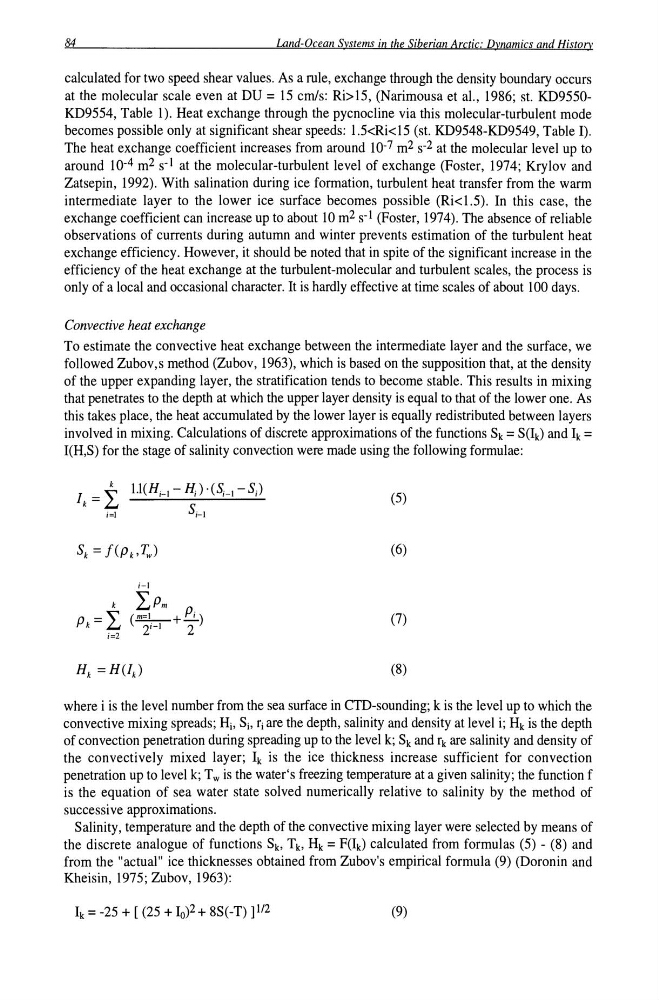
involved in mixing. Calculations of discrete approximations of the functions Sk = S(lk) and Ik =
I(H,S) for the stage of salinity convection were made using the following formulae:
(5)
(6)
(7)
(8)
where i is the level number from the sea surface in CTD-sounding; k is the level up to which the
convective mixing spreads; Hi, Si, ri are the depth, salinity and density at level i; Hk is the depth
of convection penetration during spreading up to the level k; Sk and rk are salinity and density of
the convectively mixed layer; Ik is the ice thickness increase sufficient for convection
penetration up to level k; Tw is the water's freezing temperature at a given salinity; the function f
is the equation of sea water state solved numerically relative to salinity by the method of
successive approximations.
Salinity, temperature and the depth of the convective mixing layer were selected by means of
the discrete analogue of functions Sb Tb Hk = F(lk) calculated from formulas (5) - (8) and
from the "actual" ice thicknesses obtained from Zubov's empirical formula (9) (Doronin and
Kheisin, 1975; Zubov, 1963):
Ik = -25 + [(25 + 10)2+ 8S(-T) ]1/2
(9)
Land-Ocean Systems in the Siberian Arctic: Dynamics and History
calculated for two speed shear values. As a rule, exchange through the density boundary occurs
at the molecular scale even at DU = 15 cmls: Ri>15, (Narimousa et aI., 1986; st. KD9550KD9554, Table 1). Heat exchange through the pycnocline via this molecular-turbulent mode
becomes possible only at significant shear speeds: 1.5
around 10- 4 m 2 s·l at the molecular-turbulent level of exchange (Foster, 1974; Krylov and
Zatsepin, 1992). With salination during ice formation, turbulent heat transfer from the warm
intermediate layer to the lower ice surface becomes possible (Rid.5). In this case, the
exchange coefficient can increase up to about 10 m 2 s·l (Foster, 1974). The absence of reliable
observations of currents during autumn and winter prevents estimation of the turbulent heat
exchange efficiency. However, it should be noted that in spite of the significant increase in the
efficiency of the heat exchange at the turbulent-molecular and turbulent scales, the process is
only of a local and occasional character. It is hardly effective at time scales of about 100 days.
Convective heat exchange
To estimate the convective heat exchange between the intermediate layer and the surface, we
followed Zubov,s method (Zubov, 1963), which is based on the supposition that, at the density
of the upper expanding layer, the stratification tends to become stable. This results in mixing
that penetrates to the depth at which the upper layer density is equal to that of the lower one. As
this takes place, the heat accumulated by the lower layer is equally redistributed between layers
involved in mixing. Calculations of discrete approximations of the functions Sk = S(lk) and Ik =
I(H,S) for the stage of salinity convection were made using the following formulae:
(5)
(6)
(7)
(8)
where i is the level number from the sea surface in CTD-sounding; k is the level up to which the
convective mixing spreads; Hi, Si, ri are the depth, salinity and density at level i; Hk is the depth
of convection penetration during spreading up to the level k; Sk and rk are salinity and density of
the convectively mixed layer; Ik is the ice thickness increase sufficient for convection
penetration up to level k; Tw is the water's freezing temperature at a given salinity; the function f
is the equation of sea water state solved numerically relative to salinity by the method of
successive approximations.
Salinity, temperature and the depth of the convective mixing layer were selected by means of
the discrete analogue of functions Sb Tb Hk = F(lk) calculated from formulas (5) - (8) and
from the "actual" ice thicknesses obtained from Zubov's empirical formula (9) (Doronin and
Kheisin, 1975; Zubov, 1963):
Ik = -25 + [(25 + 10)2+ 8S(-T) ]1/2
(9)