

Dmitrenkn et at.: Oceanographic Causes for Transarctic Ice Transport
81
formation via convection and may to some extent govern the position of the fast ice edge and
the flaw polynya, presumably through some efficient mode of heat transfer to the surface.
Figure 4 provides a basis for testing for a correlation between the fast ice edge position and
the heat content of the subsurface layer at a time when the edge position was quasi-steady (midFebruary 1995 and 1996). Clearly, fast ice in the eastern Laptev Sea was stable during the
autumn of 1994 and was congruent with the spread of river water and with heat content isolines
for the subsurface layer (Figure 4A). Fast ice edge formation during the 1995-1996 autumn and
winter seasons displayed similar congruencies: the configuration of the fast ice edge correlates
well with the heat content isolines in the intermediate layer (Figure 4B). Thus, it seems that the
quasi-steady position of the fast ice edge depends on the heat supply from the intermediate
water layer. In the river water discharge zones, the fast ice edge was located much further south
(up to 150 km) than the northern boundary of river water spreading. Analysis of weekly ice
charts has shown that the northward spreading of fast ice was in agreement with the heat
content of the intermediate water layer. Investigations of the annual variability of the mid-winter
fast ice edge position between 1990 and 1996 shows that it is governed to some extent by the
direction of river water spreading in the preceding summer season.
"
"
r---~--~==~~--------~
\ &\./,
: 'C.
O ~1If
~~ ',,"'I
river mouth
offshore zone
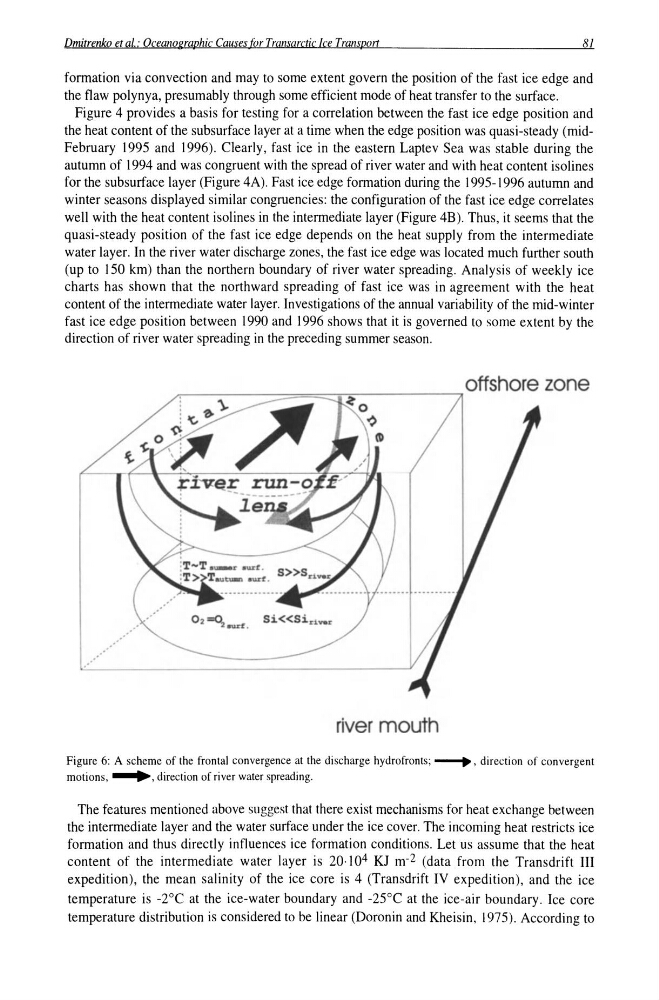
Figure 6: A scheme of the frontal convergence at the discharge hydrofronts; .......... , direction of convergent
motions, ...... , direction of river water spreading.
The features mentioned above suggest that there exist mechanisms for heat exchange between
the intermediate layer and the water surface under the ice cover. The incoming heat restricts ice
formation and thus directly influences ice formation conditions. Let us assume that the heat
content of the intermediate water layer is 20· 10 4 KJ m- 2 (data from the Transdrift III
expedition), the mean salinity of the ice core is 4 (Transdrift IV expedition), and the ice
temperature is -2°C at the ice-water boundary and -25°C at the ice-air boundary. Ice core
temperature distribution is considered to be linear (Doronin and Kheisin, 1975). According to
81
formation via convection and may to some extent govern the position of the fast ice edge and
the flaw polynya, presumably through some efficient mode of heat transfer to the surface.
Figure 4 provides a basis for testing for a correlation between the fast ice edge position and
the heat content of the subsurface layer at a time when the edge position was quasi-steady (midFebruary 1995 and 1996). Clearly, fast ice in the eastern Laptev Sea was stable during the
autumn of 1994 and was congruent with the spread of river water and with heat content isolines
for the subsurface layer (Figure 4A). Fast ice edge formation during the 1995-1996 autumn and
winter seasons displayed similar congruencies: the configuration of the fast ice edge correlates
well with the heat content isolines in the intermediate layer (Figure 4B). Thus, it seems that the
quasi-steady position of the fast ice edge depends on the heat supply from the intermediate
water layer. In the river water discharge zones, the fast ice edge was located much further south
(up to 150 km) than the northern boundary of river water spreading. Analysis of weekly ice
charts has shown that the northward spreading of fast ice was in agreement with the heat
content of the intermediate water layer. Investigations of the annual variability of the mid-winter
fast ice edge position between 1990 and 1996 shows that it is governed to some extent by the
direction of river water spreading in the preceding summer season.
"
"
r---~--~==~~--------~
\ &\./,
: 'C.
O ~1If
~~ ',,"'I
river mouth
offshore zone
Figure 6: A scheme of the frontal convergence at the discharge hydrofronts; .......... , direction of convergent
motions, ...... , direction of river water spreading.
The features mentioned above suggest that there exist mechanisms for heat exchange between
the intermediate layer and the water surface under the ice cover. The incoming heat restricts ice
formation and thus directly influences ice formation conditions. Let us assume that the heat
content of the intermediate water layer is 20· 10 4 KJ m- 2 (data from the Transdrift III
expedition), the mean salinity of the ice core is 4 (Transdrift IV expedition), and the ice
temperature is -2°C at the ice-water boundary and -25°C at the ice-air boundary. Ice core
temperature distribution is considered to be linear (Doronin and Kheisin, 1975). According to