

Dmitrenko et at.: Oceanographic Causes for Transarctic Ice Transport
77
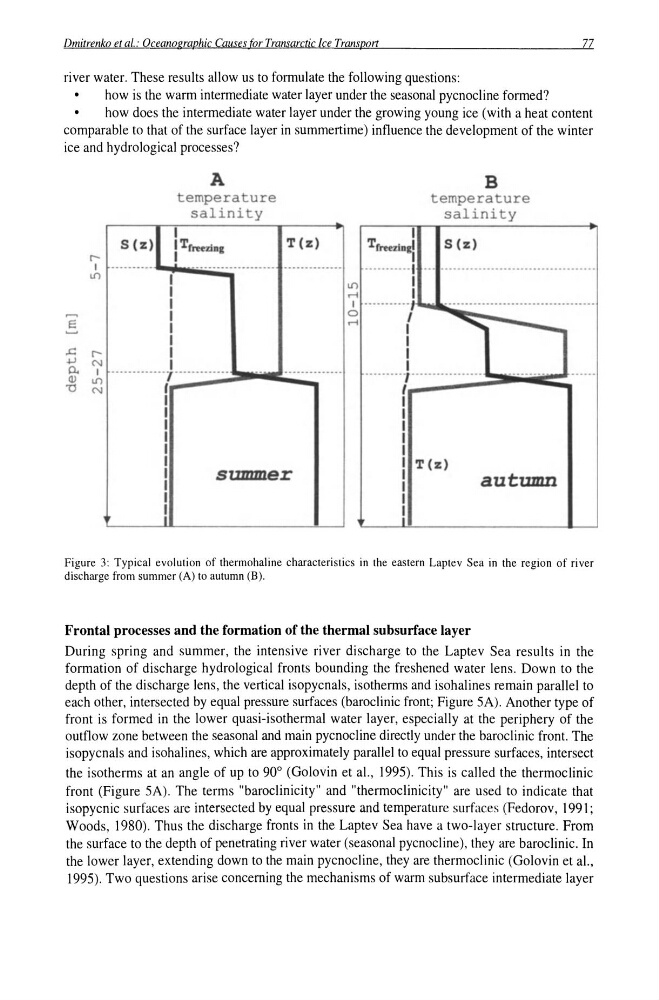
river water. These results allow us to formulate the following questions:
how is the warm intermediate water layer under the seasonal pycnocline formed?
how does the intermediate water layer under the growing young ice (with a heat content
comparable to that of the surface layer in summertime) influence the development of the winter
ice and hydrological processes?
E
rI
U')
s (z)
I
I
I
I
I
I
..c: rI
A
temperature
salinity
T (z)
.jJ
N
I
~ I ············ 7C·:.:. ···~ ··~ ·· ~ ···~ ··:-... c; ··;,;,; ··.;,;, ·· ~ ·········
"0 ~
'I""'""
-
I
I
I
I
I
I
I
I
I
I
summer
I
TrremD,1
I
B
temperature
salini t y
s (z)
..... ······1 ....................................... .
U')
I
rl
I
I ···········t ... ..: ................................. .
~
{ ---...... ~=:::-........ -I
........
I
I
·········1·················
,~
I
I
I
I
I
I T (z)
I
I
I
-
autumn
Figure 3: Typical evolution of thermohaline characteristics in the eastern Laptev Sea in the region of ri ver
discharge from summer (A) to autumn (B).
Frontal processes and the formation of the thermal subsurface layer
During spring and summer, the intensive river discharge to the Laptev Sea results in the
formation of discharge hydrological fronts bounding the freshened water lens. Down to the
depth of the discharge lens, the vertical isopycnals, isotherms and isohalines remain parallel to
each other, intersected by equal pressure surfaces (baroclinic front; Figure SA). Another type of
front is formed in the lower quasi-isothermal water layer, especially at the periphery of the
outflow zone between the seasonal and main pycnocline directly under the baroclinic front. The
isopycnals and isohalines, which are approximately parallel to equal pressure surfaces, intersect
the isotherms at an angle of up to 90° (Golovin et aI., 1995). This is called the thermoclinic
front (Figure SA). The terms "baroclinicity" and "thermoclinicity" are used to indicate that
isopycnic surfaces are intersected by equal pressure and temperature surfaces (Fedorov, 1991;
Woods, 1980). Thus the discharge fronts in the Laptev Sea have a two-layer structure. From
the surface to the depth of penetrating river water (seasonal pycnocline), they are baroclinic. In
the lower layer, extending down to the main pycnocline, they are thermoclinic (Golovin et aI.,
1995). Two questions arise concerning the mechanisms of warm subsurface intermediate layer
77
river water. These results allow us to formulate the following questions:
how is the warm intermediate water layer under the seasonal pycnocline formed?
how does the intermediate water layer under the growing young ice (with a heat content
comparable to that of the surface layer in summertime) influence the development of the winter
ice and hydrological processes?
E
rI
U')
s (z)
I
I
I
I
I
I
..c: rI
A
temperature
salinity
T (z)
.jJ
N
I
~ I ············ 7C·:.:. ···~ ··~ ·· ~ ···~ ··:-... c; ··;,;,; ··.;,;, ·· ~ ·········
"0 ~
'I""'""
-
I
I
I
I
I
I
I
I
I
I
summer
I
TrremD,1
I
B
temperature
salini t y
s (z)
..... ······1 ....................................... .
U')
I
rl
I
I ···········t ... ..: ................................. .
~
{ ---...... ~=:::-........ -I
........
I
I
·········1·················
,~
I
I
I
I
I
I T (z)
I
I
I
-
autumn
Figure 3: Typical evolution of thermohaline characteristics in the eastern Laptev Sea in the region of ri ver
discharge from summer (A) to autumn (B).
Frontal processes and the formation of the thermal subsurface layer
During spring and summer, the intensive river discharge to the Laptev Sea results in the
formation of discharge hydrological fronts bounding the freshened water lens. Down to the
depth of the discharge lens, the vertical isopycnals, isotherms and isohalines remain parallel to
each other, intersected by equal pressure surfaces (baroclinic front; Figure SA). Another type of
front is formed in the lower quasi-isothermal water layer, especially at the periphery of the
outflow zone between the seasonal and main pycnocline directly under the baroclinic front. The
isopycnals and isohalines, which are approximately parallel to equal pressure surfaces, intersect
the isotherms at an angle of up to 90° (Golovin et aI., 1995). This is called the thermoclinic
front (Figure SA). The terms "baroclinicity" and "thermoclinicity" are used to indicate that
isopycnic surfaces are intersected by equal pressure and temperature surfaces (Fedorov, 1991;
Woods, 1980). Thus the discharge fronts in the Laptev Sea have a two-layer structure. From
the surface to the depth of penetrating river water (seasonal pycnocline), they are baroclinic. In
the lower layer, extending down to the main pycnocline, they are thermoclinic (Golovin et aI.,
1995). Two questions arise concerning the mechanisms of warm subsurface intermediate layer