

Thiede et al.: Dvnamics and History ofthe Laplev Sea and its Continental Hinterland
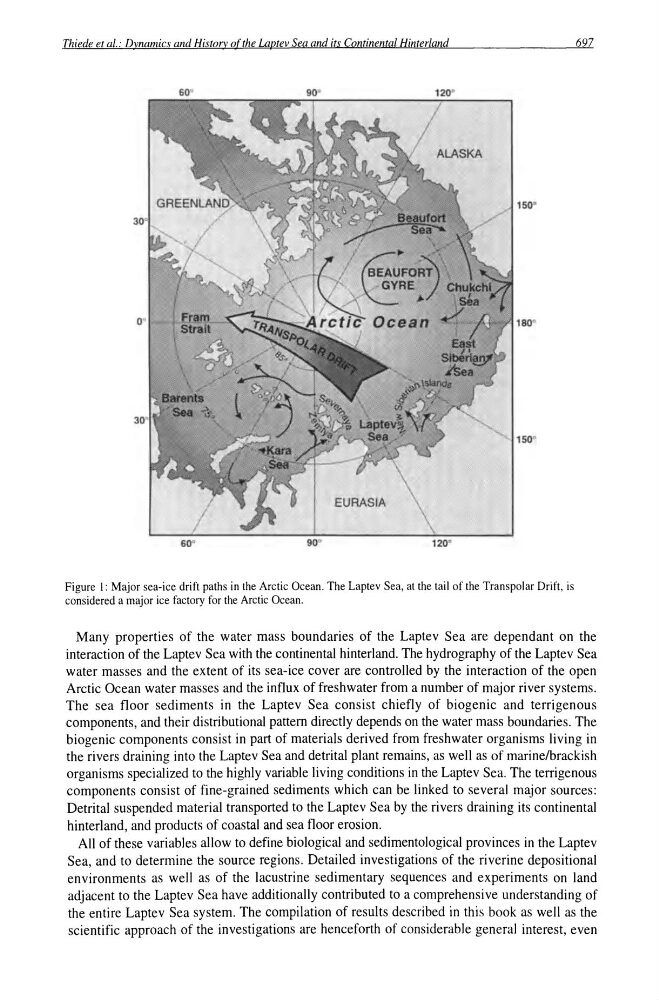
Figure I: Major sea-ice drift paths in the Arctic Ocean. The Laptev Sea, at the tail of the Transpolar Drift, is
considered a major ice factory for the Arctic Ocean.
697
Many properties of the water mass boundaries of the Laptev Sea are dependant on the
interaction of the Laptev Sea with the continental hinterland. The hydrography of the Laptev Sea
water masses and the extent of its sea-ice cover are controlled by the interaction of the open
Arctic Ocean water masses and the influx of freshwater from a number of m~or river systems.
The sea floor sediments in the Laptev Sea consist chiefly of biogenic and terrigenous
components, and their distributional pattern directly depends on the water mass boundaries. The
biogenic components consist in part of materials derived from freshwater organisms living in
the rivers draining into the Laptev Sea and detrital plant remains, as welI as of marine/brackish
organisms specialized to the highly variable living conditions in the Laptev Sea. The terrigenous
components consist of fine-grained sediments which can be linked to several major sources:
Detrital suspended material transported to the Laptev Sea by the rivers draining its continental
hinterland, and products of coastal and sea floor erosion.
All of these variables allow to define biological and sedimentological provinces in the Laptev
Sea, and to determine the source regions. Detailed investigations of the riverine depositional
environments as well as of the lacustrine sedimentary sequences and experiments on land
adjacent to the Laptev Sea have additionally contributed to a comprehensive understanding of
the entire Laptev Sea system. The compilation of results described in this book as well as the
scientific approach of the investigations are henceforth of considerable general interest, even
Figure I: Major sea-ice drift paths in the Arctic Ocean. The Laptev Sea, at the tail of the Transpolar Drift, is
considered a major ice factory for the Arctic Ocean.
697
Many properties of the water mass boundaries of the Laptev Sea are dependant on the
interaction of the Laptev Sea with the continental hinterland. The hydrography of the Laptev Sea
water masses and the extent of its sea-ice cover are controlled by the interaction of the open
Arctic Ocean water masses and the influx of freshwater from a number of m~or river systems.
The sea floor sediments in the Laptev Sea consist chiefly of biogenic and terrigenous
components, and their distributional pattern directly depends on the water mass boundaries. The
biogenic components consist in part of materials derived from freshwater organisms living in
the rivers draining into the Laptev Sea and detrital plant remains, as welI as of marine/brackish
organisms specialized to the highly variable living conditions in the Laptev Sea. The terrigenous
components consist of fine-grained sediments which can be linked to several major sources:
Detrital suspended material transported to the Laptev Sea by the rivers draining its continental
hinterland, and products of coastal and sea floor erosion.
All of these variables allow to define biological and sedimentological provinces in the Laptev
Sea, and to determine the source regions. Detailed investigations of the riverine depositional
environments as well as of the lacustrine sedimentary sequences and experiments on land
adjacent to the Laptev Sea have additionally contributed to a comprehensive understanding of
the entire Laptev Sea system. The compilation of results described in this book as well as the
scientific approach of the investigations are henceforth of considerable general interest, even