

686
Land-Ocean SYstems in the Siberian Arctic: Dynamics and History
ascending order) units A, B, C, and D.
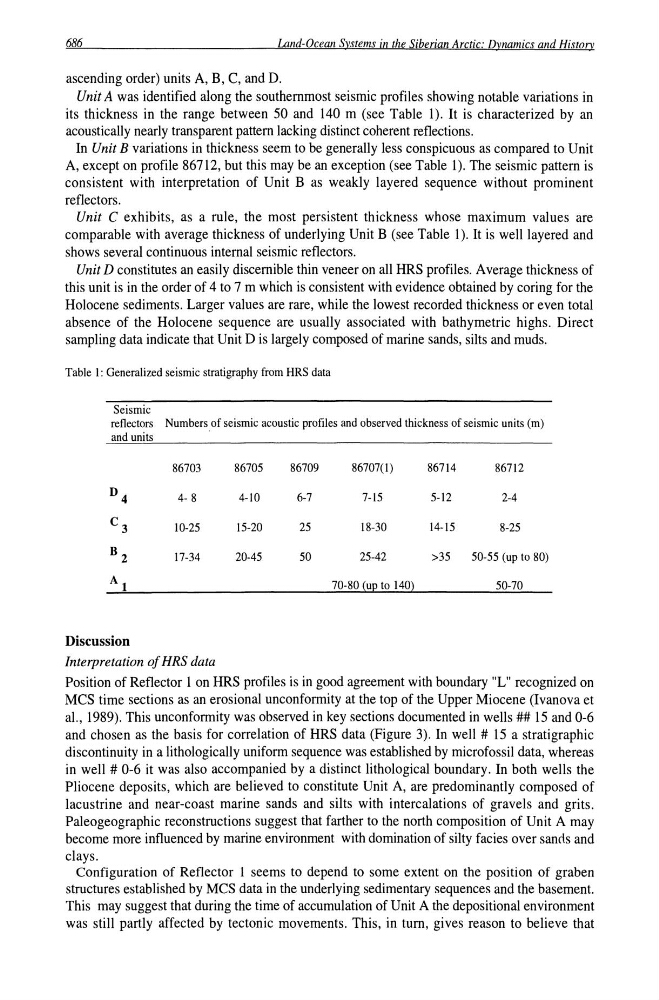
Unit A was identified along the southernmost seismic profiles showing notable variations in
its thickness in the range between 50 and 140 m (see Table 1). It is characterized by an
acoustically nearly transparent pattern lacking distinct coherent reflections.
In Unit B variations in thickness seem to be generally less conspicuous as compared to Unit
A, except on profile 86712, but this may be an exception (see Table 1). The seismic pattern is
consistent with interpretation of Unit B as weakly layered sequence without prominent
reflectors.
Unit C exhibits, as a rule, the most persistent thickness whose maximum values are
comparable with average thickness of underlying Unit B (see Table 1). It is well layered and
shows several continuous internal seismic reflectors.
Unit D constitutes an easily discernible thin veneer on all HRS profiles. Average thickness of
this unit is in the order of 4 to 7 m which is consistent with evidence obtained by coring for the
Holocene sediments. Larger values are rare, while the lowest recorded thickness or even total
absence of the Holocene sequence are usually associated with bathymetric highs. Direct
sampling data indicate that Unit D is largely composed of marine sands, silts and muds.
Table 1: Generalized seismic stratigraphy from HRS data
Seismic
reflectors Numbersof seismic acoustic profiles and observed thickness of seismic units (m)
and units
86703
86705
86709
86707(1)
86714
86712
D4
4- 8
4-10
6-7
7-15
5-12
2-4
C 3
10-25
15-20
25
18-30
14-15
8-25
B2
17-34
20-45
50
25-42
>35
50-55 (up to 80)
At
70-80 (up to 140)
50-70
Discussion
Interpretation of HRS data
Position of Reflector 1 on HRS profiles is in good agreement with boundary "L" recognized on
MCS time sections as an erosional unconformity at the top of the Upper Miocene (Ivanov a et
a!., 1989). This unconformity was observed in key sections documented in wells ## 15 and 0-6
and chosen as the basis for correlation of HRS data (Figure 3). In well # 15 a stratigraphic
discontinuity in a lithologically uniform sequence was established by microfossil data, whereas
in well # 0-6 it was also accompanied by a distinct lithological boundary. In both wells the
Pliocene deposits, which are believed to constitute Unit A, are predominantly composed of
lacustrine and near-coast marine sands and silts with intercalations of gravels and grits.
Paleogeographic reconstructions suggest that farther to the north composition of Unit A may
become more influenced by marine environment with domination of silty facies over sanns and
clays.
Configuration of Reflector 1 seems to depend to some extent on the position of graben
structures established by MCS data in the underlying sedimentary sequences and the basement.
This may suggest that during the time of accumulation of Unit A the depositional environment
was still partly affected by tectonic movements. This, in turn, gives reason to believe that
Land-Ocean SYstems in the Siberian Arctic: Dynamics and History
ascending order) units A, B, C, and D.
Unit A was identified along the southernmost seismic profiles showing notable variations in
its thickness in the range between 50 and 140 m (see Table 1). It is characterized by an
acoustically nearly transparent pattern lacking distinct coherent reflections.
In Unit B variations in thickness seem to be generally less conspicuous as compared to Unit
A, except on profile 86712, but this may be an exception (see Table 1). The seismic pattern is
consistent with interpretation of Unit B as weakly layered sequence without prominent
reflectors.
Unit C exhibits, as a rule, the most persistent thickness whose maximum values are
comparable with average thickness of underlying Unit B (see Table 1). It is well layered and
shows several continuous internal seismic reflectors.
Unit D constitutes an easily discernible thin veneer on all HRS profiles. Average thickness of
this unit is in the order of 4 to 7 m which is consistent with evidence obtained by coring for the
Holocene sediments. Larger values are rare, while the lowest recorded thickness or even total
absence of the Holocene sequence are usually associated with bathymetric highs. Direct
sampling data indicate that Unit D is largely composed of marine sands, silts and muds.
Table 1: Generalized seismic stratigraphy from HRS data
Seismic
reflectors Numbersof seismic acoustic profiles and observed thickness of seismic units (m)
and units
86703
86705
86709
86707(1)
86714
86712
D4
4- 8
4-10
6-7
7-15
5-12
2-4
C 3
10-25
15-20
25
18-30
14-15
8-25
B2
17-34
20-45
50
25-42
>35
50-55 (up to 80)
At
70-80 (up to 140)
50-70
Discussion
Interpretation of HRS data
Position of Reflector 1 on HRS profiles is in good agreement with boundary "L" recognized on
MCS time sections as an erosional unconformity at the top of the Upper Miocene (Ivanov a et
a!., 1989). This unconformity was observed in key sections documented in wells ## 15 and 0-6
and chosen as the basis for correlation of HRS data (Figure 3). In well # 15 a stratigraphic
discontinuity in a lithologically uniform sequence was established by microfossil data, whereas
in well # 0-6 it was also accompanied by a distinct lithological boundary. In both wells the
Pliocene deposits, which are believed to constitute Unit A, are predominantly composed of
lacustrine and near-coast marine sands and silts with intercalations of gravels and grits.
Paleogeographic reconstructions suggest that farther to the north composition of Unit A may
become more influenced by marine environment with domination of silty facies over sanns and
clays.
Configuration of Reflector 1 seems to depend to some extent on the position of graben
structures established by MCS data in the underlying sedimentary sequences and the basement.
This may suggest that during the time of accumulation of Unit A the depositional environment
was still partly affected by tectonic movements. This, in turn, gives reason to believe that