

Stein et al.: Late Ouaternary Organic Carbon and Biomarker Records from the Laptev Sea
645
,....
r-..
'
en
c...
0
~
E
'
'
~
.;t
r-..
'
en
c...
0
~
E
,....
C\J
~
(0
r-..
'
en c...
~
U
Z
U
A
0·--- N
B
c
.......
1ll~~~-------J~~~--~~~~~----------~-------------r-----4
D Turbidites
o+-~~ ______ ~+-~~~~~~~ __________ ~ ____________ ~ __ ~
0
N
III
0
N
III
0
III
0
0
100
200
300
400
500
600
700
800
Depth (cmbsf)
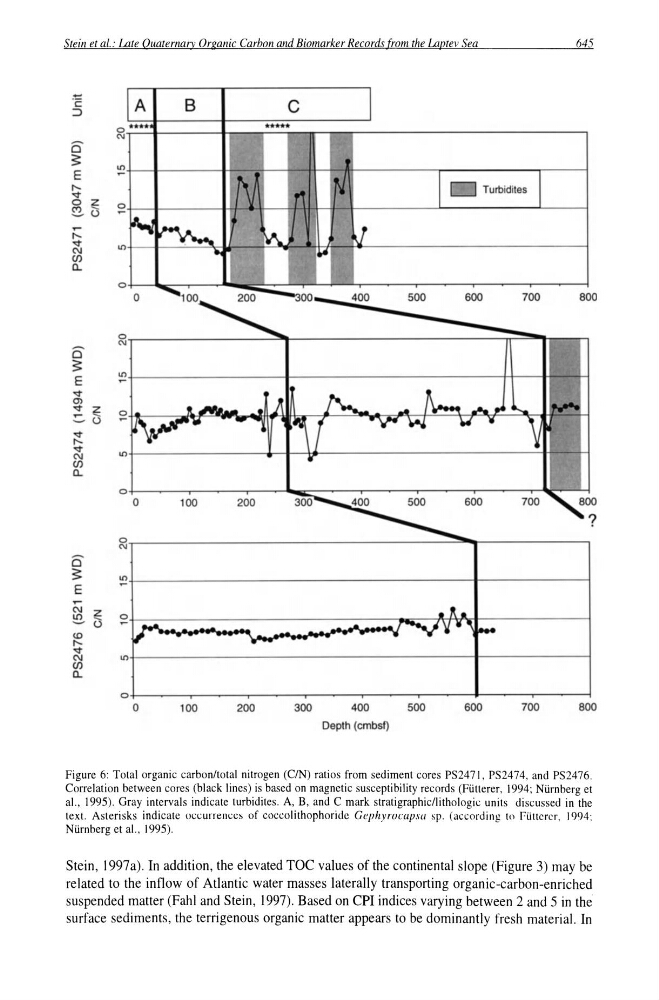
Figure 6: Total organic carbon/total nitrogen (C/N) ratios from sediment cores PS2471, PS2474, and PS2476.
Correlation between cores (hlack lines) is based on magnetic susceptibility records (Flitterer, 1994; Nlirnberg et
aI., 1995). Gray intervals indicate turbidites. A, B, and C mark stratigraphic/lithologic units discussed in the
text. Asterisks indicate occurrences of coccolithophoridc GephyrocupslI 'p. (according to rUllcrcr, 1994;
Nlirnberg et aI., 1995).
Stein, 1997a). In addition, the elevated Toe values of the continental slope (Figure 3) may be
related to the inflow of Atlantic water masses laterally transporting organic-carbon-enriched
suspended matter (Fahl and Stein, 1997). Based on ePI indices varying between 2 and 5 in the
surface sediments, the terrigenous organic matter appears to be dominantly fresh material. In
645
,....
r-..
'
en
c...
0
~
E
'
'
~
.;t
r-..
'
en
c...
0
~
E
,....
C\J
~
(0
r-..
'
en c...
~
U
Z
U
A
0·--- N
B
c
.......
1ll~~~-------J~~~--~~~~~----------~-------------r-----4
D Turbidites
o+-~~ ______ ~+-~~~~~~~ __________ ~ ____________ ~ __ ~
0
N
III
0
N
III
0
III
0
0
100
200
300
400
500
600
700
800
Depth (cmbsf)
Figure 6: Total organic carbon/total nitrogen (C/N) ratios from sediment cores PS2471, PS2474, and PS2476.
Correlation between cores (hlack lines) is based on magnetic susceptibility records (Flitterer, 1994; Nlirnberg et
aI., 1995). Gray intervals indicate turbidites. A, B, and C mark stratigraphic/lithologic units discussed in the
text. Asterisks indicate occurrences of coccolithophoridc GephyrocupslI 'p. (according to rUllcrcr, 1994;
Nlirnberg et aI., 1995).
Stein, 1997a). In addition, the elevated Toe values of the continental slope (Figure 3) may be
related to the inflow of Atlantic water masses laterally transporting organic-carbon-enriched
suspended matter (Fahl and Stein, 1997). Based on ePI indices varying between 2 and 5 in the
surface sediments, the terrigenous organic matter appears to be dominantly fresh material. In